


Lower glial metabolite levels in brains of young children with prenatal nicotine exposure
- PMID: 21912896
- PMCID: PMC3821865
- DOI: 10.1007/s11481-011-9311-6
Lower glial metabolite levels in brains of young children with prenatal nicotine exposure
Abstract
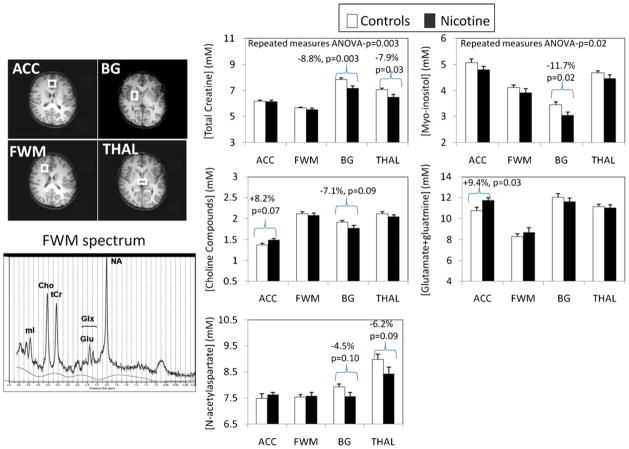
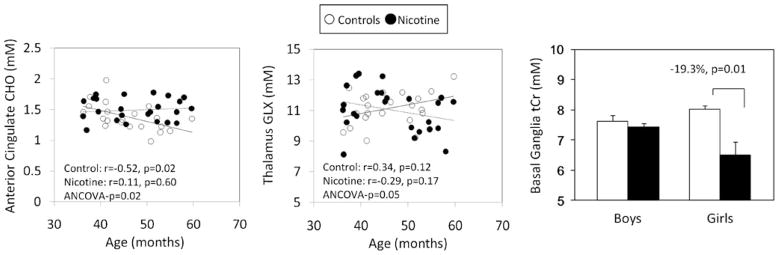
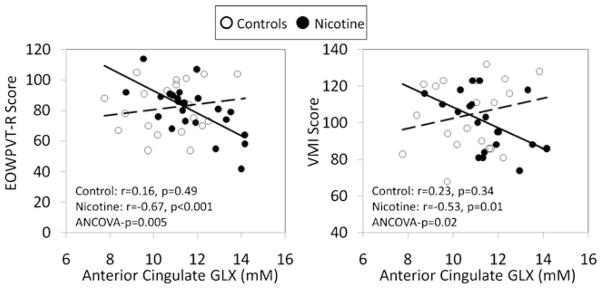
Many pregnant women smoke cigarettes during pregnancy, but the effect of nicotine on the developing human brain is not well understood, especially in young children. This study aims to determine the effects of prenatal nicotine exposure (PNE) on brain metabolite levels in young (3-4 years old) children, using proton magnetic resonance spectroscopy ((1)H MRS). Twenty-six children with PNE and 24 nicotine-unexposed children (controls) were evaluated with a structured examination, a battery of neuropsychological tests, and MRI/(1)H MRS (without sedation). Concentrations of N-acetyl compounds (NA), total creatine (tCR), choline-containing compounds (CHO), myo-inositol (MI), and glutamate+glutamine (GLX) were measured in four brain regions. Children with PNE had similar performance to controls on neuropsychological testing. However, compared to controls, the PNE group had lower MI (repeated measures ANOVA-p = 0.03) and tCr levels (repeated measures ANOVA-p = 0.003), especially in the basal ganglia of the girls (-19.3%, p = 0.01). In contrast, GLX was elevated in the anterior cingulate cortex of the PNE children (+9.4%, p = 0.03), and those with the highest GLX levels had the poorest performance on vocabulary (r = -0.67; p < 0.001) and visual motor integration (r = -0.53; p = 0.01). The amount of prenatal nicotine exposure did not correlate with metabolite concentrations. These findings suggest that PNE may lead to subclinical abnormalities in glial development, especially in the basal ganglia, and regionally specific changes in other neurometabolites. These alterations were not influenced by the amount of nicotine exposure prenatally. However, the effects of PNE on energy metabolism may be sex specific, with greater alterations in girls.
Conflict of interest statement
Figures
References
Publication types
MeSH terms
Substances
Grants and funding
- R01 NS036524/NS/NINDS NIH HHS/United States
- 1R01 DA21016/DA/NIDA NIH HHS/United States
- R01-DA021016-05/DA/NIDA NIH HHS/United States
- U54 NS039406/NS/NINDS NIH HHS/United States
- 5U54-NS056883/NS/NINDS NIH HHS/United States
- R01 DA021146/DA/NIDA NIH HHS/United States
- L30 DA018596/DA/NIDA NIH HHS/United States
- U01-DA013045-11S1/DA/NIDA NIH HHS/United States
- 1R01-DA21016/DA/NIDA NIH HHS/United States
- R21 CA139712/CA/NCI NIH HHS/United States
- RC2 DA029475/DA/NIDA NIH HHS/United States
- 2 K24-DA016170-07/DA/NIDA NIH HHS/United States
- 5R21-DA02444/DA/NIDA NIH HHS/United States
- R01 DA021016/DA/NIDA NIH HHS/United States
- U54-NS056883-04/NS/NINDS NIH HHS/United States
- 1U54-NS56883/NS/NINDS NIH HHS/United States
- K01 DA021203/DA/NIDA NIH HHS/United States
- RC2-DA029475-02/DA/NIDA NIH HHS/United States
- 2 K24-DA16170/DA/NIDA NIH HHS/United States
- K01-DA021203/DA/NIDA NIH HHS/United States
- P20 RR011091/RR/NCRR NIH HHS/United States
- R21-CA139712-02/CA/NCI NIH HHS/United States
- K24 DA016170/DA/NIDA NIH HHS/United States
- U54 NS056883/NS/NINDS NIH HHS/United States
- R01-MH061427-08/MH/NIMH NIH HHS/United States
- 2U54-NS039406/NS/NINDS NIH HHS/United States
- R24 DA027318/DA/NIDA NIH HHS/United States
- K02-DA16991/DA/NIDA NIH HHS/United States
- R01-DA021146-04/DA/NIDA NIH HHS/United States
- 1P20-RR11091/RR/NCRR NIH HHS/United States
- U10 DA013045/DA/NIDA NIH HHS/United States
- R01-NS36524/NS/NINDS NIH HHS/United States
- G12-RR003061-25/RR/NCRR NIH HHS/United States
- R01 MH061427/MH/NIMH NIH HHS/United States
- G12 RR003061/RR/NCRR NIH HHS/United States
- R24-DA027318-02/DA/NIDA NIH HHS/United States
- K02 DA016991/DA/NIDA NIH HHS/United States
LinkOut - more resources
Full Text Sources
Medical
