. 2011;6(9):e24649.
doi: 10.1371/journal.pone.0024649. Epub 2011 Sep 6.

Molecular characterization of a strawberry FaASR gene in relation to fruit ripening

Affiliations

Molecular characterization of a strawberry FaASR gene in relation to fruit ripening

Jian-ye Chen et al. PLoS One. 2011.

Abstract

Background: ABA-, stress- and ripening-induced (ASR) proteins have been reported to act as a downstream component involved in ABA signal transduction. Although much attention has been paid to the roles of ASR in plant development and stress responses, the mechanisms by which ABA regulate fruit ripening at the molecular level are not fully understood. In the present work, a strawberry ASR gene was isolated and characterized (FaASR), and a polyclonal antibody against FaASR protein was prepared. Furthermore, the effects of ABA, applied to two different developmental stages of strawberry, on fruit ripening and the expression of FaASR at transcriptional and translational levels were investigated.

Methodology/principal findings: FaASR, localized in the cytoplasm and nucleus, contained 193 amino acids and shared common features with other plant ASRs. It also functioned as a transcriptional activator in yeast with trans-activation activity in the N-terminus. During strawberry fruit development, endogenous ABA content, levels of FaASR mRNA and protein increased significantly at the initiation of ripening at a white (W) fruit developmental stage. More importantly, application of exogenous ABA to large green (LG) fruit and W fruit markedly increased endogenous ABA content, accelerated fruit ripening, and greatly enhanced the expression of FaASR transcripts and the accumulation of FaASR protein simultaneously.

Conclusions: These results indicate that FaASR may be involved in strawberry fruit ripening. The observed increase in endogenous ABA content, and enhanced FaASR expression at transcriptional and translational levels in response to ABA treatment might partially contribute to the acceleration of strawberry fruit ripening.


Conflict of interest statement

Competing Interests: The authors have declared that no competing interests exist.

Figures

Figure 1
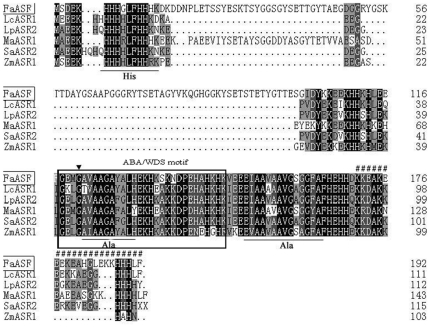
Figure 1. Amino acid sequence alignment of FaASR with other plant ASR proteins.
Strawberry FaASR was aligned with tomato LcASR1, LpASR2 and SaASR2, banana MpASR1 and maize ZmASR1. Conserved residues were shaded in black. Gray shading indicated similar residues in 3 out of 6 of the sequences. Gaps were introduced to optimize alignment. Multiple alignments was done by CLUSTALW and viewed with BOXSHADE program, and then manually edited. One Zn-binding His-rich region and two Ala-rich regions were underlined. The ABA/WDS motif was indicated with rectangle. One site for N-myristoylation and a putative nuclear targeting signal (KKEDKEEAEEASGKKHHH) were marked with ‘▾’ and ‘#’, respectively.
Figure 2
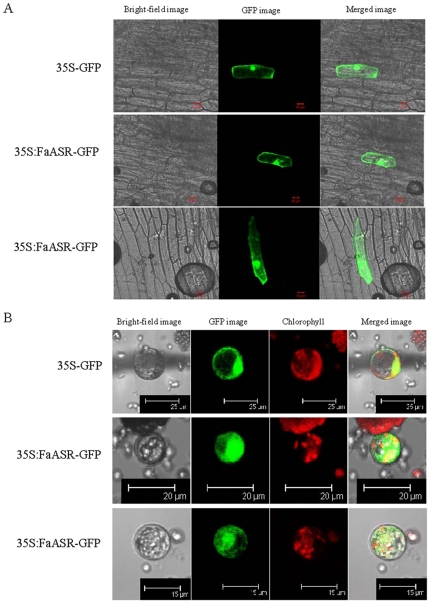
Figure 2. Subcellular localization of FaASR in onion epidermal cells (A) or tobacco protoplasts (B).
Constructs carrying GFP or FaASR-GFP were bombarded into onion epidermal cells or transfected into tobacco protoplasts as described in the Materials and methods. GFP and FaASR-GFP fusion proteins were transiently expressed under control of the CaMV 35S promoter and observed with a laser scanning confocal microscope. Experiments were done in triplicate resulting in the same fluorescence pattern, and two different images for FaASR-GFP were presented. The FaASR-GFP fusion protein was present in the cell outlines and the nuclear. The length of Bar was indicated in the photos.
Figure 3
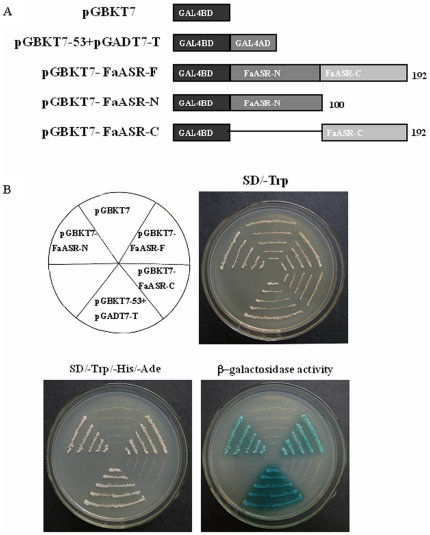
Figure 3. Transcriptional activation of FaASR in yeast.
(A) Diagram showing all the reporter constructs for analysis of pGBKT7 (DNA-binding protein)-dependent transactivation of FaASR in the yeast strain AH109. The vectors were constructed with pGBKT7 (negative control), pGBKT7-53 + pGADT7-T (positive control), pGBKT7-FaASR-F (amino acids 1-192), pGBKT7-FaASR-N (amino acids 1–100), and pGBKT7-FaASR-C (amino acids 101–192). (B) Clones transformed with the different vectors were grown on SD plates with or without histidine and adenine for 3 d at 30°C. Transcription activation was monitored by the detection of yeast growth without histidine and adenine and β-galactosidase assay.
Figure 4
Figure 4. SDS-PAGE analysis of induced and purified recombinant FaASR fusion protein.
The gel was visualized by Coomassie Brilliant Blue R250 staining. Lane 1: sample collected before induction by IPTG; Lanes 2–3: samples collected after induction by IPTG for 4 and 6 h, respectively and Lane 4: purified fusion protein. M: protein marker. The arrow showed the protein of recombinant FaASR.
Figure 5
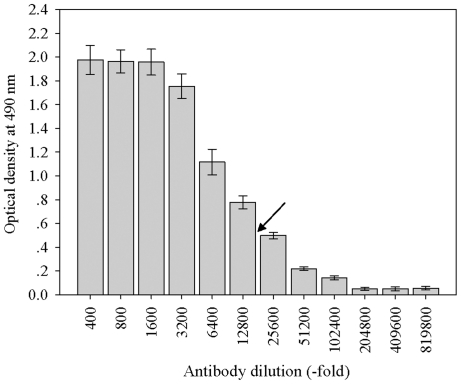
Figure 5. Analysis of anti-FaASR titer by ELISA.
The antibody at different dilutions (400- to 819,800-fold) was reacted with the equal amount of the purified fusion protein (1 μg). Antibody titer is defined as the dilution of the antibody corresponding to an absorbance of 0.500 at 490 nm. The arrow indicated the 0.500 absorbance value that corresponds to antibody dilution times of about 25,000. Values in the figure were the means ± S.D. (n = 3).
Figure 6
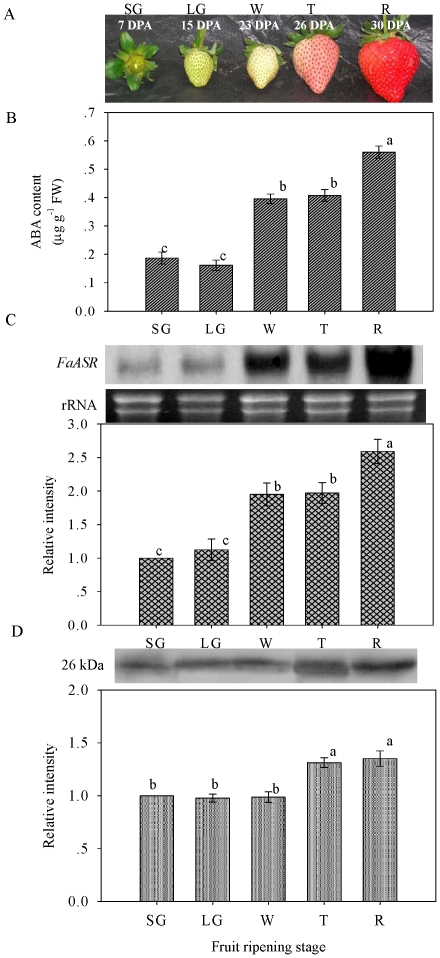
Figure 6. Photograph of fruits representative of each stage (A), SG: small green; LG: large green; W: white; T: turning, 50% red and R: full-ripe red, and changes of endogenous ABA content (B), levels of FaASR mRNA (C) and protein (D) at different fruit ripening stages.
In (A), each stage of fruit development corresponded to days after post-anthesis (DPA) were indicated. In (C), total RNA (10 μg per lane) was used for northern blot analysis and hybridized with DIG-labeled probe, and ethidium bromide-stained rRNA was shown as the loading control. In (D), equal amounts of protein (30 μg) per lane were subjected to SDS-PAGE and then transferred to a nitrocellulose membrane. Thereafter, the FaASR protein amount was immunodetected by western blot using the anti-FaASR specific polyclonal antibody. In (C) and (D), the quantification of the northern or western blot bands was expressed in relation to the amount in fruit sampled at SG, which was set to 1. In (B), (C) and (D), vertical bars represented standard deviations (SD) of means (n = 3). Different letters indicated a statistical difference at the 5% level among data groups according to the Duncan's multiple range test.
Figure 7
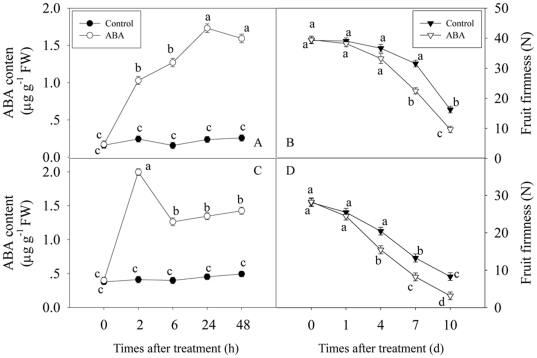
Figure 7. Changes of endogenous ABA content (A and C) and fruit firmness (B and D) after ABA treatment.
(A) and (B) showed changes of endogenous ABA content and fruit firmness at the LG stage (about 15 days after post-anthesis (DPA)), while (C) and (D) presented changes of endogenous ABA content and fruit firmness at the W stage (about 23 DPA), respectively. Selected fruit were dipped for 1 min in a solution containing 0 (control) or 100 µM ABA, and then sampled at 0, 0.5, 2, 6, 12 h, 1, 2, 4, 7 and 10 days. Each value represented the means of three replicates, and vertical bars indicated the SD. Different letters indicated a statistical difference at the 5% level among data groups according to the Duncan's multiple range test.
Figure 8
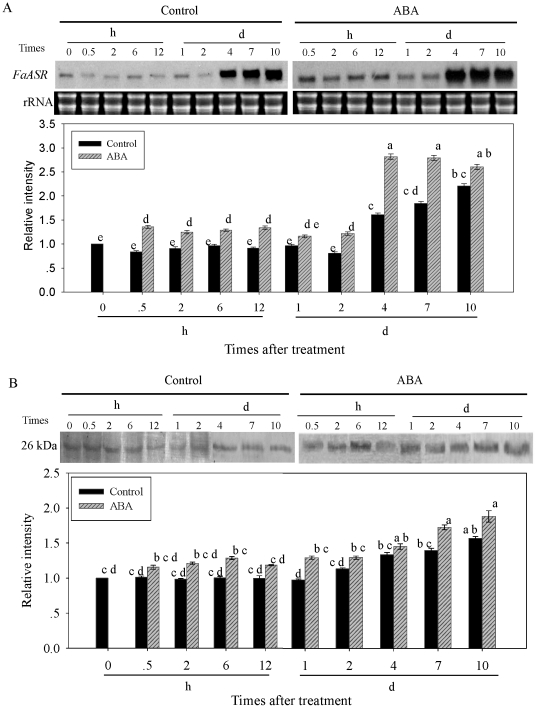
Figure 8. Changes in FaASR mRNA (A) and protein (B) accumulations after ABA treatment at the LG stage.
Selected fruits at the LG stage (about 15 days after post-anthesis) were dipped for 1 min in a solution containing 0 (control) or 100 µM ABA, and then sampled at 0, 0.5, 2, 6 and 12 h, 1, 2, 4, 7 and 10 days. In (A), total RNA (10 μg per lane) was used for northern blot analysis and hybridized with DIG-labeled probe, and ethidium bromide-stained rRNA was shown as the loading control. In (B), equal amounts of protein (30 μg per lane) were subjected to SDS-PAGE and then transferred to a nitrocellulose membrane. Thereafter, the FaASR protein amount was immunodetected by western blot using the anti-FaASR specific polyclonal antibody. The quantification of the northern or western blot bands was expressed in relation to the amount in control fruit sampled at time 0, which was set to 1. Vertical bars represented standard deviations (SD) of means (n = 3). Different letters indicated a statistical difference at the 5% level among data groups according to the Duncan's multiple range test.
Figure 9
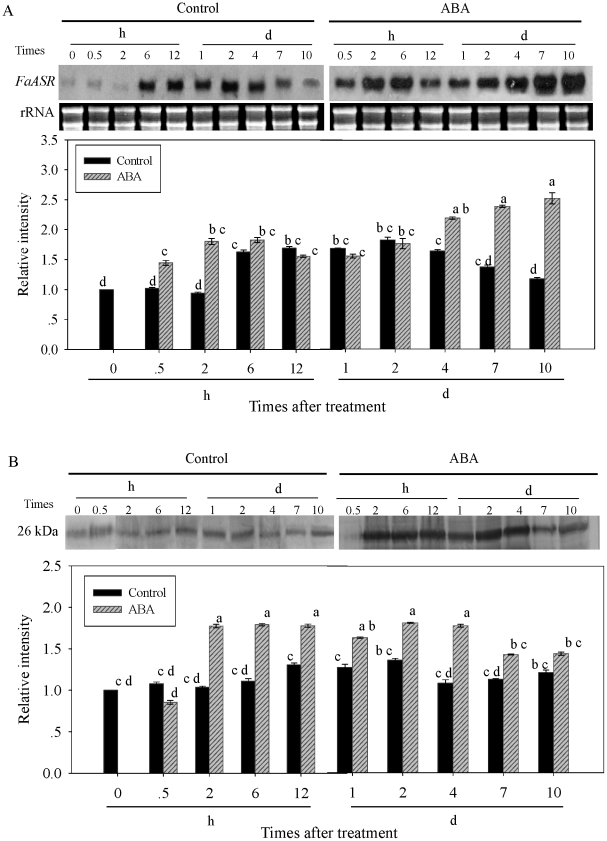
Figure 9. Changes in FaASR mRNA (A) and protein (B) accumulations after ABA treatment at the W stage.
Selected fruits at the W stage (about 23 days after post-anthesis) were dipped for 1 min in a solution containing 0 (control) or 100 µM ABA, and then sampled at 0, 0.5, 2, 6 and 12 h, 1, 2, 4, 7 and 10 days. In (A), total RNA (10 μg per lane) was used for northern blot analysis and hybridized with DIG-labeled probe, and ethidium bromide-stained rRNA was shown as the loading control. In (B), equal amounts of protein (30 μg per lane) were subjected to SDS-PAGE and then transferred to a nitrocellulose membrane. Thereafter, the FaASR protein amount was immunodetected by western blot using the anti-FaASR specific polyclonal antibody. The quantification of the northern or western blot bands was expressed in relation to the amount in control fruit sampled at time 0, which was set to 1. Vertical bars represented standard deviations (SD) of means (n = 3). Different letters indicated a statistical difference at the 5% level among data groups according to the Duncan's multiple range test.

References

    1. Giovannoni JJ. Molecular biology of fruit maturation and ripening. Annu Rev Plant Physiol Plant Mol Biol. 2001;52:725–749. - PubMed
    1. Giovannoni JJ. Genetic regulation of fruit development and ripening. Plant Cell. 2004;16:170–180. - PMC - PubMed
    1. Alexander L, Grierson D. Ethylene biosynthesis and action in tomato: a model for climacteric fruit ripening. J Exp Bot. 2002;53:2039–2055. - PubMed
    1. Manning K. Isolation of a set of ripening-related genes from strawberry: their identification and possible relationship to fruit quality traits. Planta. 1998;205:622–631. - PubMed
    1. Chervin C, El-Kereamy A, Roustan JP, Latché A, Lamon J, et al. Ethylene seems required for the berry development and ripening in grape, a non-climacteric fruit. Plant Sci. 2004;167:1301–1305.

Publication types

MeSH terms