. 2011 Oct 15;204(8):1217-26.
doi: 10.1093/infdis/jir507.

Immunologic failure despite suppressive antiretroviral therapy is related to activation and turnover of memory CD4 cells

Affiliations

Immunologic failure despite suppressive antiretroviral therapy is related to activation and turnover of memory CD4 cells

Michael M Lederman et al. J Infect Dis. .

Abstract

Background: Failure to normalize CD4(+) T-cell numbers despite effective antiretroviral therapy is an important problem in human immunodeficiency virus (HIV) infection.

Methods: To evaluate potential determinants of immune failure in this setting, we performed a comprehensive immunophenotypic characterization of patients with immune failure despite HIV suppression, persons who experienced CD4(+) T-cell restoration with therapy, and healthy controls.

Results: Profound depletion of all CD4(+) T-cell maturation subsets and depletion of naive CD8(+) T cells was found in immune failure, implying failure of T-cell production/expansion. In immune failure, both CD4(+) and CD8(+) cells were activated but only memory CD4(+) cells were cycling at increased frequency. This may be the consequence of inflammation induced by in vivo exposure to microbial products, as soluble levels of the endotoxin receptor CD14(+) and interleukin 6 were elevated in immune failure. In multivariate analyses, naive T-cell depletion, phenotypic activation (CD38(+) and HLA-DR expression), cycling of memory CD4(+) T cells, and levels of soluble CD14 (sCD14) distinguished immune failure from immune success, even when adjusted for CD4(+) T-cell nadir, age at treatment initiation, and other clinical indices.

Conclusions: Immune activation that appears related to exposure to microbial elements distinguishes immune failure from immune success in treated HIV infection.


Figures
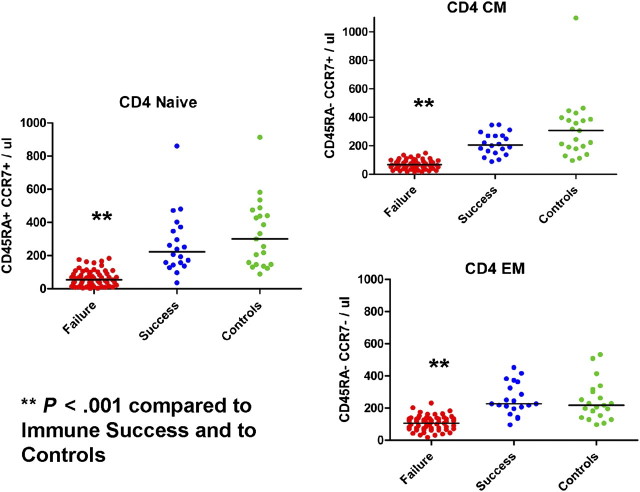
Figure 1.
Figure 1.
CD4+ lymphocyte maturation subsets. Absolute numbers of circulating naive (CD45RA+/CCR7+), central memory (CM; CD45RA/CCR7+), and effector memory (EM; CD45RA/CCR7) CD4+ lymphocytes in immune successes, immune failures, and healthy controls. Lymphocytes were identified by forward and right-angle light scatter and were gated according to high-level expression of CD4.** lower than numbers in immune successes and healthy controls (P < .001).
Figure 2.
Figure 2.
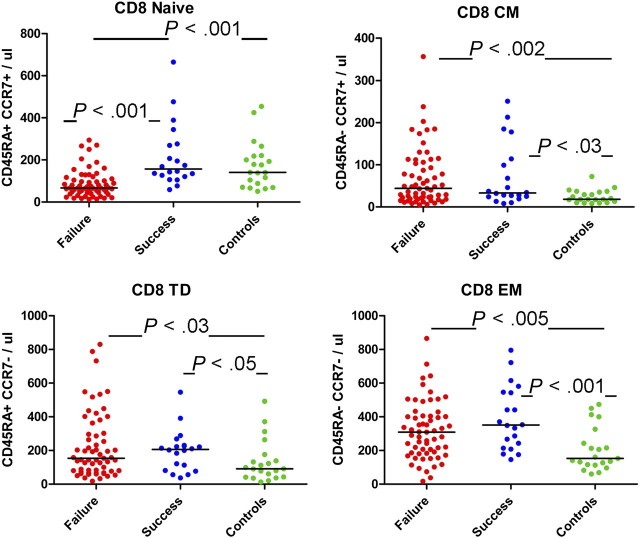
CD8+ lymphocyte maturation subsets. Absolute numbers of circulating central memory (CM), effector memory (EM), and terminally differentiated memory (TM; CD45RA+/CCR7) cells were lower in healthy controls than in immune success and immune failure subjects. Naive cell numbers were lower in immune failure subjects than among immune success subjects and healthy controls.
Figure 3.
Figure 3.
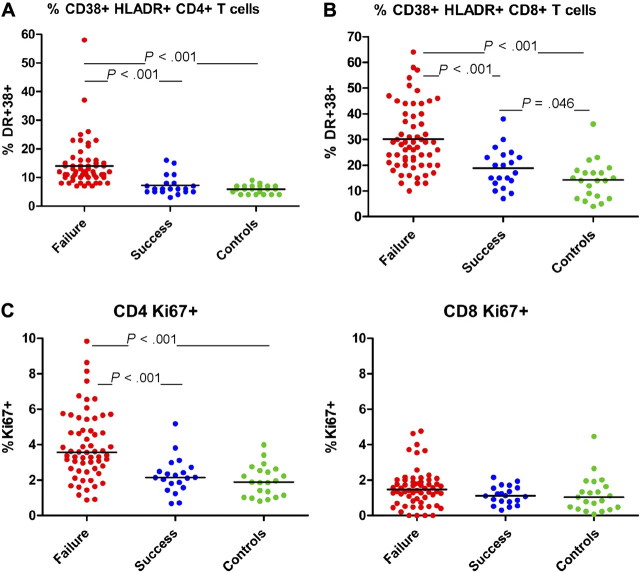
A, B, Proportions of activated (CD38+, HLA-DR+) CD4+ and CD8+ lymphocytes. Among both CD4+ and CD8+ cell populations, proportions of activated cells were higher in immune failure patients than among immune success patients and healthy controls. C, Proportions of CD4+ and CD8+ lymphocytes in cell cycle. The proportions of CD4+ lymphocytes in cell cycle (expressing the nuclear antigen Ki-67) were higher in immune failure patients than among immune success patients and healthy controls, while these proportions were not different among CD8+ lymphocytes.
Figure 4.
Figure 4.
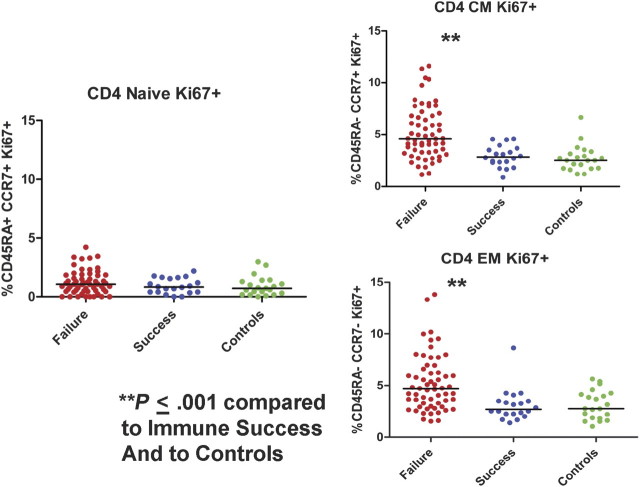
Proportions of CD4+ lymphocyte maturation subsets in cell cycle. The proportions of both central memory (CM) and effector memory (EM) CD4+ lymphocytes in cycle was greater in immune failure patients than among immune success patients and healthy controls.
Figure 5.
Figure 5.
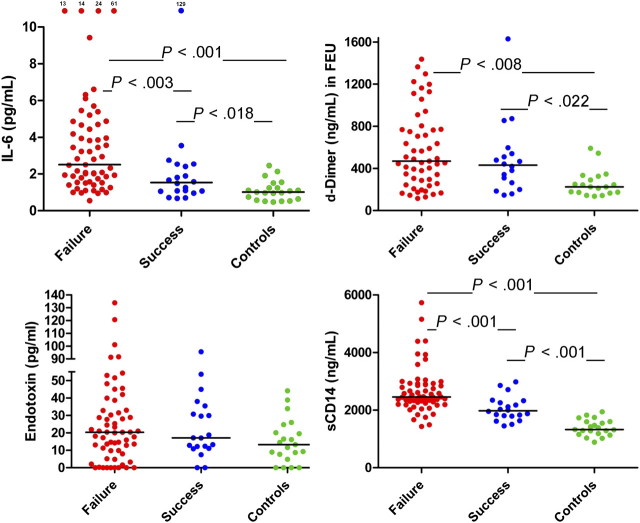
Soluble markers of microbial translocation, inflammation, and coagulation. Plasma levels of IL-6 were higher in immune failure patients than in immune success patients, and the levels in both patient groups were higher than in controls. D-dimer levels were comparable in both patient groups but higher than among controls. Levels of bacterial lipopolysaccharide (LPS), though nominally higher in immune failure patients than in immune success patients and controls, were not significantly elevated, while levels of the soluble LPS receptor CD14+ were higher in immune failure patients than in immune success patients and were higher in each patient group than in controls.

References

    1. Palella FJ, Jr, Baker RK, Moorman AC, et al. Mortality in the highly active antiretroviral therapy era: changing causes of death and disease in the HIV outpatient study. J Acquir Immune Defic Syndr. 2006;43:27–34. - PubMed
    1. Keiser O, Taffe P, Zwahlen M, et al. All cause mortality in the Swiss HIV Cohort Study from 1990 to 2001 in comparison with the Swiss population. AIDS. 2004;18:1835–43. - PubMed
    1. Baker JV, Peng G, Rapkin J, et al. CD4+ count and risk of non-AIDS diseases following initial treatment for HIV infection. AIDS. 2008;22:841–8. - PMC - PubMed
    1. Lewden C, Chene G, Morlat P, et al. HIV-infected adults with a CD4 cell count greater than 500 cells/mm3 on long-term combination antiretroviral therapy reach same mortality rates as the general population. J Acquir Immune Defic Syndr. 2007;46:72–7. - PubMed
    1. Kelley CF, Kitchen CM, Hunt PW, et al. Incomplete peripheral CD4+ cell count restoration in HIV-infected patients receiving long-term antiretroviral treatment. Clin Infect Dis. 2009;48:787–94. - PMC - PubMed

Publication types