


Molecular epidemiology of carbapenem-nonsusceptible Acinetobacter baumannii in the United States
- PMID: 21918019
- PMCID: PMC3209126
- DOI: 10.1128/JCM.00619-11
Molecular epidemiology of carbapenem-nonsusceptible Acinetobacter baumannii in the United States
Abstract
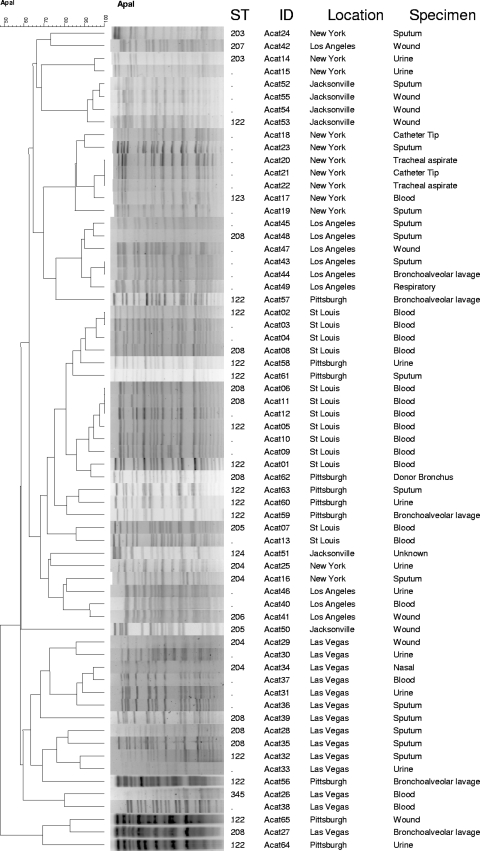
Acinetobacter baumannii is emerging as an important nosocomial pathogen worldwide. We report molecular epidemiology of 65 carbapenem-nonsusceptible A. baumannii isolates identified from hospitals in New York, Pennsylvania, Florida, Missouri, Nevada, and California between 2008 and 2009. All isolates were subjected to pulsed-field gel electrophoresis (PFGE). Select isolates then underwent multilocus sequence typing (MLST). While the PFGE patterns tended to cluster within each hospital, sequence types (STs) belonging to the clonal complex 92 (CC92) and the pan-European clonal lineage II (EUII; worldwide clonal lineage 2) were predominant in all hospitals. Of them, ST122 and ST208 were the most common and were found in four of the six hospitals. Isolates belonging to the pan-European clonal lineages I and III were identified in one hospital each. Carbapenemase-encoding genes bla(OXA-23) and/or ISAba1-bla(OXA-51-like) were present among the majority of isolates. These findings suggest that carbapenem-nonsusceptible A. baumannii isolates found in U.S. hospitals constitute part of the global epidemic driven by CC92, but have unique STs other than ST92, which may be spreading by means of patient transfer between health care facilities within the United States.
Figures
References
-
- Betrosian A. P., et al. 2007. High-dose ampicillin-sulbactam as an alternative treatment of late-onset VAP from multidrug-resistant Acinetobacter baumannii. Scand. J. Infect. Dis. 39:38–43 - PubMed
-
- Clinical and Laboratory Standards Institute. 2010. Performance standards for antimicrobial susceptibility testing: twentieth informational supplement. Clinical and Laboratory Standards Institute, Wayne, PA.
Publication types
MeSH terms
Substances
Grants and funding
LinkOut - more resources
Full Text Sources
Medical
