


Review
doi: 10.1097/JES.0b013e318236e5ee.
Physical activity in childhood may be the key to optimizing lifespan skeletal health
Affiliations
- PMID: 21918458
- PMCID: PMC3245809
- DOI: 10.1097/JES.0b013e318236e5ee
Item in Clipboard
Review
Physical activity in childhood may be the key to optimizing lifespan skeletal health
Exerc Sport Sci Rev.
2012 Jan.
Abstract
Physical activities undertaken in childhood, particularly activities, which apply large forces quickly convey optimal benefits to bone mass, size, and structure. Evidence is accumulating that benefits persist well beyond activity cessation. This review examines the potential for early childhood activity to improve bone mineralization and structure and explores childhood activity as prevention for osteoporosis in later life.
Conflict of interest statement
The authors indicate no conflicts of interest.
Figures
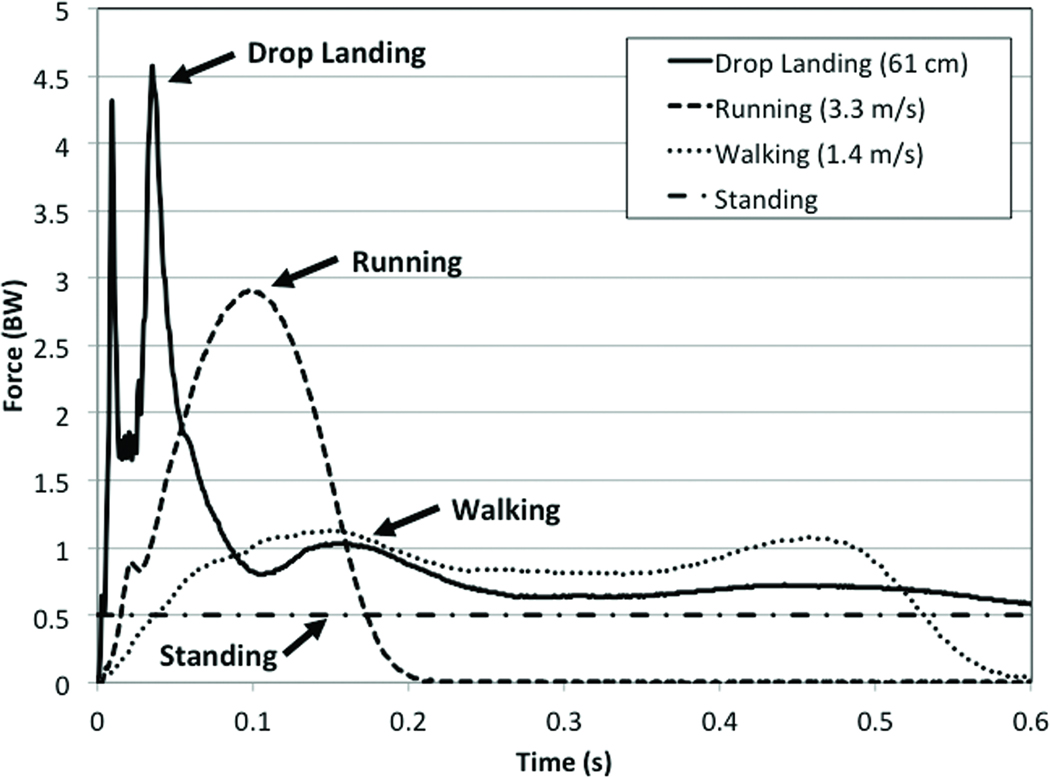
Ground reaction forces (measured in portions of bodyweight (BW)) and loading rates experienced by a pre-pubertal female child during quite standing, walking, running and a drop landing from a 61 cm height. All recorded values are from a single leg. Values for the drop jump were derived from a two-foot drop landing on dual force plates. Values for quiet standing reflect 0.5 BW per leg while standing on two feet; one foot on each plate.
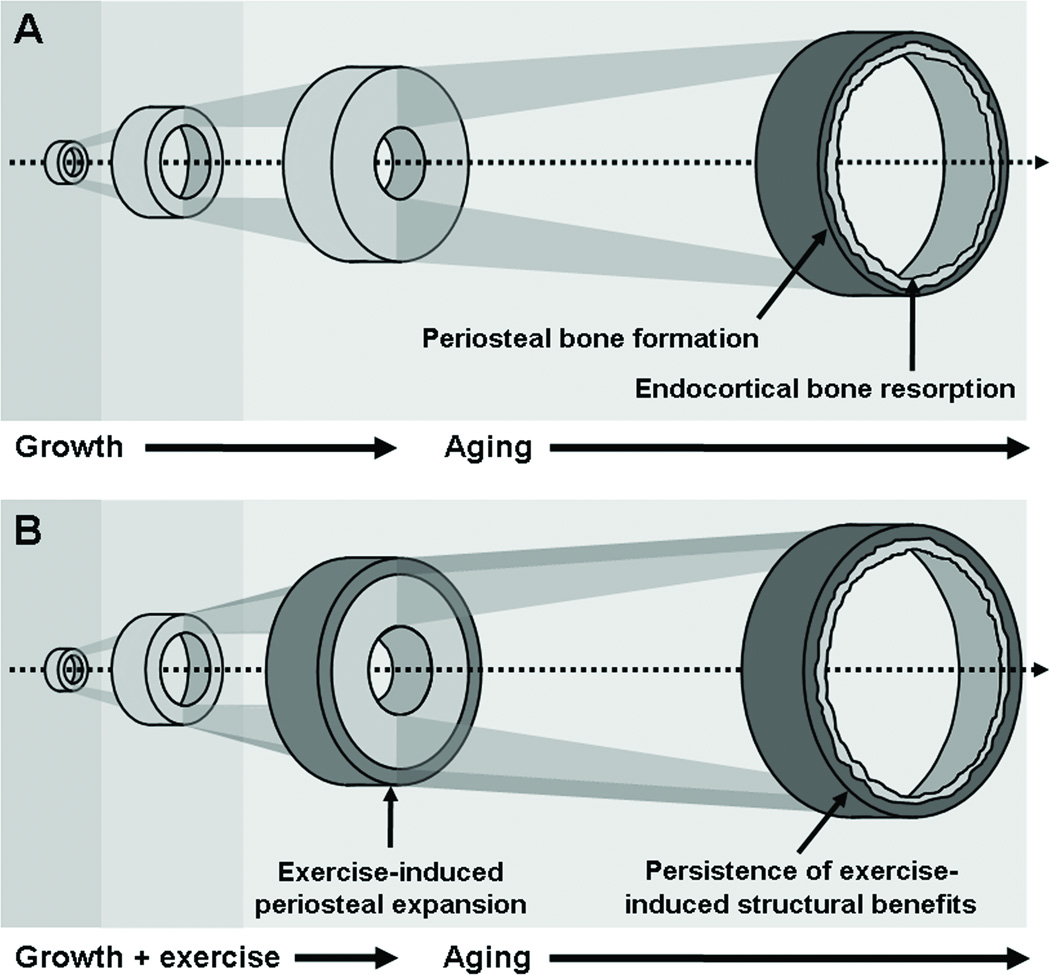
Bone structural changes attributed to growth and aging (A) contrasted with the additive effects of exercise during growth and the subsequent benefits to lifelong skeletal health if effects persist into older adulthood (B). (Reprinted from (36). Copyright © 2009 BMJ Publishing Group Ltd.. Used with permission.
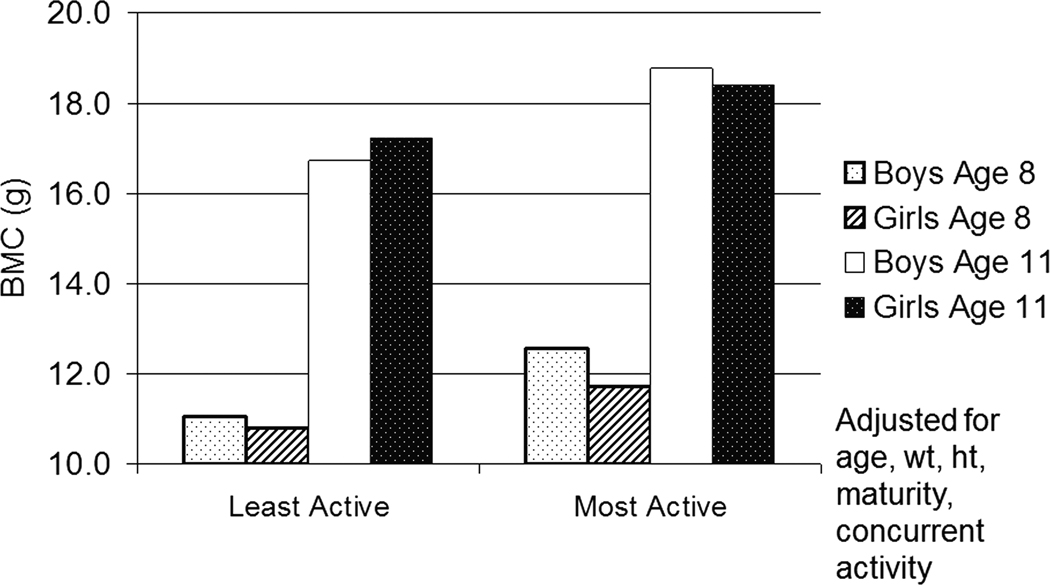
Mixed model least square means of Iowa Bone Development Study cohort contrasting the hip bone mineral content (BMC) (g) at ages 8 and 11 in the most active and least physically active quartiles of boys and girls at age 5 with adjustment for age, weight (wt), height (ht), maturity, and current physical activity (at age 8 and 11). N = 333 children. Findings published in (18).
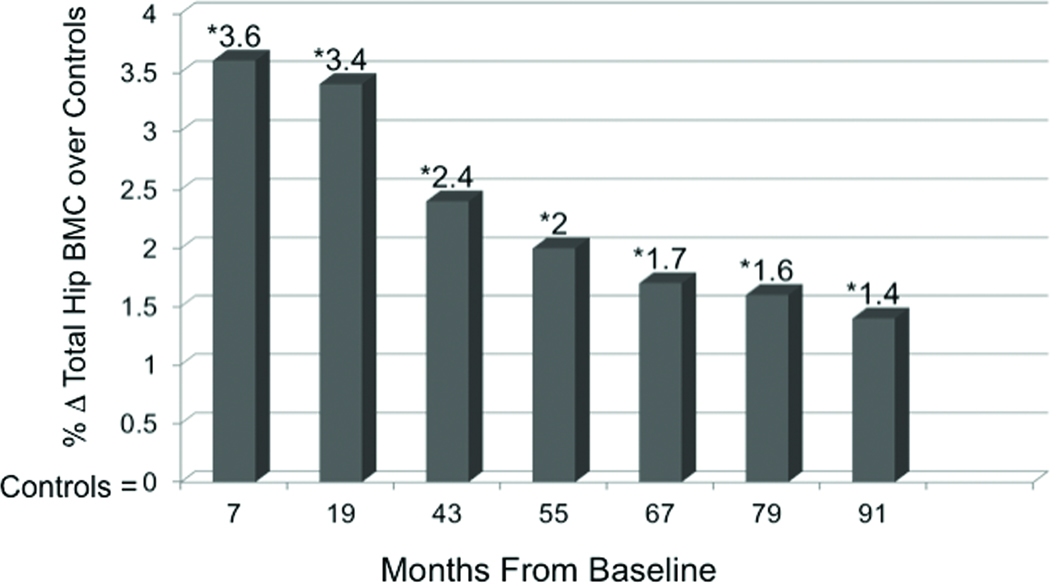
The effect of a jumping intervention on Δtotal hip bone mineral content (BMC) after 8 years showing percent change in total hip BMC from baseline in jumpers above that of controls. Data points are displayed after 7 mo of exercise training, 1 yr of detraining (19 mo), and 4–8 yr of detraining (43–91 mo). The intervention participants had 3.6% greater bone mass at the total hip than controls immediately after the intervention and 1.4% greater bone mass 8 yrs later. *Results are significant at each of the seven measurement intervals (p < 0.05) and are adjusted for baseline age, ΔHt, ΔWt, maturity, and sports participation. [Adapted from (9). Copyright © 2008 John Wiley and Sons. Used with permission.]
References
-
- Bailey DA, McKay HA, Mirwald RL, Crocker PR, Faulkner RA. A six-year longitudinal study of the relationship of physical activity to bone mineral accrual in growing children: the university of Saskatchewan bone mineral accrual study. J. Bone Miner. Res. 1999;14:1672–1679. - PubMed
-
- Bauer JJ, Snow CM. What is the prescription for healthy bones? J. Musculoskelet Neuronal Interact. 2003;3:352–355. - PubMed
-
- Baxter-Jones AD, Faulkner RA, Forwood M, Mirwald RL, Bailey DA. Bone mineral accrual from 8 to 30 years of age: An estimation of peak bone mass. J. Bone Miner. Res. 2011;26(8) 1729-394. - PubMed
-
- Baxter-Jones AD, Kontulainen SA, Faulkner RA, Bailey DA. A longitudinal study of the relationship of physical activity to bone mineral accrual from adolescence to young adulthood. Bone. 2008;43:1101–1107. - PubMed
-
- Blimkie CJ, Rice S, Webber CE, Martin J, Levy D, Gordon CL. Effects of resistance training on bone mineral content and density in adolescent females. Can. J. Physiol. Pharmacol. 1996;74:1025–1033. - PubMed
Publication types
MeSH terms
Grants and funding
LinkOut - more resources
Full Text Sources
Medical
