. 2012 Jan;37(2):412-21.
doi: 10.1038/npp.2011.188. Epub 2011 Sep 14.

Anti-aversive effects of cannabidiol on innate fear-induced behaviors evoked by an ethological model of panic attacks based on a prey vs the wild snake Epicrates cenchria crassus confrontation paradigm

Affiliations

Anti-aversive effects of cannabidiol on innate fear-induced behaviors evoked by an ethological model of panic attacks based on a prey vs the wild snake Epicrates cenchria crassus confrontation paradigm

Andrés Uribe-Mariño et al. Neuropsychopharmacology. 2012 Jan.

Abstract

Several pharmacological targets have been proposed as modulators of panic-like reactions. However, interest should be given to other potential therapeutic neurochemical agents. Recent attention has been given to the potential anxiolytic properties of cannabidiol, because of its complex actions on the endocannabinoid system together with its effects on other neurotransmitter systems. The aim of this study was to investigate the effects of cannabidiol on innate fear-related behaviors evoked by a prey vs predator paradigm. Male Swiss mice were submitted to habituation in an arena containing a burrow and subsequently pre-treated with intraperitoneal administrations of vehicle or cannabidiol. A constrictor snake was placed inside the arena, and defensive and non-defensive behaviors were recorded. Cannabidiol caused a clear anti-aversive effect, decreasing explosive escape and defensive immobility behaviors outside and inside the burrow. These results show that cannabidiol modulates defensive behaviors evoked by the presence of threatening stimuli, even in a potentially safe environment following a fear response, suggesting a panicolytic effect.


Figures
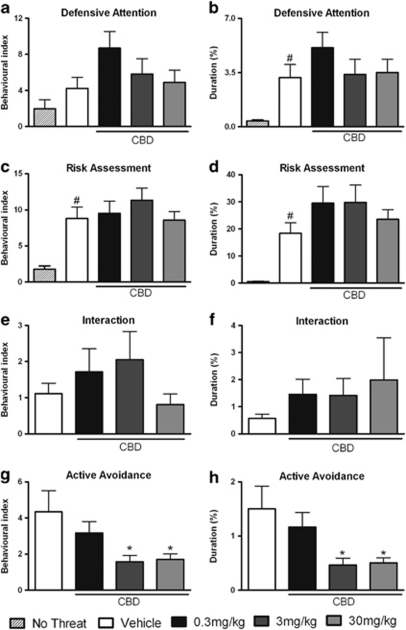
Figure 1
Figure 1
Outside-burrow behaviors. Non-threatened mouse behaviors and the effects of intraperitoneal administration of vehicle or cannabidiol (CBD) at 0.3, 3, or 30 mg/kg on the behavioral index (BI) (a) and duration (b) of defensive attention, the BI (c) and duration (d) of risk assessment, the BI (e) and duration (f) of the interaction between prey and snake, and the BI (g) and duration (h) of active avoidance exhibited by mice during the confrontation with the wild constrictor snake after a 3-day habituation period in a polygonal arena. Columns represent the mean and bars the SEM, n=11–12 mice per group. #P<0.05 when compared with the group not submitted to any threatening situation (no-threat); *P<0.05 when compared with the vehicle-treated group. BI=(100 × number of behavioral responses)/(time in seconds spent outside or inside the burrow).
Figure 2
Figure 2
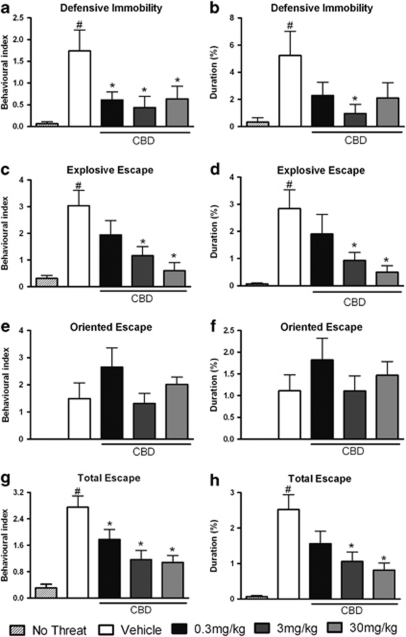
Outside-burrow behaviors. Non-threatened mouse behaviors and the effects of intraperitoneal administration of vehicle or cannabidiol (CBD) at 0.3, 3, or 30 mg/kg on the behavioral index (BI) (a) and duration (b) of defensive immobility, the BI (c) and duration (d) of explosive escape responses, the BI (e) and duration (f) of oriented escape responses and the BI (g) and duration (h) of the total escape response exhibited by mice during the confrontation with the wild constrictor snake after a 3-day habituation period in a polygonal arena. Columns represent the mean and bars the SEM, n=11–12 mice per group. #P<0.05 when compared with the group not submitted to any threatening situation (no-threat); *P<0.05 when compared with the vehicle-treated group. BI=(100 × number of behavioral responses)/(time in seconds spent outside or inside the burrow).
Figure 3
Figure 3
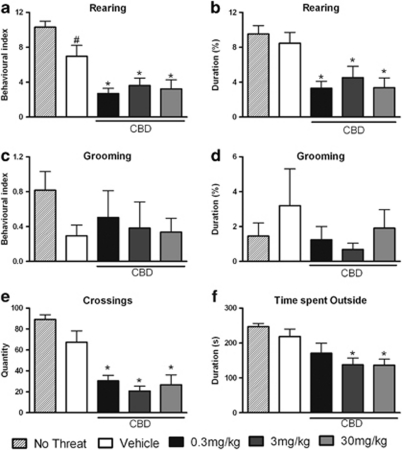
Outside-burrow behaviors. Non-threatened mouse behaviors and the effects of intraperitoneal administration of vehicle or cannabidiol (CBD) at 0.3, 3, or 30 mg/kg on the behavioral index (BI) (a) and duration (b) of rearing, the BI (c) and duration (d) of grooming, the quantity of crossings (e) and the duration of the time spent outside the burrow (f) exhibited by mice during the confrontation with the wild constrictor snake after a 3-day habituation period in a polygonal arena. Columns represent the mean and bars the SEM, n=11–12 mice per group. #P<0.05 when compared with the group not submitted to any threatening situation (no-threat); *P<0.05 when compared with the vehicle-treated group. BI=(100 × number of behavioral responses)/(time in seconds spent outside or inside the burrow).
Figure 4
Figure 4
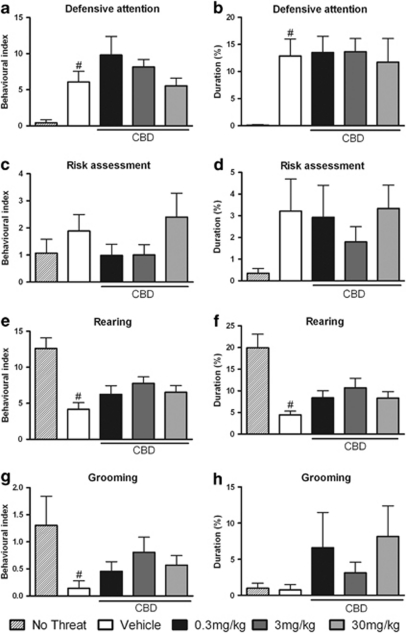
Inside-burrow behaviors. Non-threatened mouse behaviors and the effects of intraperitoneal administration of vehicle or cannabidiol (CBD) at 0.3, 3, or 30 mg/kg on the behavioral index (BI) (a) and duration (b) of defensive attention, the BI (c) and duration (d) of risk assessment, the BI (e) and duration (f) of rearing and the BI (g) and duration (h) of grooming exhibited by mice during the confrontation with the wild constrictor snake after a 3-day habituation period in the arena. Columns represent the mean and bars the SEM, n=11–12 mice per group. #P<0.05 when compared with the group not submitted to any threatening situation (no-threat). BI=(100 × number of behavioral responses)/(time in seconds spent outside or inside the burrow).
Figure 5
Figure 5
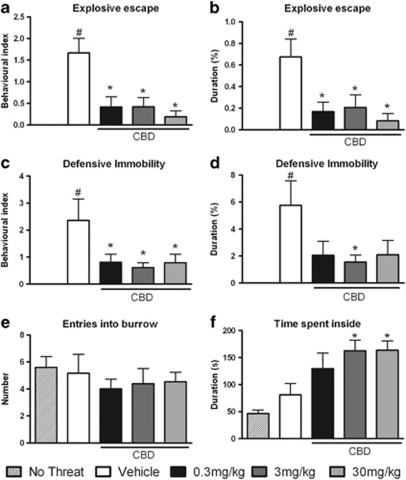
Inside-burrow behaviors. Non-threatened mouse behaviors and the effects of intraperitoneal administration of vehicle or cannabidiol (CBD) at 0.3, 3, or 30 mg/kg on the behavioral index (BI) (a) and duration (b) of explosive escape, the BI (c) and duration (d) of defensive immobility, the number of entries (e) into the burrow and the duration (f) of time spent inside by mice during the confrontation with the wild constrictor snake after a 3-day habituation period in the arena. Columns represent the mean and bars the SEM, n=11–12 per group. #P<0.05 when compared with the group not submitted to any threatening situation (no-threat); *P<0.05 when compared with the vehicle-treated group. BI=(100 × number of behavioral responses)/(time in seconds spent outside or inside the burrow).
Figure 6
Figure 6
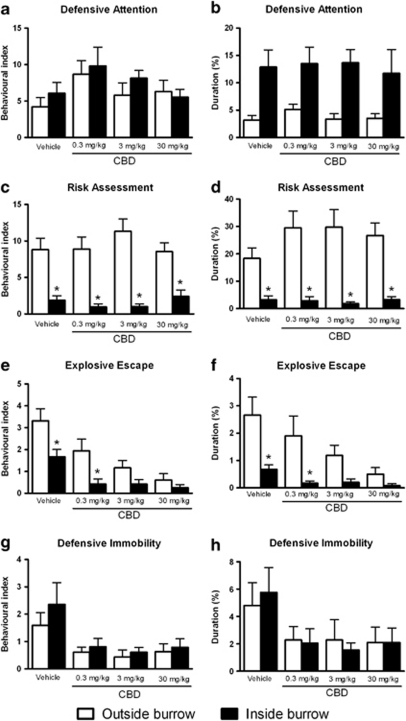
Outside- vs inside-burrow behaviors. Effects of intraperitoneal administration of vehicle or cannabidiol (CBD) at 0.3, 3, or 30 mg/kg on the behavioral index (BI) (a) and duration (b) of defensive attention, the BI (c) and duration (d) of risk assessment, the BI (e) and duration (f) of explosive escape response, and the BI (g) and duration (h) of defensive immobility exhibited by mice during the confrontation with the wild constrictor snake after a 3-day habituation period in the polygonal arena. Columns represent the mean and bars the SEM, n=11–12 mice per group. *P<0.05 when compared with the respective treatment outside the burrow. BI=(100 × number of behavioral responses)/(time in seconds spent outside or inside the burrow).

References

    1. Bisogno T, Hanus L, de Petrocellis L, Tchilibon S, Ponde DE, Brandi I, et al. Molecular targets for cannabidiol and its synthetic analogues: effect on vanilloid VR1 receptors and on the cellular uptake and enzymatic hydrolysis of anandamide. Br J Pharmacol. 2001;134:845–852. - PMC - PubMed
    1. Blanchard DC, Blanchard RJ. Cocaine potentiates defensive behaviors related to fear and anxiety. Neurosci Biobehav Rev. 1999;23:981–991. - PubMed
    1. Blanchard DC, Griebel G, Blanchard RJ. Mouse defensive behaviors: pharmacological and behavioral assays for anxiety and panic. Neurosci Biobehav Rev. 2001;25:205–218. - PubMed
    1. Blanchard DC, Griebel G, Blanchard RJ. The mouse defense test battery: pharmacological and behavioral assays for anxiety and panic. Eur J Pharmacol. 2003;463:97–116. - PubMed
    1. Blanchard DC, Griebel G, Rodgers RJ, Blanchard RJ. Benzodiazepine and serotonergic modulation of antipredator and conspecific defense. Neurosci Biobehav Rev. 1998;22:597–612. - PubMed

Publication types