Oxygen tension and formation of cervical-like tissue in two-dimensional and three-dimensional culture
- PMID: 21919792
- PMCID: PMC3286821
- DOI: 10.1089/ten.TEA.2011.0309
Oxygen tension and formation of cervical-like tissue in two-dimensional and three-dimensional culture
Abstract
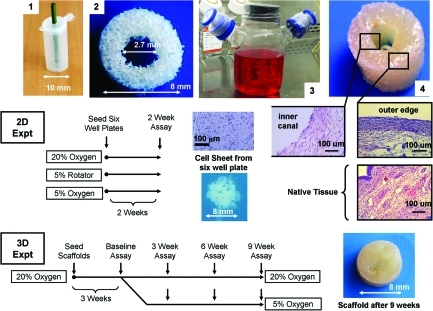
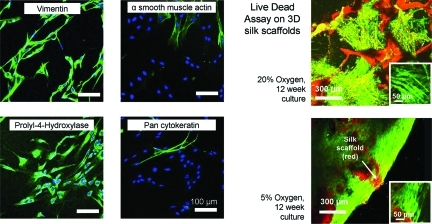
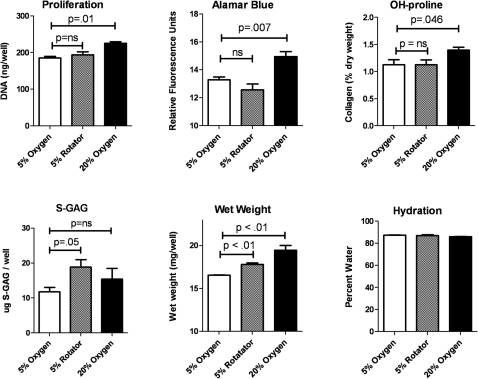
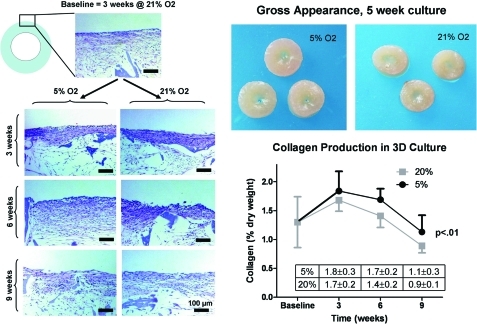
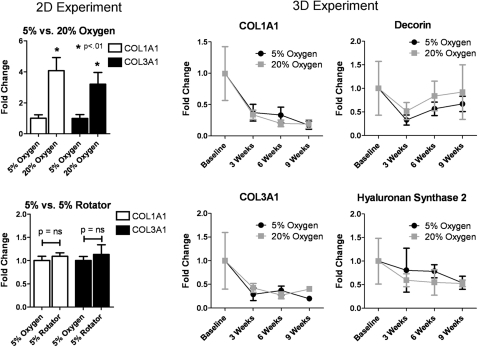
Cervical dysfunction contributes to a significant number of preterm births and is a common cause of morbidity and mortality in newborn infants. Cervical dysfunction is related to weakened load bearing properties of the collagen-rich cervical stroma. However, the mechanisms responsible for cervical collagen changes during pregnancy are not well defined. It is known that blood flow and oxygen tension significantly increase in reproductive tissues during pregnancy. To examine the effect of oxygen tension, a key mediator of tissue homeostasis, on the formation of cervical-like tissue in vitro, we grew primary human cervical cells in both two-dimensional (2D) and three-dimensional (3D) culture systems at 5% and 20% oxygen. Immunofluorescence studies revealed a stable fibroblast phenotype across six passages in all subjects studied (n=5). In 2D culture for 2 weeks, 20% oxygen was associated with significantly increased collagen gene expression (p<0.01), increased tissue wet weight (p<0.01), and increased collagen concentration (p=0.046). 3D cultures could be followed for significantly longer time frames than 2D cultures (12 weeks vs. 2 weeks). In contrast to 2D cultures, 20% oxygen in 3D cultures was associated with decreased collagen concentration (p<0.01) and unchanged collagen gene expression, which is similar to cervical collagen changes seen during pregnancy. We infer that 3D culture is more relevant for studying cervical collagen changes in vitro. The data suggest that increased oxygen tension may be related to significant cervical collagen changes seen in pregnancy.
Figures
Similar articles
-
Inhibitory effect of progesterone on cervical tissue formation in a three-dimensional culture system with human cervical fibroblasts.Biol Reprod. 2014 Jan 30;90(1):18. doi: 10.1095/biolreprod.113.112540. Print 2014 Jan. Biol Reprod. 2014. PMID: 24285720 Free PMC article.
-
Extracellular Matrix Rigidity Modulates Human Cervical Smooth Muscle Contractility-New Insights into Premature Cervical Failure and Spontaneous Preterm Birth.Reprod Sci. 2021 Jan;28(1):237-251. doi: 10.1007/s43032-020-00268-6. Epub 2020 Jul 22. Reprod Sci. 2021. PMID: 32700284 Free PMC article.
-
Cervical collagen concentration within 15 months after delivery.Am J Obstet Gynecol. 2011 Jul;205(1):59.e1-3. doi: 10.1016/j.ajog.2011.03.036. Epub 2011 Mar 26. Am J Obstet Gynecol. 2011. PMID: 22088899
-
Using imaging-based, three-dimensional models of the cervix and uterus for studies of cervical changes during pregnancy.Clin Anat. 2013 Jan;26(1):97-104. doi: 10.1002/ca.22183. Epub 2012 Nov 21. Clin Anat. 2013. PMID: 23168534 Review.
-
A debate about ultrasound and anatomic aspects of the cervix in spontaneous preterm birth.J Med Life. 2016 Oct-Dec;9(4):342-347. J Med Life. 2016. PMID: 27928435 Free PMC article. Review.
Cited by
-
Biocompatibility of a sonicated silk gel for cervical injection during pregnancy: in vivo and in vitro study.Reprod Sci. 2014 Oct;21(10):1266-73. doi: 10.1177/1933719114522551. Epub 2014 Feb 11. Reprod Sci. 2014. PMID: 24520079 Free PMC article.
-
Bioengineering of the Uterus.Reprod Sci. 2021 Jun;28(6):1596-1611. doi: 10.1007/s43032-021-00503-8. Epub 2021 Apr 7. Reprod Sci. 2021. PMID: 33826100 Free PMC article. Review.
-
Tissue Engineering for Cervical Function in Pregnancy.Curr Opin Biomed Eng. 2022 Jun;22:100385. doi: 10.1016/j.cobme.2022.100385. Epub 2022 Mar 28. Curr Opin Biomed Eng. 2022. PMID: 35574159 Free PMC article.
-
Inhibitory effect of progesterone on cervical tissue formation in a three-dimensional culture system with human cervical fibroblasts.Biol Reprod. 2014 Jan 30;90(1):18. doi: 10.1095/biolreprod.113.112540. Print 2014 Jan. Biol Reprod. 2014. PMID: 24285720 Free PMC article.
-
Mechanical and Biochemical Effects of Progesterone on Engineered Cervical Tissue.Tissue Eng Part A. 2018 Dec;24(23-24):1765-1774. doi: 10.1089/ten.TEA.2018.0036. Epub 2018 Jul 23. Tissue Eng Part A. 2018. PMID: 29855229 Free PMC article.
References
-
- Martin J.A. Hamilton B.E. Sutton P.D. Ventura S.J. Mathews T.J. Kirmeyer S. Osterman M.J. Births: final data for 2007. Natl Vital Stat Rep. 2010;58:1. - PubMed
-
- Mathews T.J. Macdorman M.F. Infant mortality statistics from the 2006 period linked birth/infant death data set. Natl Vital Stat Rep. 2010;58:1. - PubMed
-
- Saigal S. Doyle L.W. An overview of mortality and sequelae of preterm birth from infancy to adulthood. Lancet. 2008;371:261. - PubMed
-
- Institute of Medicine. Preterm Birth: Causes, Consequences, Prevention. Washington, DC: National Academies Press; 2006.
-
- Fonseca E.B. Celik E. Parra M. Singh M. Nicolaides K.H. Progesterone and the risk of preterm birth among women with a short cervix. N Engl J Med. 2007;357:462. - PubMed
Publication types
MeSH terms
Substances
Grants and funding
LinkOut - more resources
Full Text Sources
Medical