


Oxygen tension and formation of cervical-like tissue in two-dimensional and three-dimensional culture
- PMID: 21919792
- PMCID: PMC3286821
- DOI: 10.1089/ten.TEA.2011.0309
Oxygen tension and formation of cervical-like tissue in two-dimensional and three-dimensional culture
Abstract
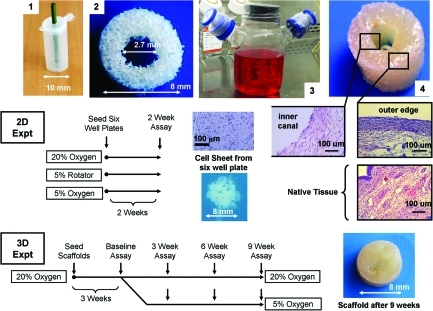
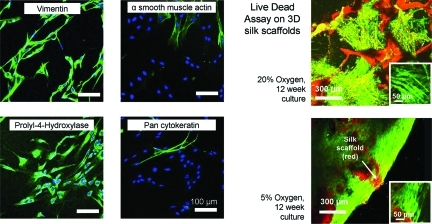
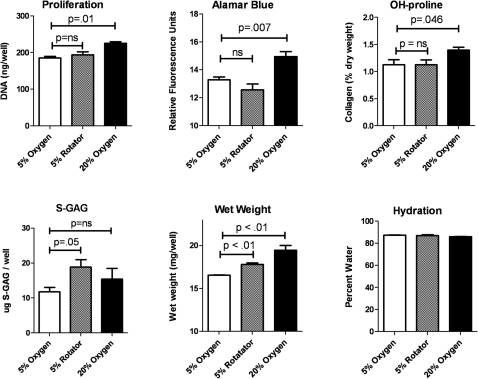
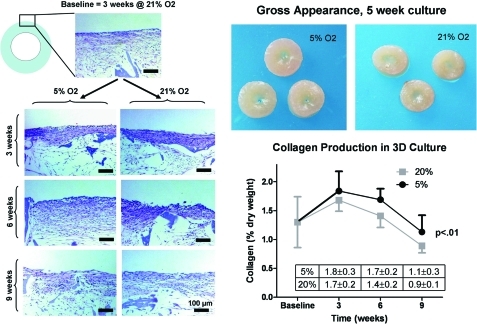
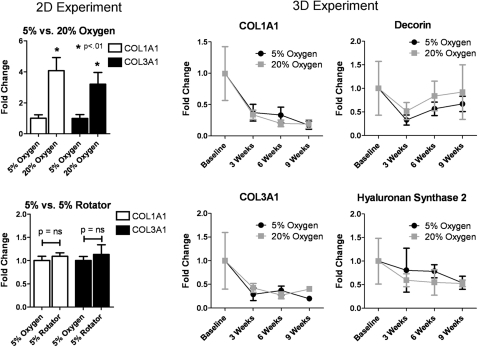
Cervical dysfunction contributes to a significant number of preterm births and is a common cause of morbidity and mortality in newborn infants. Cervical dysfunction is related to weakened load bearing properties of the collagen-rich cervical stroma. However, the mechanisms responsible for cervical collagen changes during pregnancy are not well defined. It is known that blood flow and oxygen tension significantly increase in reproductive tissues during pregnancy. To examine the effect of oxygen tension, a key mediator of tissue homeostasis, on the formation of cervical-like tissue in vitro, we grew primary human cervical cells in both two-dimensional (2D) and three-dimensional (3D) culture systems at 5% and 20% oxygen. Immunofluorescence studies revealed a stable fibroblast phenotype across six passages in all subjects studied (n=5). In 2D culture for 2 weeks, 20% oxygen was associated with significantly increased collagen gene expression (p<0.01), increased tissue wet weight (p<0.01), and increased collagen concentration (p=0.046). 3D cultures could be followed for significantly longer time frames than 2D cultures (12 weeks vs. 2 weeks). In contrast to 2D cultures, 20% oxygen in 3D cultures was associated with decreased collagen concentration (p<0.01) and unchanged collagen gene expression, which is similar to cervical collagen changes seen during pregnancy. We infer that 3D culture is more relevant for studying cervical collagen changes in vitro. The data suggest that increased oxygen tension may be related to significant cervical collagen changes seen in pregnancy.
Figures
References
-
- Martin J.A. Hamilton B.E. Sutton P.D. Ventura S.J. Mathews T.J. Kirmeyer S. Osterman M.J. Births: final data for 2007. Natl Vital Stat Rep. 2010;58:1. - PubMed
-
- Mathews T.J. Macdorman M.F. Infant mortality statistics from the 2006 period linked birth/infant death data set. Natl Vital Stat Rep. 2010;58:1. - PubMed
-
- Saigal S. Doyle L.W. An overview of mortality and sequelae of preterm birth from infancy to adulthood. Lancet. 2008;371:261. - PubMed
-
- Institute of Medicine. Preterm Birth: Causes, Consequences, Prevention. Washington, DC: National Academies Press; 2006.
-
- Fonseca E.B. Celik E. Parra M. Singh M. Nicolaides K.H. Progesterone and the risk of preterm birth among women with a short cervix. N Engl J Med. 2007;357:462. - PubMed
Publication types
MeSH terms
Substances
Grants and funding
LinkOut - more resources
Full Text Sources
Medical
