


The awakening of an advanced malignant cancer: an insult to the mitochondrial genome
- PMID: 21920409
- PMCID: PMC3269539
- DOI: 10.1016/j.bbagen.2011.08.017
The awakening of an advanced malignant cancer: an insult to the mitochondrial genome
Abstract
Background: In only months-to-years a primary cancer can progress to an advanced phenotype that is metastatic and resistant to clinical treatments. As early as the 1900s, it was discovered that the progression of a cancer to the advanced phenotype is often associated with a shift in the metabolic profile of the disease from a state of respiration to anaerobic fermentation - a phenomenon denoted as the Warburg Effect.
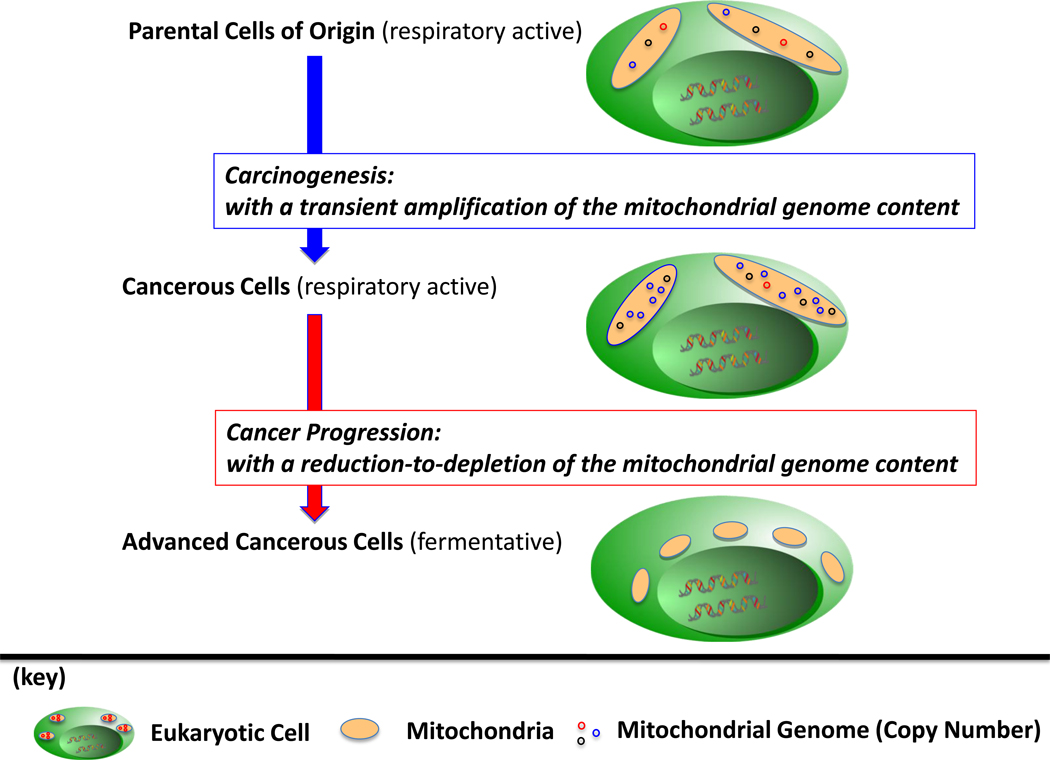
Scope of review: Reports in the literature strongly suggest that the Warburg Effect is generated as a response to a loss in the integrity of the sequence and/or copy number of the mitochondrial genome content within a cancer.
Major conclusions: Multiple studies regarding the progression of cancer indicate that mutation, and/or, a flux in the copy number, of the mitochondrial genome content can support the early development of a cancer, until; the mutational load and/or the reduction-to-depletion of the copy number of the mitochondrial genome content induces the progression of the disease to an advanced phenotype.
General significance: Collectively, evidence has revealed that the human cell has incorporated the mitochondrial genome content into a cellular mechanism that, when pathologically actuated, can de(un)differentiate a cancer from the parental tissue of origin into an autonomous disease that disrupts the hierarchical structure-and-function of the human body. This article is part of a Special Issue entitled: Biochemistry of Mitochondria.
Copyright © 2011 Elsevier B.V. All rights reserved.
Figures
References
-
- Anderson S, Bankier AT, Barrell BG, de Bruijn MH, Coulson AR, drouin J, Eperon IC, Nierlich DP, Roe BA, Sanger F, Schreier PH, Smith AJ, Staden R, Young IG. Sequence and organization of the human mitochondrial genome. Nature. 1981;290:457–465. - PubMed
-
- Koehler CM, Bauer MF. Mitochondrial function and biogenesis. Berlin; New York: Springer; 2004.
Publication types
MeSH terms
Substances
Grants and funding
LinkOut - more resources
Full Text Sources
