Randomized Controlled Trial
. 2012 Jan 1;71(1):36-43.
doi: 10.1016/j.biopsych.2011.07.033. Epub 2011 Sep 13.

Effects of acute tryptophan depletion on prefrontal-amygdala connectivity while viewing facial signals of aggression

Affiliations
Randomized Controlled Trial

Effects of acute tryptophan depletion on prefrontal-amygdala connectivity while viewing facial signals of aggression

Luca Passamonti et al. Biol Psychiatry. .

Abstract

Background: Reduced levels of serotonin (5-HT) within prefrontal cortex (PFC)-amygdala circuits have long been implicated in impulsive aggression. However, whether lowering 5-HT alters the dynamic interplay between the PFC and the amygdala has not been directly tested in humans. It is known that manipulating 5-HT via acute tryptophan depletion (ATD) causes variable effects on brain responses to a variety of emotional stimuli, but it remains unclear whether ATD affects functional connectivity in neural networks involved in processing social signals of aggression (e.g., angry faces).

Methods: Thirty healthy individuals were enrolled in a randomized, double-blind, placebo-controlled ATD study. On each treatment, brain responses to angry, sad, and neutral faces were measured with functional magnetic resonance imaging. Two methods (psycho-physiological-interaction in a general linear model and dynamic causal modeling) were used to assess the impact of ATD on the functional connectivity between PFC and amygdala.

Results: Data from 19 subjects were available for the final analyses. A whole-brain psycho-physiological-interaction in a general linear model showed that ATD significantly modulated the connectivity between the amygdala and two PFC regions (ventral anterior cingulate cortex and ventrolateral PFC) when processing angry vs. neutral and angry vs. sad but not sad vs. neutral faces. Dynamic causal modeling corroborated and extended these findings by showing that 5-HT depletion reduced the influence of processing angry vs. neutral faces on circuits within PFC and on PFC-amygdala pathways.

Conclusions: We provide strong support for neurobiological accounts positing that 5-HT significantly influences PFC-amygdala circuits implicated in aggression and other affective behaviors.


Figures

Figure 1
Figure 1
(A) Examples of angry and neutral faces during the task. (B) “Source” for Psycho-Physiological Interactions (PPI) (8-mm right amygdala sphere). (C–E) PPI Statistical Parametrical Maps (SPM). These SPM maps demonstrate that the ventral anterior cingulate cortex (vACC) and the ventrolateral prefrontal cortex (VLPFC) are the only two regions in the whole brain that are connected with the right amygdala as function of viewing angry vs. neutral faces and treatment (acute tryptophan depletion [ATD] and placebo; paired t tests). Slices shown (x, y, z) are in the Montreal Neurological Institute space. For display purposes, threshold is set at p < .001, uncorrected; the effects are significant at p < .05, family-wise error, small volume correction. The color bar represents t statistics. R, right hemisphere. (F, G) Plots of the individual data for the local maxima displayed in panels C and D, respectively. Significant differences between placebo and ATD reflect a negative change in the connectivity between the amygdala and vACC/VLPFC during placebo and a positive change in connectivity between the same regions during ATD. Black lines represent mean values for each treatment (placebo, ATD).
Figure 2
Figure 2
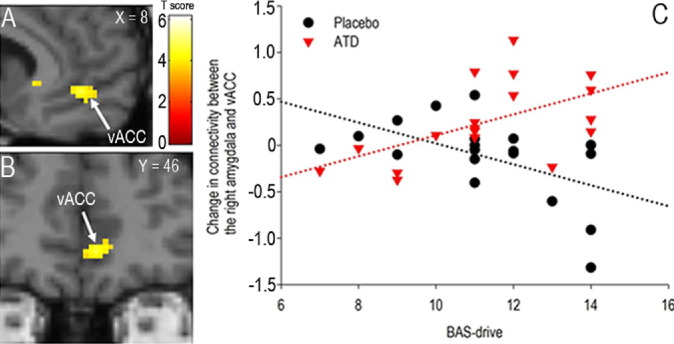
(A, B) The ventral anterior cingulate cortex (vACC) is connected with the right amygdala as a function of treatment (acute tryptophan depletion [ATD], placebo) and reward drive (BAS, behavioral activation system; treatment by personality interaction; for angry vs. neutral faces). Slices (x, y) are in the Montreal Neurological Institute space. For display purposes, threshold is set at p < .001, uncorrected; the effects are significant at p < .05, family-wise error, small volume correction. The color bar represents t statistics. (C) Plot of individual data for the local maxima displayed in panels A and B. High-BAS-drive individuals displayed the largest effect of ATD on amygdala-vACC connectivity.
Figure 3
Figure 3
(A) Preferred model during placebo. The amygdala (AMY) is the only region where driving inputs (all faces vs. fixation, black “thick” arrows) start the “perturbation” of the network. In this model, the contextual modulator (angry vs. neutral faces, red arrows) influences all neural pathways linking the ventral anterior cingulate cortex (vACC), ventrolateral prefrontal cortex (VLPFC), and AMY. The intrinsic connectivity (black “thin” arrows) represents the couplings between regions irrespective of any experimental manipulation and are modeled as reciprocal connections between all three regions. (B, C) Expected probability and (E and F) exceedance probability for all 49 models shown in Supplement 1 Figures S1–S3 using random-effects (RFX) Bayesian model selection during placebo and acute tryptophan depletion (ATD). Compared with placebo, under ATD, model C1.1 has lower expected and exceedance probabilities; at the same time, model C2.1 and C3.1 (D) became more likely. These latter models are characterized by a smaller number of contextual modulators (affecting two or one couples of specific pathways) compared with model C1.1 where contextual modulators affect all possible pathways.

References

    1. Siever L.J. Neurobiology of aggression and violence. Am J Psychiatry. 2008;165:429–442. - PMC - PubMed
    1. Davidson R.J., Putnam K.M., Larson C.L. Dysfunction in the neural circuitry of emotion regulation—a possible prelude to violence. Science. 2000;289:591–594. - PubMed
    1. Coccaro E.F., Kavoussi R.J., Cooper T.B., Hauger R.L. Central serotonin activity and aggression: Inverse relationship with prolactin response to d-fenfluramine, but not CSF 5-HIAA concentration, in human subjects. Am J Psychiatry. 1997;154:1430–1435. - PubMed
    1. Linnoila M., Virkkunen M., Scheinin M., Nuutila A., Rimon R., Goodwin F.K. Low cerebrospinal fluid 5-hydroxyindoleacetic acid concentration differentiates impulsive from nonimpulsive violent behavior. Life Sci. 1983;33:2609–2614. - PubMed
    1. Cleare A.J., Bond A.J. Does central serotonergic function correlate inversely with aggression?: A study using D-fenfluramine in healthy subjects. Psychiatry Res. 1997;69:89–95. - PubMed

Publication types

MeSH terms