Relationship between blood pressure and incident chronic kidney disease in hypertensive patients
- PMID: 21921154
- PMCID: PMC3206001
- DOI: 10.2215/CJN.02240311
Relationship between blood pressure and incident chronic kidney disease in hypertensive patients
Abstract
Background and objectives: Hypertension is an important cause of chronic kidney disease (CKD). Identifying risk factors for progression to CKD in patients with normal kidney function and hypertension may help target therapies to slow or prevent decline of kidney function. Our objective was to identify risk factors for development of incident CKD and decline in estimated GFR (eGFR) in hypertensive patients.
Design, setting, participants, & measurements: Cox proportional hazards models were used to assess the relationship between incident CKD (defined as eGFR <60 ml/min per 1.73 m(2)) and potential risk factors for CKD from a registry of hypertensive patients.
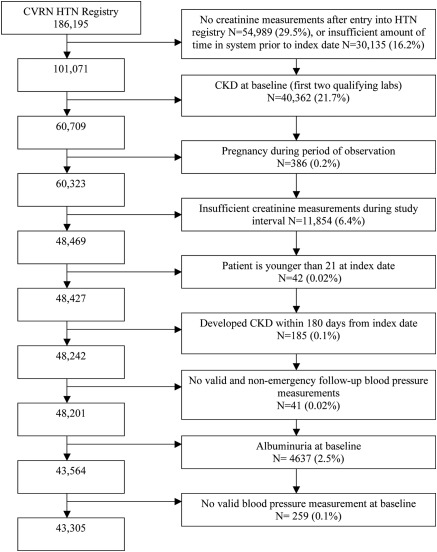
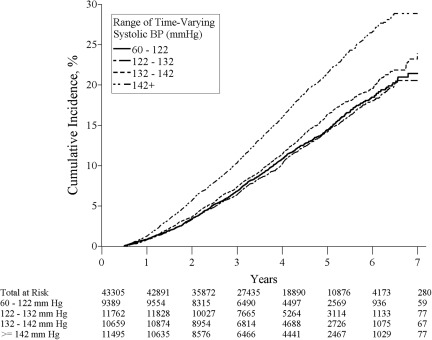
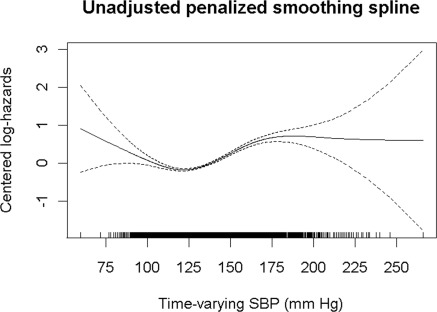
Results: Of 43,305 patients meeting the inclusion criteria, 12.1% (5236 patients) developed incident CKD. Diabetes was the strongest predictor of incident CKD (hazard ratio, 1.96; 95% confidence interval, 1.84 to 2.09) and was associated with the greatest rate of decline in eGFR (-2.2 ml/min per 1.73 m(2) per year). Time-varying systolic BP was associated with incident CKD with risk increasing above 120 mmHg; each 10-mmHg increase in baseline and time-varying systolic BP was associated with a 6% increase in the risk of developing CKD (hazard ratio, 1.06; 95% confidence interval, 1.04 to 1.08 for both). Time-weighted systolic BP was associated with a more rapid decline in eGFR of an additional 0.2 ml/min per 1.73 m(2) per year decline for every 10-mmHg increase in systolic BP.
Conclusions: We found that time-varying systolic BP was associated with incident CKD, with an increase in risk above a systolic BP of 120 mmHg among individuals with hypertension.
Figures
References
-
- Hajjar I, Kotchen TA: Trends in prevalence, awareness, treatment, and control of hypertension in the United States, 1988–2000. JAMA 290: 199–206, 2003 - PubMed
-
- U.S. Renal Data System, USRDS 2009 Annual Data Report: Atlas of Chronic Kidney Disease and End-Stage Renal Disease in the United States, National Institutes of Health, National Institute of Diabetes and Digestive and Kidney Diseases, Bethesda MD, 2009
-
- Coresh J, Selvin E, Stevens LA, Manzi J, Kusek JW, Eggers P, Van Lente F, Levey AS: Prevalence of chronic kidney disease in the United States. JAMA 298: 2038–2047, 2007 - PubMed
-
- Fox CS, Larson MG, Leip EP, Culleton B, Wilson PWF, Levy D: Predictors of new-onset kidney disease in a community-based population. JAMA 291: 844–850, 2004 - PubMed
Publication types
MeSH terms
Grants and funding
LinkOut - more resources
Full Text Sources
Medical
Research Materials
Miscellaneous