


A nationwide study of Campylobacter jejuni and Campylobacter coli bacteremia in Finland over a 10-year period, 1998-2007, with special reference to clinical characteristics and antimicrobial susceptibility
- PMID: 21921217
- PMCID: PMC3174097
- DOI: 10.1093/cid/cir509
A nationwide study of Campylobacter jejuni and Campylobacter coli bacteremia in Finland over a 10-year period, 1998-2007, with special reference to clinical characteristics and antimicrobial susceptibility
Abstract
Background: Campylobacter bacteremia is an uncommon condition, usually diagnosed in elderly and immunocompromised patients.
Methods: Blood culture isolates and clinical information were collected for patients with diagnoses of Campylobacter jejuni or Campylobacter coli bacteremia in Finland from 1998 through 2007. Bacterial species were identified by means of polymerase chain reaction analysis, and minimal inhibitory concentrations for ciprofloxacin, clindamycin, doxycycline, erythromycin, gentamicin, meropenem, and metronidazole were determined with an agar dilution method. Medical records and mortality data within 1 year after the bacteremic episode were reviewed.
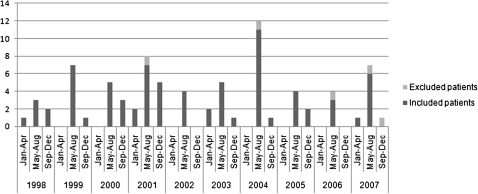
Results: The study included 76 patients (median age, 46 years), for whom bacterial isolates (C. jejuni in 73, C. coli in 3) and clinical information were available. Most patients (70%) had no significant underlying diseases. The majority (82%) of the isolates were susceptible for all antimicrobial agents tested. However, antimicrobial therapy seemed to have only a limited effect, because no differences could be detected between patients with appropriate empirical antimicrobial treatment and those with delayed appropriate, inappropriate, or no antimicrobial therapy, either in the duration of hospitalization (median, 4 days for both groups) or in attributable mortality. The outcome of the infection was severe in 4 patients infected with C. jejuni; 2 died within 30 days, spondylodiscitis developed in 1, and Guillain-Barré syndrome developed in 1.
Conclusions: C. jejuni and C. coli bacteremia occurred mainly in moderately young individuals without severe underlying diseases. The bacterial isolates were predominantly susceptible to antimicrobial agents, and the outcome of the disease was typically good, regardless of appropriate or inappropriate antimicrobial treatment given in the hospital.
Figures
References
-
- Blaser MJ. Epidemiologic and clinical features of Campylobacter jejuni infections. J Infect Dis. 1997;176:S103–5. - PubMed
-
- Rautelin H, Hänninen ML. Campylobacters: the most common bacterial enteropathogens in the Nordic countries. Ann Med. 2000;32:440–5. - PubMed
-
- European Food Safety Authority. The European Union summary report on trends and sources of zoonoses, zoonotic agents and food-borne outbreaks in 2009. Available at: http://www.efsa.europa.eu/en/efsajournal/pub/2090.htm. Accessed 28 March 2011. - PMC - PubMed
-
- Hannu T, Mattila L, Rautelin H, et al. Campylobacter-triggered reactive arthritis: a population-based study. Rheumatology. 2002;41:312–8. - PubMed
-
- McCarthy N, Giesecke J. Incidence of Guillain-Barré syndrome following infection with Campylobacter jejuni. Am J Epidemiol. 2001;153:610–4. - PubMed
Publication types
MeSH terms
Substances
LinkOut - more resources
Full Text Sources
Medical
Molecular Biology Databases
