. 2011 Oct 4;108(40):E784-93.
doi: 10.1073/pnas.1100060108. Epub 2011 Sep 15.

Timing molecular motion and production with a synthetic transcriptional clock

Affiliations

Timing molecular motion and production with a synthetic transcriptional clock

Elisa Franco et al. Proc Natl Acad Sci U S A. .

Abstract

The realization of artificial biochemical reaction networks with unique functionality is one of the main challenges for the development of synthetic biology. Due to the reduced number of components, biochemical circuits constructed in vitro promise to be more amenable to systematic design and quantitative assessment than circuits embedded within living organisms. To make good on that promise, effective methods for composing subsystems into larger systems are needed. Here we used an artificial biochemical oscillator based on in vitro transcription and RNA degradation reactions to drive a variety of "load" processes such as the operation of a DNA-based nanomechanical device ("DNA tweezers") or the production of a functional RNA molecule (an aptamer for malachite green). We implemented several mechanisms for coupling the load processes to the oscillator circuit and compared them based on how much the load affected the frequency and amplitude of the core oscillator, and how much of the load was effectively driven. Based on heuristic insights and computational modeling, an "insulator circuit" was developed, which strongly reduced the detrimental influence of the load on the oscillator circuit. Understanding how to design effective insulation between biochemical subsystems will be critical for the synthesis of larger and more complex systems.


Conflict of interest statement

The authors declare no conflict of interest.

Figures
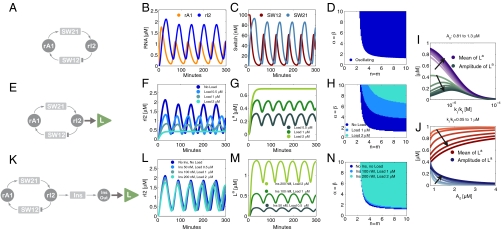
Fig. 1.
Fig. 1.
Circuits and simulations for a simple oscillator system coupled to a load. Unless otherwise noted, the parameters used for all simulations in Fig. 1 are: kp = 0.05/s, kd = 0.002/s, KA = KI = 0.5 μM, [SW21tot] = [SW12tot] = 100 nM, m = n = 5, τ = 500 s, kr = 0.006/s, kf = 7.9·103/M/s. For the insulating gene, the RNA output production rate is formula image, and the RNA degradation rate is formula image. The binding rates of the insulator RNA output and the load are chosen as formula image and formula image. (A): Diagram for the simple model for the oscillator. (B): Time traces for the oscillator species rA1 and rI2. (C): Time traces for the oscillator species SW12 and SW21. (D): Oscillatory domain of the simple model as a function of the nondimensional parameters α = β and m = n. (E): Oscillator scheme with consumptive load coupled to rI2. (F, G): Time traces for the oscillator and load for consumptive coupling on rI2. (H): The oscillatory domain shrinks as a function of [Ltot] for the consumptive coupling to rI2. (I): Mean and amplitude of the active load [La] as a function of the ratio of kr and kf, when the driving input is [rI2] = A0 + A1 sin ωt, with A0 varying between 0.81 (light color) and 1.3 μM, and A1 = .8 μM, ω = 0.001 rad/s. (J): Mean and amplitude of the active load signal [La] as a function of the baseline A0 for the input oscillating signal, for ratios kr/kf varying between 0.05 and 1 μM. For (I) and (J), [Ltot] = 1μM (K): Oscillator scheme with consumptive insulating circuit and consumptive load. (L, M): Time traces for the oscillator and load when the insulating genelet is used to amplify rI2. (N): The perturbation of the oscillatory domain is reduced by using a small amount of an additional genelet (insulator) that amplifies the oscillatory signal.
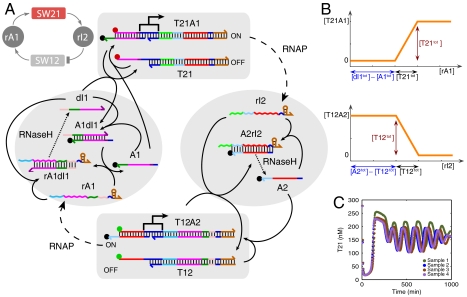
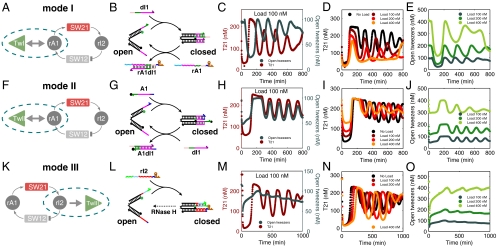
Fig. 2.
Fig. 2.
(A): Operation scheme of the transcriptional oscillator system. Colors indicate complementary DNA and RNA domains. Sequences are given in SI Appendix, Section 1. When switch SW21 is turned on, RNA polymerase (RNAP) transcribes regulatory RNA (rI2) from the genelet template T21. RNA strand rI2 inhibits transcription from switch SW12 by removal of DNA strand A2 from template T12, resulting in an incomplete promoter region. On the other hand, RNA species rA1, which is transcribed from SW12, activates transcription from SW21 by releasing A1 from the A1·dI1 complex. RNA levels in the system are controlled by RNase H-mediated RNA degradation. By fluorescently labeling strand T21 with Texas Red or TYE665 (red dot), strand T12 with TAMRA or TYE563 (green dot), and activation strands A1 and A2 with Iowa Black RQ quenchers (black dots), the genelet states can be monitored by fluorescence measurements—high signals correspond to low transcription activity. (B): Thresholds are set by adding threshold strands dI1 and A2 in excess over A1 and T12, respectively. In a typical experiment, the concentrations were [T21tot] = 250 nM, [A1tot] = 250 nM, [dI1tot] = 700 nM, [T12tot] = 120 nM, [A2tot] = 500 nM. (C): Oscillator traces showing T21 levels for typical oscillations obtained in several, separate experiments. Note the good reproducibility of the oscillations from trial to trial, although different enzyme batches yield somewhat different core oscillator behavior. T12 has lower amplitude oscillations and is not shown; see SI Appendix, Section 9.
Fig. 3.
Fig. 3.
Three different ways of coupling a load to the oscillator. (A): In the simple model scheme, mode I couples to the rA1 node. Dashed line encloses the subcircuit whose mechanistic details are provided to the right. (B): Molecularly, mode I uses dI1 to close the DNA tweezers, and rA1 to open them. (C): Oscillator traces (T21 levels) and mode I tweezers oscillations superimposed for a load of 100 nM tweezers. (D): Load dependence of the core oscillator (load 0–400 nM). (E): Corresponding oscillations of the tweezers load. (F): In the simple model scheme, mode II also couples to the rA1 node. (G): On the molecular level, mode II uses A1 to close the tweezers and dI1 to open them. (H): Oscillator traces and mode II tweezers oscillations superimposed for 100 nM load. (I, J): Oscillations of the core oscillator and the tweezers load for different load concentrations. (K): In the simple model, mode III couples to the rI2 node. (L): Mode III uses rI2 to close the tweezers and RNase H to open them. (M): Oscillator traces and mode III tweezers oscillations superimposed for 100 nM load. (N, O): Oscillations of the core oscillator and the mode III tweezers signal for different load concentrations.
Fig. 4.
Fig. 4.
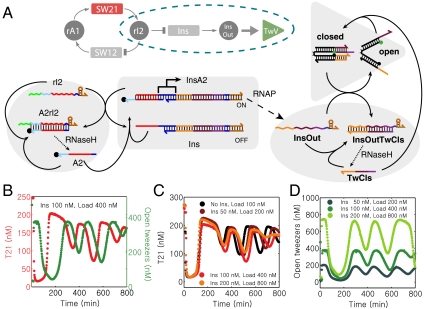
An insulator circuit (mode V coupling). (A): Insulator genelet Ins is operated in parallel with SW12. The genelet is activated by A2 and deactivated by rI2. Transcription of Ins results in RNA signal InsOut which opens tweezers previously closed by DNA strand TwCls. (“Load” for mode V is defined as closed tweezers with a 50 nM excess of TwCls, in contrast to modes I–IV where the load consists only of open tweezers.) The RNA part of hybrid duplex TwCls·InsOut is degraded by RNase H, resulting in free TwCls. This operation principle is analogous to mode I tweezers. (B): Oscillator (red) and tweezers (green) traces for 100 nM insulator genelet and 400 nM tweezers load. (C): Core-oscillator traces for 0 nM Ins and 100 nM tweezers load (black), and 200 nM (dark red), 400 nM (red), and 800 nM (orange) tweezers load and a 4∶1 ratio of tweezers:Ins. (D): Tweezers signal for 200 nM (dark green), 400 nM (green), and 800 nM (light green) tweezers load.
Fig. 5.
Fig. 5.
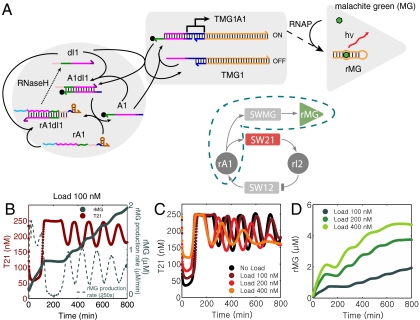
Clocked production of a MG aptamer. (A): Operation scheme of SWMG. SWMG is operated in parallel to switch SW21, but is used to produce a functional RNA molecule—the MG aptamer rMG—instead of regulatory RNA species rI2. When MG is bound to the aptamer, it becomes highly fluorescent. (B): The MG aptamer is not degraded by RNase H, and hence accumulates over time. The MG fluorescence signal grows whenever SW21 is on. Shown is the concentration of T21 (dark red) and MG aptamer (dark green) as well as the derivative of the MG signal at 100 nM SWMG concentration. (C): Oscillator time traces in the presence of 0 nM (black), 100 nM (dark red), 200 nM (red), 400 nM (orange) SWMG. (D): Corresponding fluorescence signals (converted to aptamer concentration) recorded from the MG aptamer.
Fig. 6.
Fig. 6.
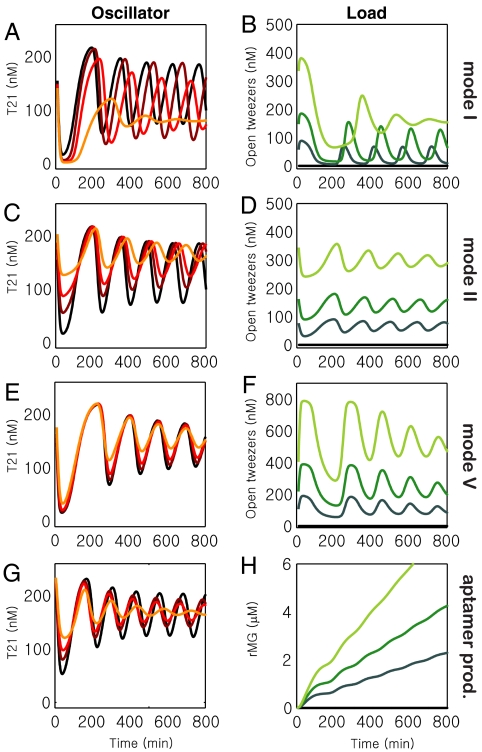
Simulations of the core oscillator and oscillator driven loads, using the mechanistic mass-action model described in the SI Appendix, Sections 24–33, for initial DNA concentrations identical to those in several experiments. (A, B): cf. Fig. 3 D and E. (C, D): cf. Fig. 3 I and J. (E, F): cf. Fig. 4 C and D. (G, H): cf. Fig. 5 C and D.
Fig. 7.
Fig. 7.
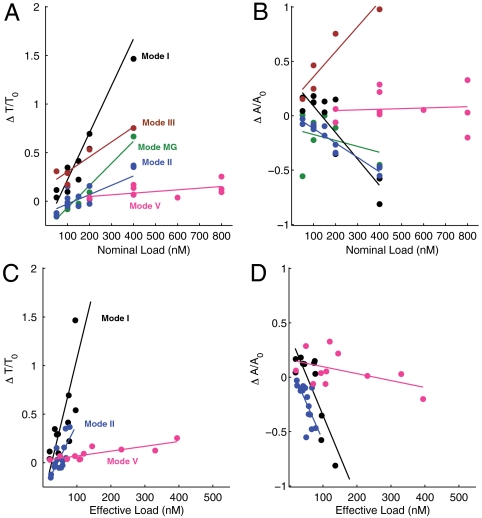
Analysis of the influence of load on the oscillation amplitude and period. (A, C): Relative period change as a function of the nominal (A) and effective (C) load concentrations. (B, D): Relative amplitude change as a function of the nominal (B) and effective (D) load concentrations. A complete overview of the effects of all coupling modes is found in the SI Appendix, Section 16.
Fig. P1.
Fig. P1.
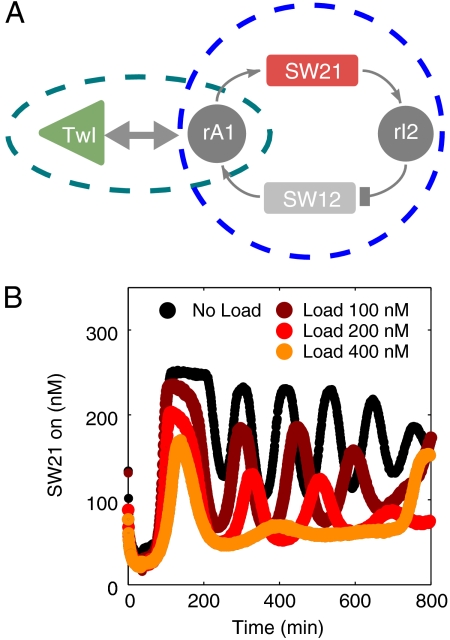
We coupled our synthetic transcriptional oscillator (3) to several nanodevices, evaluating different direct and insulated modes of interconnection. Here we show the results for one of the direct modes, where the load is represented by the DNA tweezers system (4). (A): Schematic representation of the system. The oscillator consists of two “genelets” SW12 and SW21 that are connected via inhibiting and activating RNA species rI2 and rA1. The DNA tweezers load (TwI) is coupled to the activation reaction branch of rA1. The blue dashed circle highlights the oscillator components; the green dashed circle highlights the load and the oscillator components driving it. (B): In this coupling mode, the performance of the core oscillator deteriorates for increasing load: no load (black), 100 nM (dark red), 200 nM (red), and 400 nM (orange) tweezers load.

References

    1. Winfree AT. The Geometry of Biological Time. New York, NY: Springer-Verlag; 1980.
    1. Atkinson MR, Savageau M, Myers J, Ninfa A. Development of genetic circuitry exhibiting toggle switch or oscillatory behavior in Escherichia coli. Cell. 2003;113:597–607. - PubMed
    1. Danino T, Mondragon-Palomino O, Tsimring L, Hasty J. A synchronized quorum of genetic clocks. Nature. 2010;463:326–330. - PMC - PubMed
    1. Elowitz MB, Leibler S. A synthetic oscillatory network of transcriptional regulators. Nature. 2000;403:335–338. - PubMed
    1. Fung E, et al. A synthetic gene-metabolic oscillator. Nature. 2005;435:118–122. - PubMed

Publication types

MeSH terms

LinkOut - more resources