


Phase separation in solutions of monoclonal antibodies and the effect of human serum albumin
- PMID: 21921237
- PMCID: PMC3189021
- DOI: 10.1073/pnas.1112241108
Phase separation in solutions of monoclonal antibodies and the effect of human serum albumin
Abstract
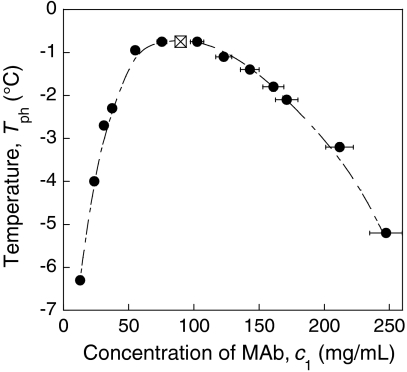
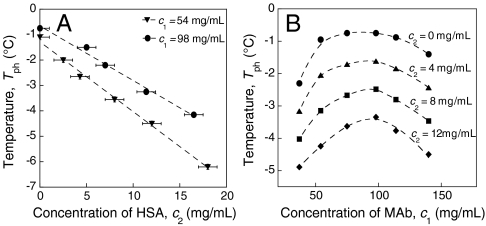
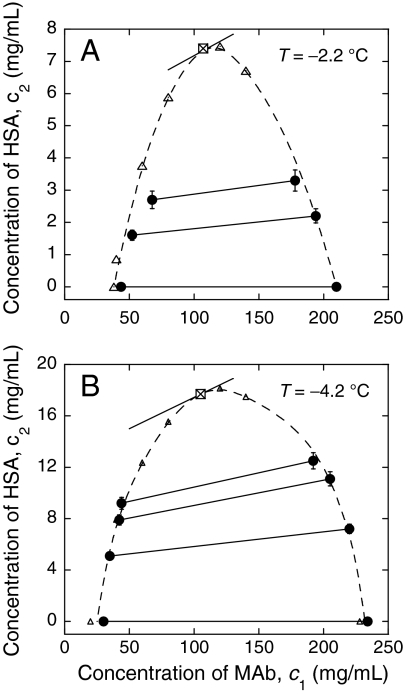
We report the observation of liquid-liquid phase separation in a solution of human monoclonal antibody, IgG2, and the effects of human serum albumin, a major blood protein, on this phase separation. We find a significant reduction of phase separation temperature in the presence of albumin, and a preferential partitioning of the albumin into the antibody-rich phase. We provide a general thermodynamic analysis of the antibody-albumin mixture phase diagram and relate its features to the magnitude of the effective interprotein interactions. Our analysis suggests that additives (HSA in this report), which have moderate attraction with antibody molecules, may be used to forestall undesirable protein condensation in antibody solutions. Our findings are relevant to understanding the stability of pharmaceutical solutions of antibodies and the mechanisms of cryoglobulinemia.
Conflict of interest statement
The authors declare no conflict of interest.
Figures
References
-
- An Z. Therapeutic monoclonal antibodies: from bench to clinic. Hoboken, NJ.: John Wiley & Sons; 2009.
-
- Shire SJ, Shahrokh Z, Liu J. Challenges in the development of high protein concentration formulations. In: Shire SJ, Gombotz W, Bechtold-Peters K, Andya J, editors. Current trends in monoclonal antibody development and manufacturing. New York: Springer; 2009. pp. 131–147.
-
- Wang W, Roberts CJ. Aggregation of therapeutic proteins. Hoboken, NJ: Wiley; 2010.
Publication types
MeSH terms
Substances
LinkOut - more resources
Full Text Sources
Other Literature Sources
