


The role of rice phenolics efflux transporter in solubilizing apoplasmic iron
- PMID: 21921697
- PMCID: PMC3256402
- DOI: 10.4161/psb.6.10.17694
The role of rice phenolics efflux transporter in solubilizing apoplasmic iron
Abstract
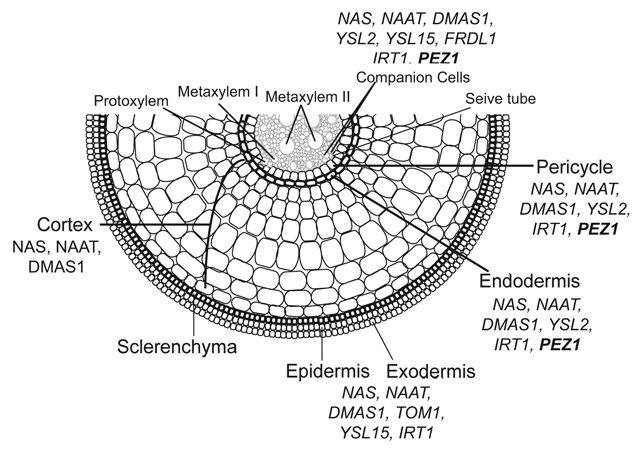
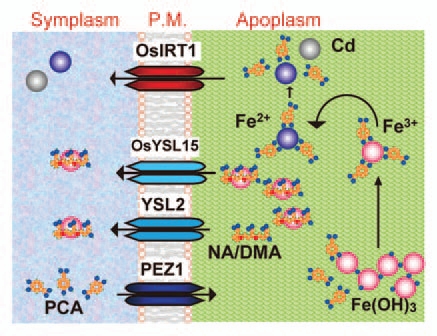
Iron (Fe) is an essential micronutrient for plants whose deficiency presents a major worldwide agricultural problem. Moreover, Fe is not easily available in neutral to alkaline soils, rendering plants deficient in Fe despite its abundance. Plants secrete phenolics, such as protocatechuic acid (PCA) and caffeic acid (CA), to take up and utilize apoplasmic precipitated Fe, but despite the rapid progress in understanding cellular and subcellular Fe transport, the molecular mechanisms of phenolics synthesis and secretion are not clear. Recently, we isolated and characterized a phenolics efflux transporter in rice by characterizing a mutant in which the amount of PCA and CA in the xylem sap was dramatically reduced, which we hence named phenolics efflux zero 1 (pez1). PEZ1 is a plasma membrane protein that transports PCA when expressed in Xenopus laevis oocytes, and characterization of PEZ1 knockdown and overexpressing plants revealed that it plays an essential role in solubilizing precipitated apoplasmic Fe. The identification of PEZ1 will increase our understanding of apoplasmic Fe solubilization as well as promote research on phenolics efflux mechanisms in different organisms.
Figures
Comment on
-
A rice phenolic efflux transporter is essential for solubilizing precipitated apoplasmic iron in the plant stele.J Biol Chem. 2011 Jul 15;286(28):24649-55. doi: 10.1074/jbc.M111.221168. Epub 2011 May 20. J Biol Chem. 2011. PMID: 21602276 Free PMC article.
References
-
- Marschner H. Mineral nutrition of higher plants. London: Academic Press; 1995.
-
- Jeong J, Guerinot ML. Homing in on iron homeostasis in plants. Trends Plant Sci. 2009;14:280–285. - PubMed
-
- Cesco S, Neumann G, Tomasi N, Pinton R, Weisskopf L. Release of plant-borne flavonoids into the rhizosphere and their role in plant nutrition. Plant Soil. 2010;329:1–25.
Publication types
MeSH terms
Substances
LinkOut - more resources
Full Text Sources
Medical
Miscellaneous
