


Review
doi: 10.1016/j.bbabio.2011.08.011.
Epub 2011 Sep 7.
Yeast cytochrome c oxidase: a model system to study mitochondrial forms of the haem-copper oxidase superfamily
Affiliations
- PMID: 21925484
- PMCID: PMC4671319
- DOI: 10.1016/j.bbabio.2011.08.011
Item in Clipboard
Review
Yeast cytochrome c oxidase: a model system to study mitochondrial forms of the haem-copper oxidase superfamily
Biochim Biophys Acta.
2012 Apr.
Abstract
The known subunits of yeast mitochondrial cytochrome c oxidase are reviewed. The structures of all eleven of its subunits are explored by building homology models based on the published structures of the homologous bovine subunits and similarities and differences are highlighted, particularly of the core functional subunit I. Yeast genetic techniques to enable introduction of mutations into the three core mitochondrially-encoded subunits are reviewed.
Copyright © 2011 Elsevier B.V. All rights reserved.
Figures
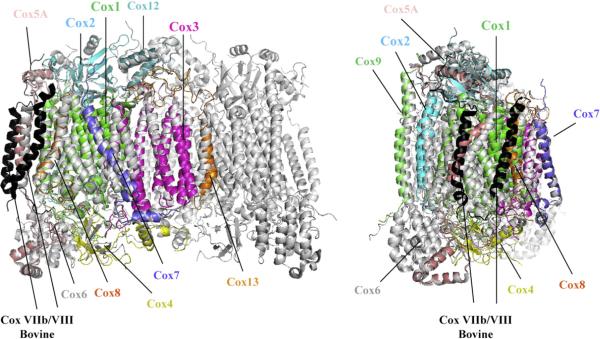
Superposition of homology models of the 11 subunits of yeast CcO on the dimeric bovine CcO structure. The whole, dimeric structure of bovine CcO (drawn from PDB ID: 1V54 [16]) is shown in light grey. Each of the eleven subunits of yeast CcO is modelled on its counterpart in one half of the bovine dimer only and is colour-coded to aid recognition. The two bovine subunits without homologues in yeast CcO are shown in black.
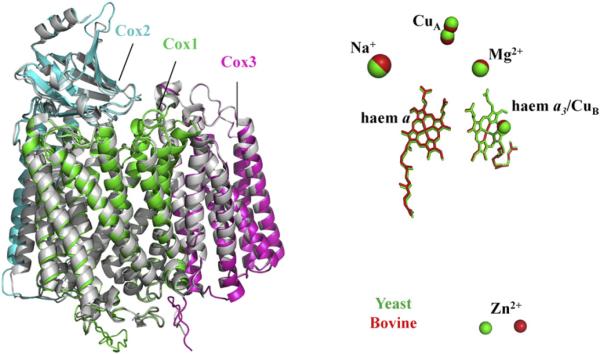
Superposition of models of the core subunits of yeast CcO on bovine CcO subunits. Colour-coding and source information are as for Fig. 1. The figure on the right shows an overlay of the positions of metal centres (see Section 5.3.1).
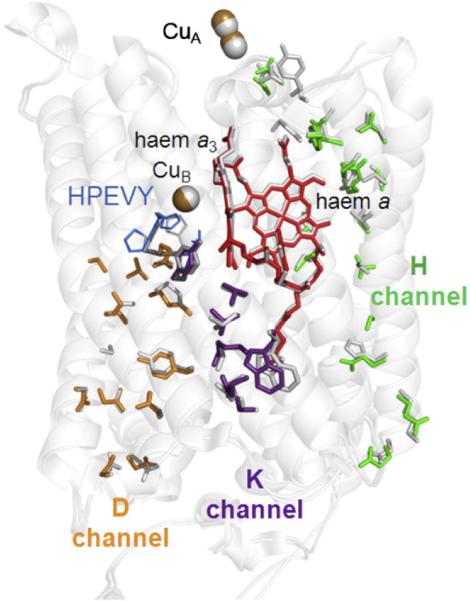
Buried hydrophilic amino acids in Cox1 and 2 of yeast CcO in comparison to the K, D and H channel residues in bovine subunit I. The yeast homology model (in colour) was superimposed onto bovine CcO (PDB ID: 1V54, white). Residues of the K channel (in purple) include: S256, Y245, T316 and K319 of Cox1 together with E82, W85 and T86 of Cox2. Residues of the D channel (in orange) include: N10, Y18, M72, N81, D92, N99, T154, S155, S157, S158, N164 and E243, all in Cox1. Residues of the H channel (in green) include: E407, Q411, Q413, S464, T462, S382, S458, S33, M428, S455, R37, N451, Y371, N56, S52 and N51 of Cox1.
References
-
- Rich PR, Maréchal A. The mitochondrial respiratory chain. Essays Biochem. 2010;47:1–23. - PubMed
-
- Daum G, Böhni PC, Schatz G. Import of proteins into mitochondria. Cytochrome b2 and cytochrome c peroxidase are located in the intermembrane space of yeast mitochondria. J. Biol. Chem. 1982;257:13028–13033. - PubMed
-
- Wikström M. Proton pump coupled to cytochrome c oxidase in mitochondria. Nature. 1977;266:271–273. - PubMed
-
- Kaila VRI, Verkhovsky MI, Wikström M. Proton-coupled electron transfer in cytochrome oxidase. Chem. Rev. 2010;110:7062–7081. - PubMed
Publication types
MeSH terms
Substances
Grants and funding
LinkOut - more resources
Full Text Sources
Molecular Biology Databases
