


Insulin sensitizers may attenuate lean mass loss in older men with diabetes
- PMID: 21926282
- PMCID: PMC3198278
- DOI: 10.2337/dc11-1032
Insulin sensitizers may attenuate lean mass loss in older men with diabetes
Abstract
Objective: To examine longitudinal changes in total and appendicular lean body mass in older men with impaired fasting glucose (IFG) or diabetes and to determine whether these changes differ by diabetes treatment.
Research design and methods: A total of 3,752 ambulatory men aged ≥ 65 years at baseline participated in a multicenter longitudinal cohort study. Baseline glycemic status was categorized as normoglycemia, IFG, undiagnosed/untreated diabetes, or treated diabetes. Insulin sensitizer medication use (metformin and/or thiazolidinediones) was assessed by prescription medication inventory. The change in total lean and appendicular lean mass was derived from dual X-ray absorptiometry scans taken at baseline and 3.5 ± 0.7 years later.
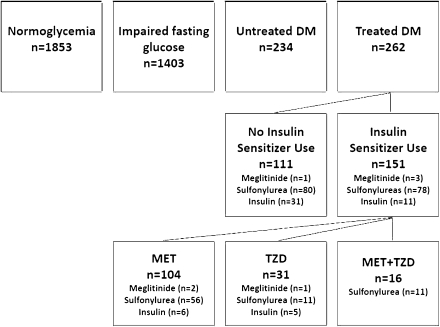
Results: This male cohort included 1,853 individuals with normoglycemia, 1,403 with IFG, 234 with untreated diabetes, 151 with diabetes treated with insulin sensitizers, and 111 with diabetes treated without insulin sensitizers. Men with untreated diabetes, diabetes treated without insulin sensitizers, or IFG had greater percentage loss in total or appendicular lean mass (P ≤ 0.05 in comparison to normoglycemic men). There remained a significantly greater percentage loss in appendicular lean mass for these groups even after adjustment for medical comorbidities or lifestyle factors. In contrast, the percentage loss in total or appendicular lean mass in men with diabetes treated with insulin sensitizers was significantly less than that in normoglycemic men in minimally and fully adjusted models.
Conclusions: Skeletal muscle loss was accelerated in men with IFG and diabetes, except when the latter was treated with insulin sensitizers. These findings suggest that insulin sensitizers may attenuate muscle loss.
Figures
References
-
- Visser M, Kritchevsky SB, Goodpaster BH, et al. Leg muscle mass and composition in relation to lower extremity performance in men and women aged 70 to 79: the health, aging and body composition study. J Am Geriatr Soc 2002;50:897–904 - PubMed
-
- Visser M, Goodpaster BH, Kritchevsky SB, et al. Muscle mass, muscle strength, and muscle fat infiltration as predictors of incident mobility limitations in well-functioning older persons. J Gerontol A Biol Sci Med Sci 2005;60:324–333 - PubMed
-
- Park SW, Goodpaster BH, Strotmeyer ES, et al. Accelerated loss of skeletal muscle strength in older adults with type 2 diabetes: the health, aging, and body composition study. Diabetes Care 2007;30:1507–1512 - PubMed
Publication types
MeSH terms
Substances
Grants and funding
- U01-AR45580/AR/NIAMS NIH HHS/United States
- K01-DK083029/DK/NIDDK NIH HHS/United States
- K12-HD043488-09/HD/NICHD NIH HHS/United States
- UL1-RR024140/RR/NCRR NIH HHS/United States
- U01 AR045614/AR/NIAMS NIH HHS/United States
- U01 AR045583/AR/NIAMS NIH HHS/United States
- U01-AR45647/AR/NIAMS NIH HHS/United States
- U01-AG18197/AG/NIA NIH HHS/United States
- U01 AR045647/AR/NIAMS NIH HHS/United States
- U01-AR45583/AR/NIAMS NIH HHS/United States
- U01 AR045632/AR/NIAMS NIH HHS/United States
- K01 DK083029/DK/NIDDK NIH HHS/United States
- U01-AR45654/AR/NIAMS NIH HHS/United States
- U01 AR045654/AR/NIAMS NIH HHS/United States
- U01-AR45632/AR/NIAMS NIH HHS/United States
- U01-AR45614/AR/NIAMS NIH HHS/United States
- U01-AG027810/AG/NIA NIH HHS/United States
- K12 HD043488/HD/NICHD NIH HHS/United States
- U01 AG027810/AG/NIA NIH HHS/United States
- UL1 RR024140/RR/NCRR NIH HHS/United States
- U01 AR045580/AR/NIAMS NIH HHS/United States
- U01 AG018197/AG/NIA NIH HHS/United States
LinkOut - more resources
Full Text Sources
Medical
