


Low serum 25-hydroxyvitamin D at critical care initiation is associated with increased mortality
- PMID: 21926604
- PMCID: PMC4427350
- DOI: 10.1097/CCM.0b013e31822d74f3
Low serum 25-hydroxyvitamin D at critical care initiation is associated with increased mortality
Abstract
Objective: We hypothesized that deficiency in 25-hydroxyvitamin D at critical care initiation would be associated with all-cause mortalities.
Design: Two-center observational study.
Setting: Two teaching hospitals in Boston, MA.
Patients: The study included 1,325 patients, age ≥ 18 yrs, in whom 25-hydroxyvitamin D was measured 7 days before or after critical care initiation between 1998 and 2009.
Measurements: 25-hydroxyvitamin D was categorized as deficiency in 25-hydroxyvitamin D (≤ 15 ng/mL), insufficiency (16-29 ng/mL), and sufficiency (≥ 30 ng/mL). Logistic regression examined death by days 30, 90, and 365 postcritical care initiation and in-hospital mortality. Adjusted odds ratios were estimated by multivariable logistic regression models.
Interventions: None.
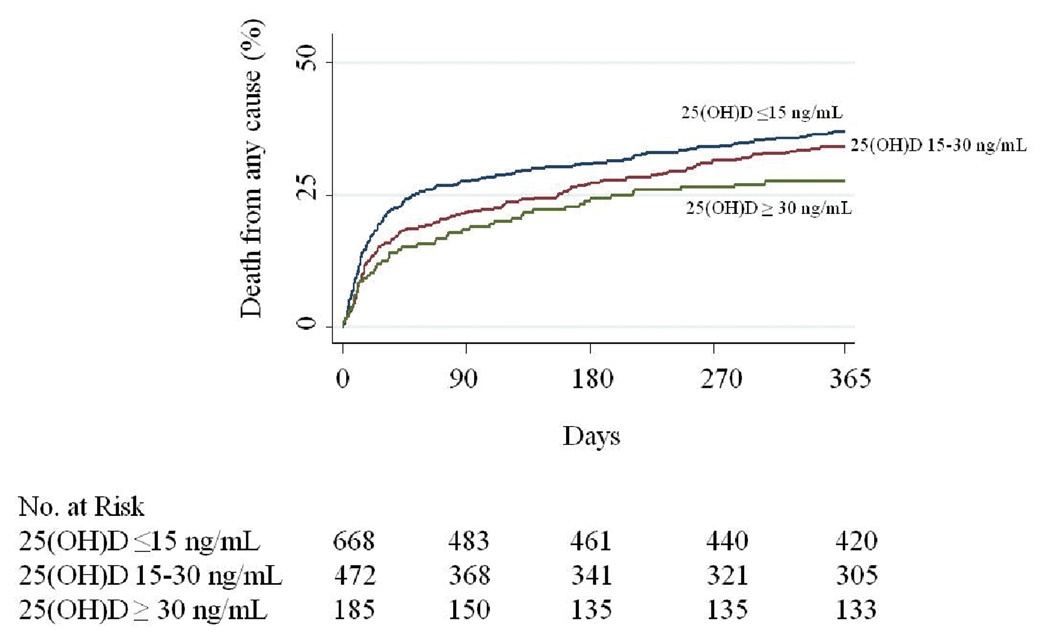
Key results: 25-hydroxyvitamin D deficiency is predictive for short-term and long-term mortality. Thirty days following critical care initiation, patients with 25-hydroxyvitamin D deficiency have an odds ratio for mortality of 1.85 (95% confidence interval 1.15-2.98; p = .01) relative to patients with 25-hydroxyvitamin D sufficiency. 25-hydroxyvitamin D deficiency remains a significant predictor of mortality at 30 days following critical care initiation following multivariable adjustment for age, gender, race, Deyo-Charlson index, sepsis, season, and surgical vs. medical patient type (adjusted odds ratio 1.94; 95% confidence interval 1.18-3.20; p = .01). Results were similarly significant at 90 and 365 days following critical care initiation and for in-hospital mortality. The association between vitamin D and mortality was not modified by sepsis, race, or neighborhood poverty rate, a proxy for socioeconomic status.
Conclusion: Deficiency of 25-hydroxyvitamin D at the time of critical care initiation is a significant predictor of all-cause patient mortality in a critically ill patient population.
Conflict of interest statement
The authors have not disclosed any potential conflicts of interest.
Figures
Comment in
-
The future of vitamin D's role in critical care.Crit Care Med. 2012 Jan;40(1):310-1. doi: 10.1097/CCM.0b013e31823729c1. Crit Care Med. 2012. PMID: 22179353 No abstract available.
-
Low-serum 25-hydroxyvitamin D reflects severity of illness in critically ill patients.Crit Care Med. 2012 Aug;40(8):2530; author reply 2530-2. doi: 10.1097/CCM.0b013e3182536a98. Crit Care Med. 2012. PMID: 22809939 No abstract available.
References
-
- Fraser DR. Regulation of the metabolism of vitamin D. Physiol Rev. 1980;60:551–613. - PubMed
-
- Raiten DJ, Picciano MF. Vitamin D and health in the 21st century: bone and beyond. Executive summary. Am J Clin Nutr. 2004;80:1673S–1677S. - PubMed
-
- Holick MF. Vitamin D: importance in the prevention of cancers, type 1 diabetes, heart disease, and osteoporosis. Am J Clin Nutr. 2004;79:362–371. - PubMed
-
- Teegarden D, Donkin SS. Vitamin D: emerging new roles in insulin sensitivity. Nutr Res Rev. 2009;22:82–92. - PubMed
-
- Autier P, Gandini S. Vitamin D supplementation and total mortality: a meta-analysis of randomized controlled trials. Arch Intern Med. 2007;167:1730–1737. - PubMed
Publication types
MeSH terms
Substances
Grants and funding
LinkOut - more resources
Full Text Sources
Medical
