


Review
doi: 10.1007/s00412-011-0342-9.
Epub 2011 Sep 17.
Safeguarding genetic information in Drosophila
Affiliations
- PMID: 21927823
- PMCID: PMC3247294
- DOI: 10.1007/s00412-011-0342-9
Item in Clipboard
Review
Safeguarding genetic information in Drosophila
Chromosoma.
2011 Dec.
Abstract
Eukaryotic cells employ a plethora of conserved proteins and mechanisms to ensure genome integrity. In metazoa, these mechanisms must operate in the context of organism development. This mini-review highlights two emerging features of DNA damage responses in Drosophila: a crosstalk between DNA damage responses and components of the spindle assembly checkpoint, and increasing evidence for the effect of DNA damage on the developmental program at multiple points during the Drosophila life cycle.
Figures
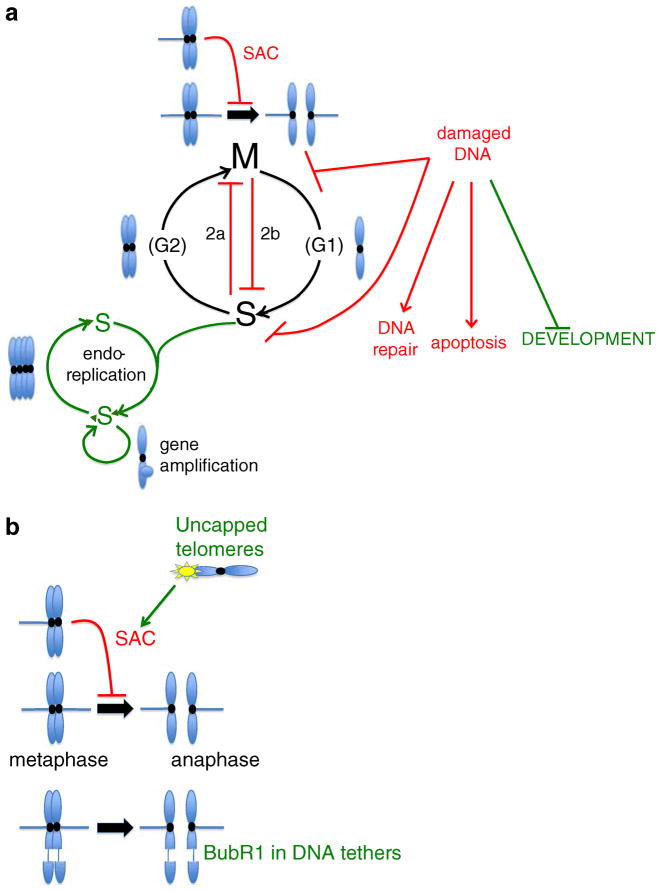
a The chromosome cycle and four rules that govern it to safeguard genetic integrity. During a canonical cell cycle, each molecule of chromosomal DNA is copied once and only once per S phase (rule 1). Ongoing S phase inhibits the start of M (2a). Likewise, cells in mitosis cannot initiate S until after protein degradation at exit from M (2b). Thus, S and M phases are mutually exclusive, and initiation of one requires the completion of the other. This ensures that S and M phases alternate (rule 2). G1 and G2 are in parentheses to indicate the fact that some cell cycles lack gap phases. The Spindle Assembly Checkpoint (SAC) ensures equal chromosome segregation in mitosis (rule 3) by inhibiting anaphase onset until all sister chromatids have achieved bipolar attachment. Cells respond to damaged DNA by arresting the cell cycle, activating DNA repair, or undergoing apoptosis (rule 4). In Drosophila (responses in green), gene amplification violates rule 1, while endoreplication cycles violate rule 2. Responses to DNA damage include the disruption of development at multiple points in the life cycle. b Crosstalk between DNA damage and SAC in Drosophila includes the delay in metaphase–anaphase transition in response to uncapped telomeres that operates through SAC proteins and the role of BubR1 in the formation of DNA tethers that help segregate acentric chromosome fragments
References
-
- Abdu U, Brodsky M, Schupbach T. Activation of a meiotic checkpoint during Drosophila oogenesis regulates the translation of Gurken through Chk2/Mnk. Curr Biol. 2002;12:1645–1651. - PubMed
-
- Beall EL, Manak JR, Zhou S, Bell M, Lipsick JS, Botchan MR. Role for a Drosophila Myb-containing protein complex in site-specific DNA replication. Nature. 2002;420:833–837. - PubMed
-
- Bosco G, Du W, Orr-Weaver TL. DNA replication control through interaction of E2F-RB and the origin recognition complex. Nat Cell Biol. 2001;3:289–295. - PubMed
-
- Branzei D, Foiani M. Maintaining genome stability at the replication fork. Nat Rev Mol Cell Biol. 2010;11:208–219. - PubMed
Publication types
MeSH terms
Substances
Grants and funding
LinkOut - more resources
Full Text Sources
Molecular Biology Databases
