


Interpreter perspectives of in-person, telephonic, and videoconferencing medical interpretation in clinical encounters
- PMID: 21930360
- PMCID: PMC4059012
- DOI: 10.1016/j.pec.2011.08.006
Interpreter perspectives of in-person, telephonic, and videoconferencing medical interpretation in clinical encounters
Abstract
Objective: To examine professional medical interpreters' perspectives of in-person and remote interpreting modalities.
Methods: Survey of interpreters at three medical centers assessing satisfaction with aspects of communication using each modality, and adequacy of videoconferencing medical interpretation (VMI) and telephonic interpretation for 21 common clinical scenarios in the hospital and ambulatory care settings.
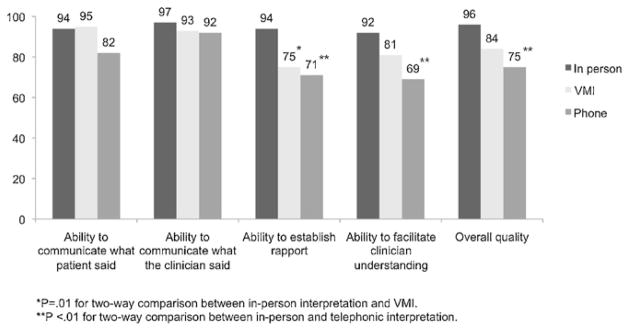
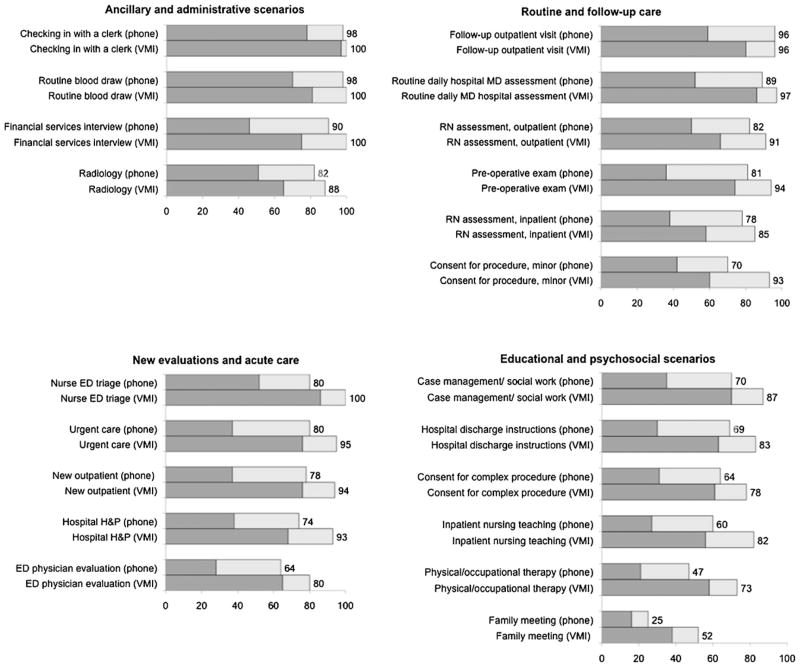
Results: 52 interpreters completed the survey (73% response). All modalities were equally satisfactory for conveying information. Respondents favored in-person to telephonic interpretation for establishing rapport (95% versus 71%, p=.002) and for facilitating clinician understanding of patients' social and cultural backgrounds (92% versus 69%, p=.002). Scenarios with substantial educational or psychosocial dimensions had no more than 70% of respondents rating telephonic interpretation as adequate (25-70%); for all of these scenarios, VMI represented an improvement (52-87%).
Conclusion: From the interpreter perspective, telephonic interpretation is satisfactory for information exchange, but less so for interpersonal aspects of communication. In scenarios where telephonic interpretation does not suffice, particularly those with substantial educational or psychosocial components, VMI offers improved communication.
Practice implications: Differences in interpreters' perspectives of modalities based on communication needs and clinical scenario suggest mixed use of multiple modalities may be the best language access strategy.
Copyright © 2011 Elsevier Ireland Ltd. All rights reserved.
Conflict of interest statement
None.
Figures
References
-
- 2006–008 American Community Survey 3-Year Estimates. U.S. Census Bureau; 2008. [Accessed September 3, 2010]. 2010, at http://factfinder.census.gov/servlet/STTable?_bm=y&-geo_id=01000US&-qr_n....
-
- Shin H, Bruno R. Language Use and English-Speaking Ability: 2000. U.S. Census Bureau; 2003. Oct,
-
- Fiscella K, Shin P. The inverse care law: implications for healthcare of vulnerable populations. J Ambul Care Manage. 2005;28:304–12. - PubMed
Publication types
MeSH terms
Grants and funding
LinkOut - more resources
Full Text Sources
