Persistence of leukemia stem cells in chronic myelogenous leukemia patients in prolonged remission with imatinib treatment
- PMID: 21931114
- PMCID: PMC3217358
- DOI: 10.1182/blood-2010-12-327437
Persistence of leukemia stem cells in chronic myelogenous leukemia patients in prolonged remission with imatinib treatment
Abstract
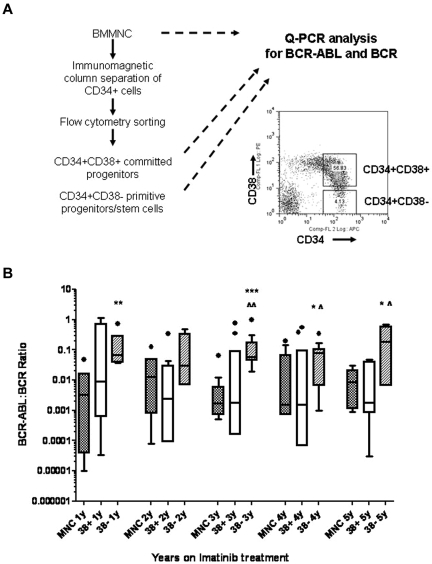
Imatinib mesylate treatment markedly reduces the burden of leukemia cells in chronic myelogenous leukemia (CML) patients. However, patients remain at risk for relapse on discontinuing treatment. We have previously shown that residual BCR-ABL(+) progenitors can be detected in CML patients within the first 2 years of imatinib treatment. However, reduced rates of relapse and continued decline of BCR-ABL levels with prolonged treatment, together with the ability of selected patients to maintain remission after discontinuing treatment, led us to investigate whether prolonged imatinib exposure resulted in reduction or elimination of BCR-ABL(+) stem cells. We evaluated BCR-ABL expression in CD34(+)CD38(+) (38(+)) committed progenitors and CD34(+)CD38(-) (38(-)) stem/primitive progenitor cells in samples from CML patients on imatinib treatment for at least 4 years with cytogenetic and molecular response. High levels of BCR-ABL expression were maintained over time in the 38(-) stem cell fraction. The absolute frequency of BCR-ABL(+) cells as determined by limiting dilution analysis was consistently higher in 38(-) compared with 38(+) cells. Transplantation into NOD/SCID-IL2Rγ-chain knockout mice demonstrated that BCR-ABL(+) cells had long-term in vivo repopulating capacity. These results directly demonstrate that BCR-ABL(+) stem cells persist in CML patients despite prolonged treatment with imatinib, and support ongoing efforts to target this population.
Figures



References
-
- Sawyers CL. Chronic myeloid leukemia. N Engl J Med. 1999;340(17):1330–1340. - PubMed
-
- Hughes TP, Kaeda J, Branford S, et al. Frequency of major molecular responses to imatinib or interferon alfa plus cytarabine in newly diagnosed chronic myeloid leukemia. N Engl J Med. 2003;349(15):1423–1432. - PubMed
-
- Bhatia R, Holtz M, Niu N, et al. Persistence of malignant hematopoietic progenitors in chronic myelogenous leukemia patients in complete cytogenetic remission following imatinib mesylate treatment. Blood. 2003;101(12):4701–4707. - PubMed
-
- Michor F, Hughes TP, Iwasa Y, et al. Dynamics of chronic myeloid leukaemia. Nature. 2005;435(7046):1267–1270. - PubMed
-
- Roeder I, Horn M, Glauche I, Hochhaus A, Mueller MC, Loeffler M. Dynamic modeling of imatinib-treated chronic myeloid leukemia: functional insights and clinical implications. Nat Med. 2006;12(10):1181–1184. - PubMed
Publication types
MeSH terms
Substances
Grants and funding
LinkOut - more resources
Full Text Sources
Other Literature Sources
Medical
Research Materials
Miscellaneous