Two-photon excited UV fluorescence for protein crystal detection
- PMID: 21931215
- PMCID: PMC3176620
- DOI: 10.1107/S0907444911028253
Two-photon excited UV fluorescence for protein crystal detection
Abstract
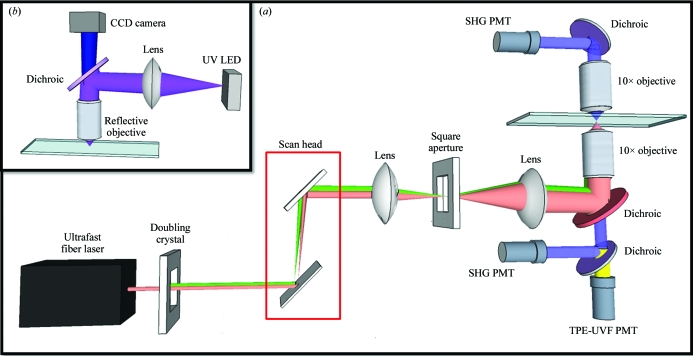
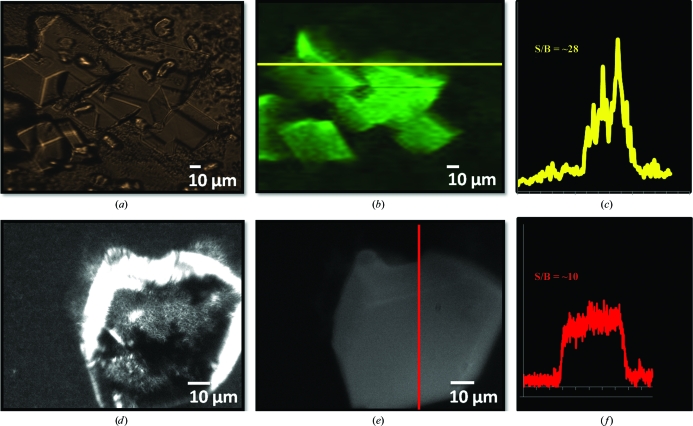
Two-photon excited ultraviolet fluorescence (TPE-UVF) microscopy is explored for sensitive protein-crystal detection as a complement to second-order nonlinear optical imaging of chiral crystals (SONICC). Like conventional ultraviolet fluorescence (UVF), TPE-UVF generates image contrast based on the intrinsic fluorescence of aromatic residues, generally producing higher fluorescence emission within crystals than the mother liquor by nature of the higher local protein concentration. However, TPE-UVF has several advantages over conventional UVF, including (i) insensitivity to optical scattering, allowing imaging in turbid matrices, (ii) direct compatibility with conventional optical plates and windows by using visible light for excitation, (iii) elimination of potentially damaging out-of-plane UV excitation, (iv) improved signal to noise through background reduction from out-of-plane excitation and (v) relatively simple integration into instrumentation developed for SONICC.
Figures
References
-
- Andrey, P., Lavault, B., Cipriani, F. & Maurin, Y. (2004). J. Appl. Cryst. 37, 265–269.
-
- Beaurepaire, E., Oheim, M. & Mertz, J. (2001). Opt. Commun. 188, 25–29.
-
- Beechem, J. M. & Brand, L. (1985). Annu. Rev. Biochem. 54, 43–71. - PubMed
-
- Bern, M., Goldberg, D., Stevens, R. C. & Kuhn, P. (2004). J. Appl. Cryst. 37, 279–287.
Publication types
MeSH terms
Substances
Grants and funding
LinkOut - more resources
Full Text Sources
Other Literature Sources