. 2012 Oct;17(10):996-1006.
doi: 10.1038/mp.2011.117. Epub 2011 Sep 20.

Functional gene group analysis identifies synaptic gene groups as risk factor for schizophrenia

Affiliations
Free PMC article

Functional gene group analysis identifies synaptic gene groups as risk factor for schizophrenia

E S Lips et al. Mol Psychiatry. 2012 Oct.
Free PMC article

Abstract

Schizophrenia is a highly heritable disorder with a polygenic pattern of inheritance and a population prevalence of ~1%. Previous studies have implicated synaptic dysfunction in schizophrenia. We tested the accumulated association of genetic variants in expert-curated synaptic gene groups with schizophrenia in 4673 cases and 4965 healthy controls, using functional gene group analysis. Identifying groups of genes with similar cellular function rather than genes in isolation may have clinical implications for finding additional drug targets. We found that a group of 1026 synaptic genes was significantly associated with the risk of schizophrenia (P=7.6 × 10(-11)) and more strongly associated than 100 randomly drawn, matched control groups of genetic variants (P<0.01). Subsequent analysis of synaptic subgroups suggested that the strongest association signals are derived from three synaptic gene groups: intracellular signal transduction (P=2.0 × 10(-4)), excitability (P=9.0 × 10(-4)) and cell adhesion and trans-synaptic signaling (P=2.4 × 10(-3)). These results are consistent with a role of synaptic dysfunction in schizophrenia and imply that impaired intracellular signal transduction in synapses, synaptic excitability and cell adhesion and trans-synaptic signaling play a role in the pathology of schizophrenia.


Figures
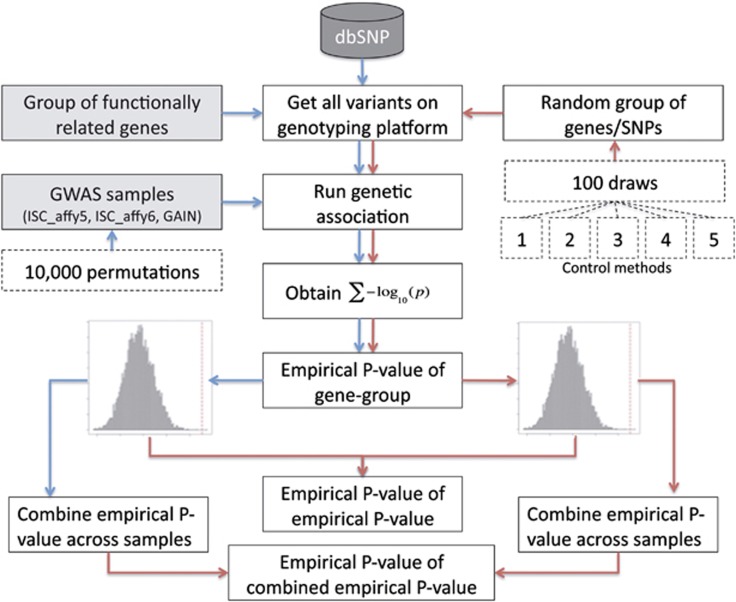
Figure 1
Figure 1
Overview of steps in data analysis. The arrows in red represent the flow for the real data whereas the blue arrows represent the flow for the control methods.
Figure 2
Figure 2
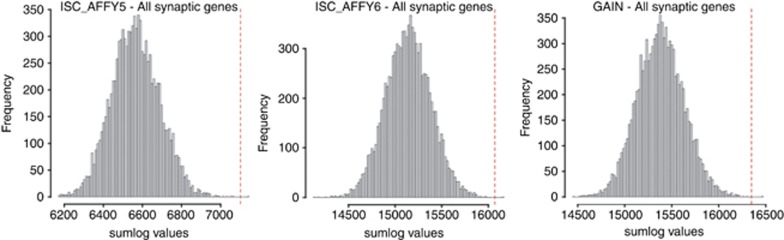
Empirical distribution under the null hypothesis of no association between any single-nucleotide polymorphism (SNP) and the risk of schizophrenia. The Σ-log(P) obtained in the original analysis of all synaptic genes is indicated in red.
Figure 3
Figure 3
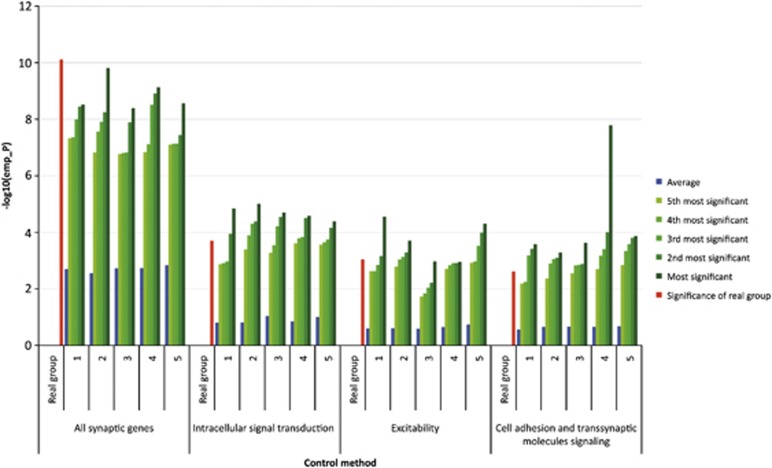
Overview of combined empirical P-values from the total group of synaptic genes and the three subgroups that were significant after correction for multiple testing, obtained from the analysis based on the actual functional gene groups (‘real', red bars), the five most significant results from the 100 draws for each control method (green bars) as well as the average combined empirical P-value (blue bars) obtained from five control methods across 100 draws. Note that the combined empirical P-values for the real group analysis as well as those for each of the 100 draws in 5 control methods are obtained from 10 000 permutations of the data and are the combined P-values across the three samples. For the ‘all synaptic genes' group, none of the control methods resulted in a lower P-value than the real analysis (that is, all empirical P-values of the empirical P-values <0.01), for the intracellular signal transduction group, control methods 1, 2, 3, 4, 5 resulted in empirical P-values of the empirical P-values of 0.02, 0.04, 0.03, 0.04 and 0.03 respectively. For Excitability, this was 0.02, 0.03, <0.01, <0.01 and 0.03, respectively, and for cell adhesion and trans-synaptic molecules signaling this was 0.03, 0.04, 0.04, 0.06 and 0.05, respectively. For description of competitive control methods and different null hypotheses tested we refer to Table 1.

References

    1. Andreasen NC. Symptoms, signs, and diagnosis of schizophrenia. Lancet. 1995;346:477–481. - PubMed
    1. Mowry BJ, Holmans PA, Pulver AE, Gejman PV, Riley B, Williams NM, et al. Multicenter linkage study of schizophrenia loci on chromosome 22q. Mol Psychiatry. 2004;9:784–795. - PubMed
    1. Sullivan PF, Kendler KS, Neale MC. Schizophrenia as a complex trait: evidence from a meta-analysis of twin studies. Arch Gen Psychiatry. 2003;60:1187–1192. - PubMed
    1. Purcell SM, Wray NR, Stone JL, Visscher PM, O'Donovan MC, Sullivan PF, et al. Common polygenic variation contributes to risk of schizophrenia and bipolar disorder. Nature. 2009;460:748–752. - PMC - PubMed
    1. Shi J, Levinson DF, Duan J, Sanders AR, Zheng Y, Pe'er I, et al. Common variants on chromosome 6p22.1 are associated with schizophrenia. Nature. 2009;460:753–757. - PMC - PubMed

Publication types

MeSH terms

Substances