


Family-based behavioural treatment of childhood obesity in a UK National Health Service setting: randomized controlled trial
- PMID: 21931327
- PMCID: PMC3272466
- DOI: 10.1038/ijo.2011.182
Family-based behavioural treatment of childhood obesity in a UK National Health Service setting: randomized controlled trial
Abstract
Background: The best outcomes for treating childhood obesity have come from comprehensive family-based programmes. However there are questions over their generalizability.
Objective: To examine the acceptability and effectiveness of 'family-based behavioural treatment' (FBBT) for childhood obesity in an ethnically and socially diverse sample of families in a UK National Health Service (NHS) setting.
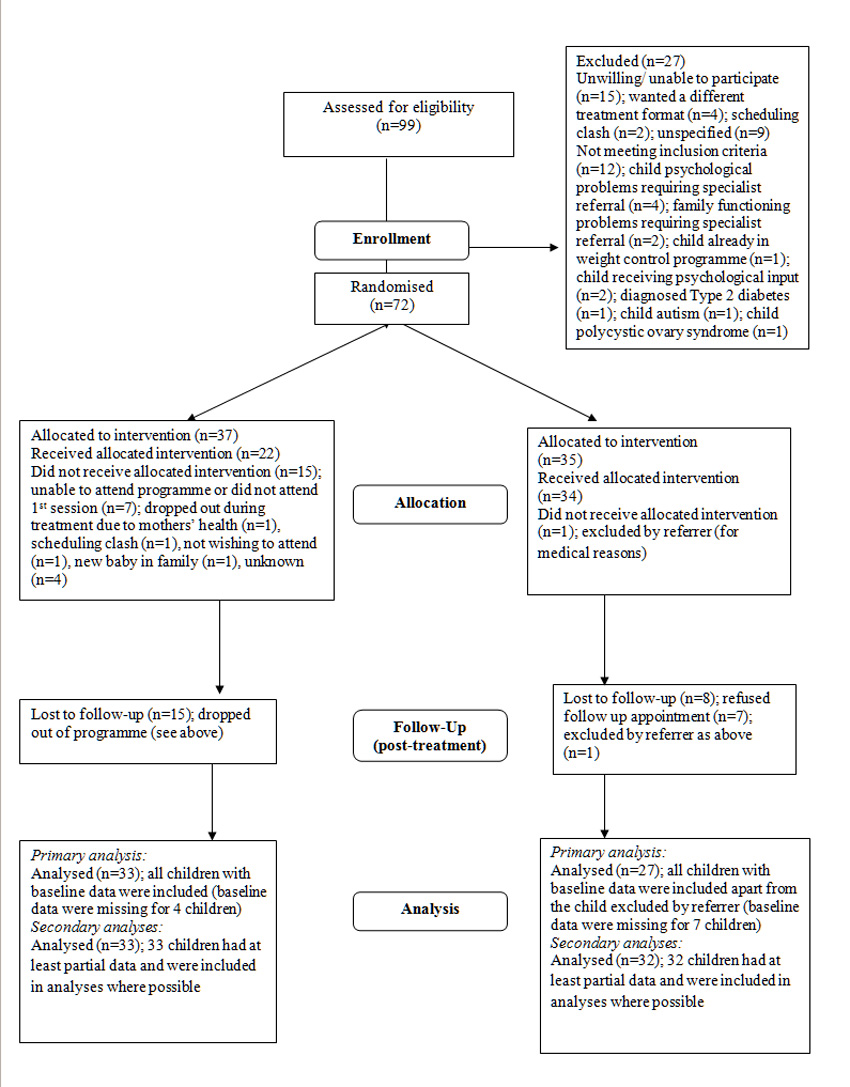
Methods: In this parallel group, randomized controlled trial, 72 obese children were randomized to FBBT or a waiting-list control. Primary outcomes were body mass index (BMI) and BMI s.d. scores (SDSs). Secondary outcomes were weight, weight SDSs, height, height SDSs, waist, waist SDSs, FM index, FFM index, blood pressure (BP) and psychosocial measures. The outcomes were assessed at baseline and after treatment, with analyses of 6-month data performed on an intent-to-treat (ITT) basis. Follow-up anthropometric data were collected at 12 months for the treatment group.
Results: ITT analyses included all children with baseline data (n=60). There were significant BMI SDS changes (P<0.01) for the treatment and control groups of -0.11 (0.16) and -0.10 (1.6). The treatment group showed a significant reduction in systolic BP (-0.24 (0.7), P<0.05) and improvements in quality of life and eating attitudes (P<0.05), with no significant changes for the control group. However the between-group treatment effects for BMI, body composition, BP and psychosocial outcomes were not significant. There was no overall change in BMI or BMI SDSs from 0-12 months for the treatment group. No adverse effects were reported.
Conclusions: Both treatment and control groups experienced significant reductions in the level of overweight, but with no significant difference between them. There were no significant group differences for any of the secondary outcomes. This trial was registered at http://www.controlled-trials.com/ under ISRCTN 51382628.
References
-
- Griffiths LJ, Parsons TJ, Hill AJ. Self-esteem and quality of life in obese children and adolescents: A systematic review. Int J Pediatr Obes. 2010;5:282–304. (2010) - PubMed
-
- Singh AS, Mulder C, Twisk JWR, van Mechelen W, Chinapaw MJM. Tracking of childhood overweight into adulthood: a systematic review of the literature. Obes Rev. 2008;9:474–488. - PubMed
-
- The NHS Information Centre Health Survey for England- 2008 trend tables. 2009 available at www.ic.nhs.uk/pubs/hse08trends.
Publication types
MeSH terms
Associated data
Grants and funding
LinkOut - more resources
Full Text Sources
Medical
