Active control of acoustic field-of-view in a biosonar system
- PMID: 21931535
- PMCID: PMC3172196
- DOI: 10.1371/journal.pbio.1001150
Active control of acoustic field-of-view in a biosonar system
Abstract
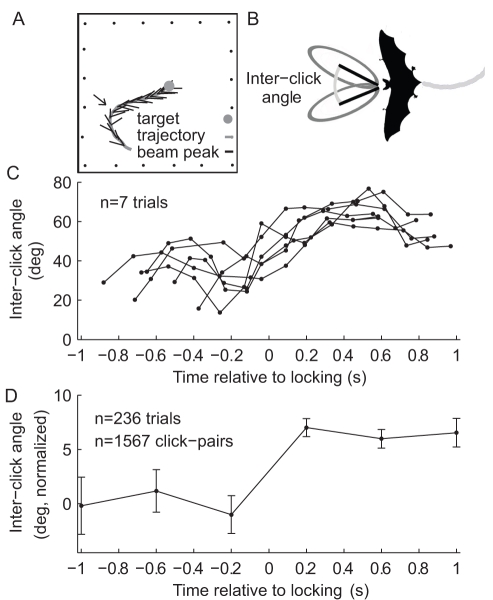
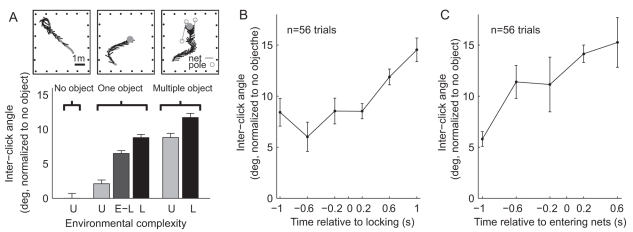
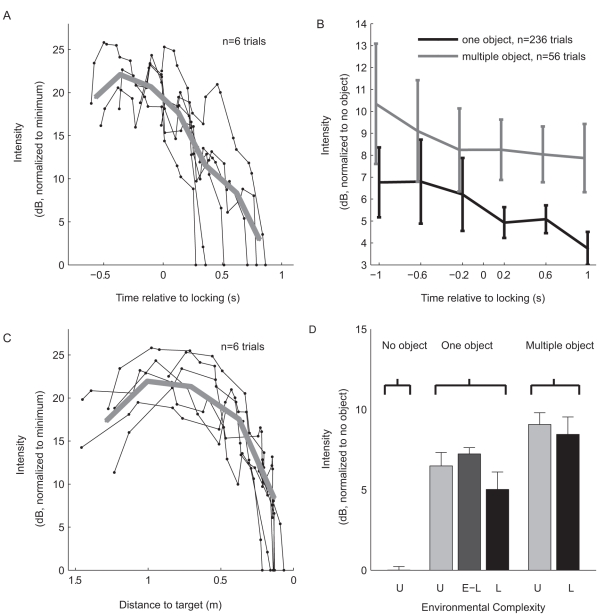
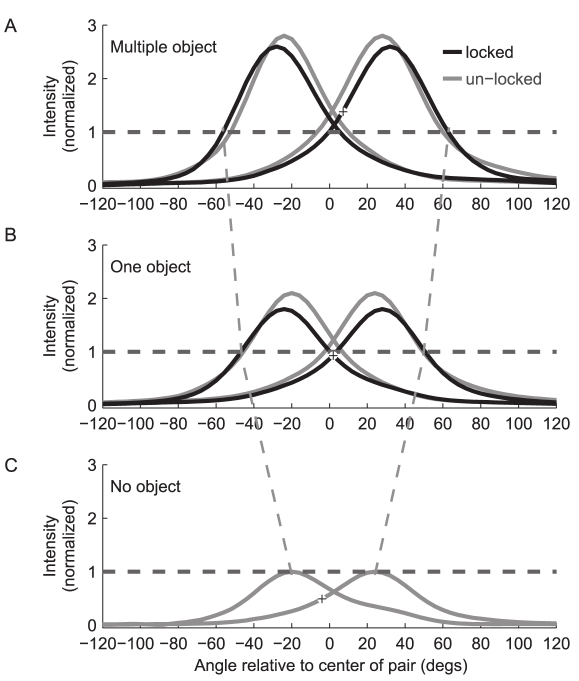
Active-sensing systems abound in nature, but little is known about systematic strategies that are used by these systems to scan the environment. Here, we addressed this question by studying echolocating bats, animals that have the ability to point their biosonar beam to a confined region of space. We trained Egyptian fruit bats to land on a target, under conditions of varying levels of environmental complexity, and measured their echolocation and flight behavior. The bats modulated the intensity of their biosonar emissions, and the spatial region they sampled, in a task-dependant manner. We report here that Egyptian fruit bats selectively change the emission intensity and the angle between the beam axes of sequentially emitted clicks, according to the distance to the target, and depending on the level of environmental complexity. In so doing, they effectively adjusted the spatial sector sampled by a pair of clicks-the "field-of-view." We suggest that the exact point within the beam that is directed towards an object (e.g., the beam's peak, maximal slope, etc.) is influenced by three competing task demands: detection, localization, and angular scanning-where the third factor is modulated by field-of-view. Our results suggest that lingual echolocation (based on tongue clicks) is in fact much more sophisticated than previously believed. They also reveal a new parameter under active control in animal sonar-the angle between consecutive beams. Our findings suggest that acoustic scanning of space by mammals is highly flexible and modulated much more selectively than previously recognized.
Conflict of interest statement
The authors have declared that no competing interests exist.
Figures
Comment in
-
Bats broaden sonar field of view to maneuver around obstacles.PLoS Biol. 2011 Sep;9(9):e1001147. doi: 10.1371/journal.pbio.1001147. Epub 2011 Sep 13. PLoS Biol. 2011. PMID: 21931532 Free PMC article. No abstract available.
References
-
- Kleinfeld D, Ahissar E, Diamond M. E. Active sensation: insights from the rodent vibrissa sensorimotor system. Curr Opin Neurobiol. 2006;16:435–444. - PubMed
-
- Catania K. C. Olfaction: underwater ‘sniffing’ by semi-aquatic mammals. Nature. 2006;444:1024–1025. - PubMed
-
- Porter J, Craven B, Khan R. M, Chang S. J, Kang I, et al. Mechanisms of scent-tracking in humans. Nat Neurosci. 2007;10:27–29. - PubMed
-
- Nelson M. E, MacIver M. A. Sensory acquisition in active sensing systems. J Comp Physiol A. 2006;192:573–586. - PubMed
-
- Au W. W, Benoit-Bird K. J. Automatic gain control in the echolocation system of dolphins. Nature. 2003;423:861–863. - PubMed
Publication types
MeSH terms
LinkOut - more resources
Full Text Sources