Efficacy of synaptic inhibition depends on multiple, dynamically interacting mechanisms implicated in chloride homeostasis
- PMID: 21931544
- PMCID: PMC3169517
- DOI: 10.1371/journal.pcbi.1002149
Efficacy of synaptic inhibition depends on multiple, dynamically interacting mechanisms implicated in chloride homeostasis
Abstract
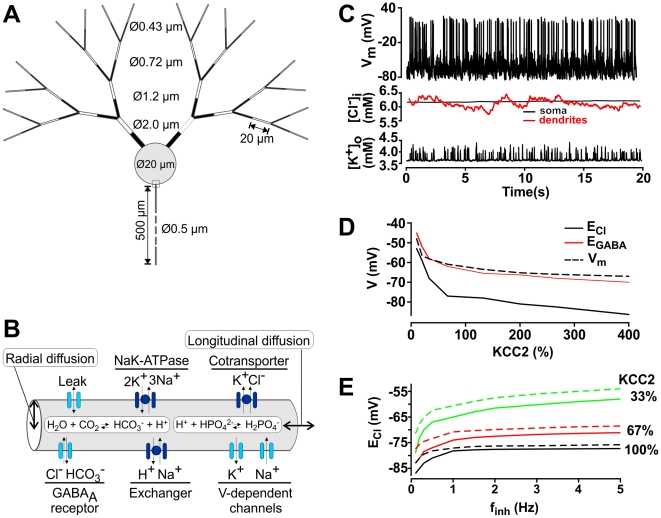
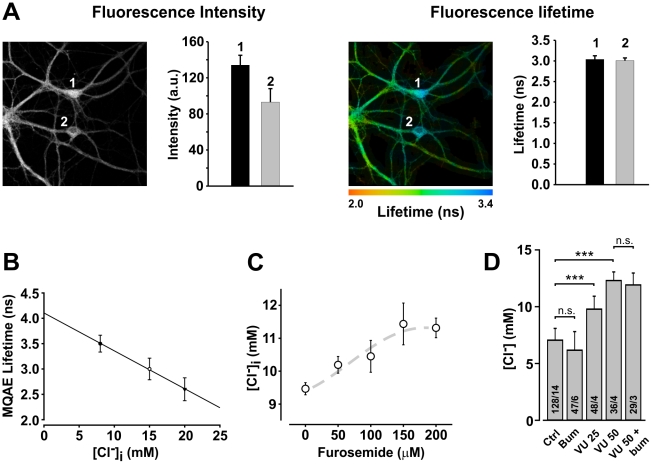
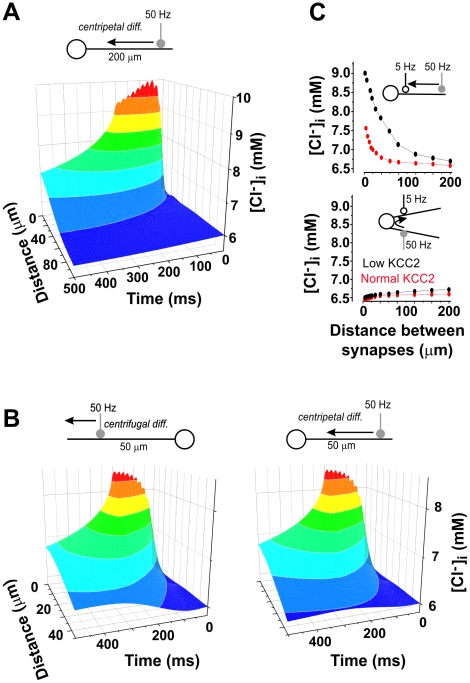
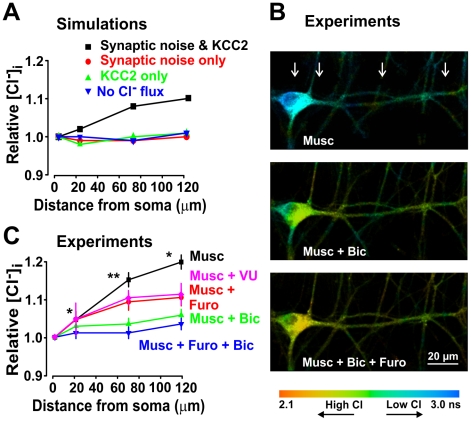
Chloride homeostasis is a critical determinant of the strength and robustness of inhibition mediated by GABA(A) receptors (GABA(A)Rs). The impact of changes in steady state Cl(-) gradient is relatively straightforward to understand, but how dynamic interplay between Cl(-) influx, diffusion, extrusion and interaction with other ion species affects synaptic signaling remains uncertain. Here we used electrodiffusion modeling to investigate the nonlinear interactions between these processes. Results demonstrate that diffusion is crucial for redistributing intracellular Cl(-) load on a fast time scale, whereas Cl(-)extrusion controls steady state levels. Interaction between diffusion and extrusion can result in a somato-dendritic Cl(-) gradient even when KCC2 is distributed uniformly across the cell. Reducing KCC2 activity led to decreased efficacy of GABA(A)R-mediated inhibition, but increasing GABA(A)R input failed to fully compensate for this form of disinhibition because of activity-dependent accumulation of Cl(-). Furthermore, if spiking persisted despite the presence of GABA(A)R input, Cl(-) accumulation became accelerated because of the large Cl(-) driving force that occurs during spikes. The resulting positive feedback loop caused catastrophic failure of inhibition. Simulations also revealed other feedback loops, such as competition between Cl(-) and pH regulation. Several model predictions were tested and confirmed by [Cl(-)](i) imaging experiments. Our study has thus uncovered how Cl(-) regulation depends on a multiplicity of dynamically interacting mechanisms. Furthermore, the model revealed that enhancing KCC2 activity beyond normal levels did not negatively impact firing frequency or cause overt extracellular K(-) accumulation, demonstrating that enhancing KCC2 activity is a valid strategy for therapeutic intervention.
Conflict of interest statement
The authors have declared that no competing interests exist.
Figures
References
-
- Hausser M, Major G, Stuart GJ. Differential shunting of EPSPs by action potentials. Science. 2001;291:138–141. - PubMed
-
- Staley KJ, Soldo BL, Proctor WR. Ionic mechanisms of neuronal excitation by inhibitory GABAA receptors. Science. 1995;269:977–981. - PubMed
-
- Kaila K, Voipio J. Postsynaptic Fall in intracellular pH induced by GABA-activated bicarbonate Cconductance. Nature. 1987;330:163–165. - PubMed
Publication types
MeSH terms
Substances
Grants and funding
LinkOut - more resources
Full Text Sources