. 2011;6(9):e23834.
doi: 10.1371/journal.pone.0023834. Epub 2011 Sep 8.

The hedgehog receptor patched is involved in cholesterol transport

Affiliations

The hedgehog receptor patched is involved in cholesterol transport

Michel Bidet et al. PLoS One. 2011.

Abstract

Background: Sonic hedgehog (Shh) signaling plays a crucial role in growth and patterning during embryonic development, and also in stem cell maintenance and tissue regeneration in adults. Aberrant Shh pathway activation is involved in the development of many tumors, and one of the most affected Shh signaling steps found in these tumors is the regulation of the signaling receptor Smoothened by the Shh receptor Patched. In the present work, we investigated Patched activity and the mechanism by which Patched inhibits Smoothened.

Methodology/principal findings: Using the well-known Shh-responding cell line of mouse fibroblasts NIH 3T3, we first observed that enhancement of the intracellular cholesterol concentration induces Smoothened enrichment in the plasma membrane, which is a crucial step for the signaling activation. We found that binding of Shh protein to its receptor Patched, which involves Patched internalization, increases the intracellular concentration of cholesterol and decreases the efflux of a fluorescent cholesterol derivative (BODIPY-cholesterol) from these cells. Treatment of fibroblasts with cyclopamine, an antagonist of Shh signaling, inhibits Patched expression and reduces BODIPY-cholesterol efflux, while treatment with the Shh pathway agonist SAG enhances Patched protein expression and BODIPY-cholesterol efflux. We also show that over-expression of human Patched in the yeast S. cerevisiae results in a significant boost of BODIPY-cholesterol efflux. Furthermore, we demonstrate that purified Patched binds to cholesterol, and that the interaction of Shh with Patched inhibits the binding of Patched to cholesterol.

Conclusion/significance: Our results suggest that Patched may contribute to cholesterol efflux from cells, and to modulation of the intracellular cholesterol concentration. This activity is likely responsible for the inhibition of the enrichment of Smoothened in the plasma membrane, which is an important step in Shh pathway activation.


Conflict of interest statement

Competing Interests: The authors have declared that no competing interests exist.

Figures

Figure 1
Figure 1. Effect of Hh signaling modulators on Ptc and Smo.
ShhN acts on the levels of Ptc and Smo at the plasma membrane (A). Enriched plasma membrane fractions were prepared from NIH 3T3 cells (control and cells treated with 30 nM ShhN for 1, 6, or 24 h) for immunoblotting with antibodies against Ptc or Smo. ShhN does not modify the Smo total amount (B). Total extract from NIH 3T3 cells treated or not treated with 30 nM ShhN for 6 h were prepared for immunoblotting with antibodies against Smo. Cholesterol enhances Smo enrichment at the plasma membrane (C). Enriched plasma membranes fractions were prepared from NIH 3T3 cells (control and cells treated for 6 h with 30 nM ShhN, 6 h with 10 µM purmorphamine (a Smo agonist), 3 h with 2.5 µM cholesterol, or 6 h with 30 nM ShhN plus 10 µg/mL of the cholesterol biosynthesis inhibitor lovastatin) for immunoblotting with antibodies against Smo. Contrary to the Hh signaling activators such as purmorphamine, cholesterol does not enhance Ptc expression (D). NIH 3T3 cells were treated for 48 h with 10 µM purmorphamine, with 2.5 µM cholesterol, or with 30 nM ShhN plus 10 µg/mL of lovastatin. Enriched membrane fractions were prepared for immunoblotting with antibodies against Ptc and the Ptc signal was quantified using Image J software from 3 independent experiments (left panel). RT PCR analysis were performed and quantified using 18S mRNA as an endogenous control (right panel).
Figure 2
Figure 2. BODIPY-cholesterol efflux from fibroblasts is affected by ShhN.
BODIPY-cholesterol induces the accumulation of Smo in the plasma membrane as cholesterol (A). Plasma membrane enriched fractions from control NIH 3T3 (A, lane 1), NIH 3T3 treated for 6 h with 30 nM ShhN (A, lane 2), and NIH 3T3 treated for 3 h with 2.5 µM BODIPY-cholesterol (A, lane 3) were prepared for immunoblotting with antibodies against Smo. ShhN decreases BODIPY-cholesterol efflux (B). NIH 3T3 were cultured in 24-well plates, incubated for 2 h with 2.5 µM BODIPY-cholesterol, and rinsed. Physiological buffer with or without 30 nM ShhN was added to the wells, and the BODIPY fluorescence intensity of the supernatants was measured after 1 h. The mean ± SEM of 8 independent experiments is presented (p = 0.006). The BODIPY fluorescence intensity that remained in NIH 3T3 after 1 h efflux was observed using Delta vision fluorescent microscope (C) and quantified using Image J software (D). The results show that cells treated with ShhN retain more BODIPY-cholesterol than untreated cells. Immunoblotting with antibodies against Ptc of enriched plasma membrane fractions (E, upper panel) and total extracts (E, lower panel) from NIH 3T3 in the presence or absence of 30 nM ShhN show that the level of Ptc protein is decreased by ShhN treatment. The Ptc signal was quantified using Image J software from 3 independent experiments and untreated cells as control.
Figure 3
Figure 3. Fibroblast treatment with Hh pathway modulators modifies BODIPY-cholesterol efflux.
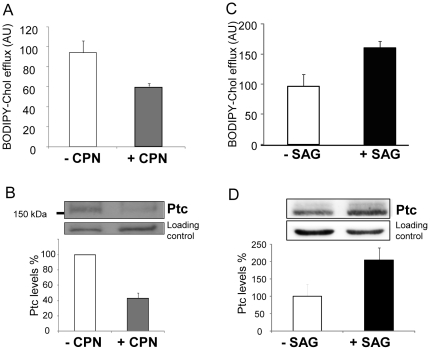
NIH 3T3 fibroblasts were cultured in 24-well plates for BODIPY-cholesterol efflux measurements (A and C) or in 100-mm diameter plates for membrane preparations and immunoblotting (B and D), and treated for 48 h with 10 µM cyclopamine (CPN) (A and B) or 100 nM SAG (C and D). CPN and SAG are antagonists and agonists of the Hh pathway, respectively. The histograms presented in A and C are the mean ± SEM of 3 independent experiments (p = 0.04). The Ptc signals from immunoblots presented in B and D and other independent experiments were quantified using Image J software and untreated cells as control.
Figure 4
Figure 4. hPtc over-expressed in S. cerevisiae induces cholesterol efflux.
Membranes from human Ptc (hPtc) expressing yeast (A, lane 1) and mouse myodulin (Myo) expressing yeast (used as control) (A, lane 2) were prepared for immunoblotting with antibodies against hemagglutinin (A). Yeast over-expressing Myo (control) or hPtc were incubated for 2 h with 2.5 µM BODIPY-cholesterol, washed, re-suspended in buffer, and then centrifuged for 30 s and for 3, 5, or 20 min. Then, the fluorescence intensity of the supernatants was measured (B). The BODIPY fluorescence intensity of the supernatants 20 min after resuspension and in yeast after loading and washing was measured in 9 independent experiments. The mean values ± SEM are presented (p = 0.002) (C). The same experiments were carried out with yeast expressing human Smo and in the presence of 5 mM 2-deoxy-D-glucose to inhibit ABC transporters during BODIPY-cholesterol loading and efflux (D).
Figure 5
Figure 5. Purified Ptc binds to cholesterol.
Human Ptc and mouse Myodulin were purified from S. cerevisiae. Proteins were injected onto the flow cell 2 (fc2) covalently coupled with thiocholesterol and the flow cell 1 (fc1) used as control of a Biacore sensor chip CM5. The difference between the sensorgrams recorded on fc2 and fc1 are reported (A). The sensorgrams recorded with Ptc (black lines) and Myodulin (grey lines) before (full lines) and after (tear lines) incubation with 15 nM pure ShhN show that Ptc binds to cholesterol coupled onto the sensor chip and that ShhN partially inhibits this binding. Sensorgrams were recorded with Ptc incubated with increasing concentrations of pure ShhN (1.5, 7.5, 15 nM) before injection, and the% cholesterol binding inhibition was plotted vs. ShhN concentration. The curves obtained from 3 independent experiments were fitted on an exponential curve using Origin software, giving Ki values between 0.8 and 1.0 nM (B).
Figure 6
Figure 6. Schematic representation of Ptc/Smo regulation mechanism.
Left panel: In the absence of Shh, Ptc (red) is present at the plasma membrane, where it contributes to cholesterol (yellow) efflux from the cell. Smo (blue) is inactivated and traffics between endosomes and the plasma membrane. Right panel: Shh (green) binding to Ptc induces Ptc internalization and inhibits cholesterol efflux. The concentration of cholesterol increases, allowing accumulation of Smo at the cilium membrane.

References

    1. Varjosalo M, Taipale J. Hedgehog: functions and mechanisms. Genes Dev. 2008;22:2454–2472. - PubMed
    1. Bale A. Hedgehog signaling and human disease. Annu Rev Genomics Hum Genet. 2002;3:47–65. - PubMed
    1. Nieuwenhuis E, Hui C. Hedgehog signaling and congenital malformations. Clin Genet. 2005;67:193–208. - PubMed
    1. Nehmé R, Mus-Veteau I. Proteins of the Hedgehog signaling pathway as therapeutic targets against cancer. Expert Rev Proteomics. 2010;7:601–612. - PubMed
    1. Beachy P, Karhadkar S, Berman D. Tissue repair and stem cell renewal in carcinogenesis. Nature. 2004;432:324–331. - PubMed

Publication types