


A novel system for transcutaneous application of carbon dioxide causing an "artificial Bohr effect" in the human body
- PMID: 21931656
- PMCID: PMC3169585
- DOI: 10.1371/journal.pone.0024137
A novel system for transcutaneous application of carbon dioxide causing an "artificial Bohr effect" in the human body
Abstract
Background: Carbon dioxide (CO(2)) therapy refers to the transcutaneous administration of CO(2) for therapeutic purposes. This effect has been explained by an increase in the pressure of O(2) in tissues known as the Bohr effect. However, there have been no reports investigating the oxygen dissociation of haemoglobin (Hb) during transcutaneous application of CO(2)in vivo. In this study, we investigate whether the Bohr effect is caused by transcutaneous application of CO2 in human living body.
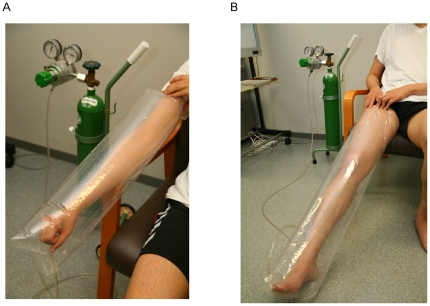
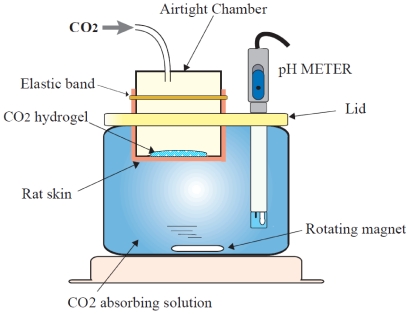
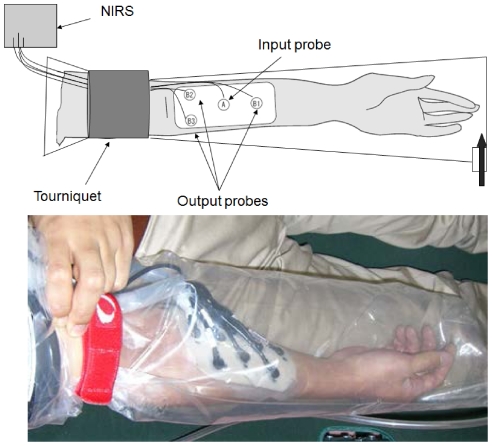
Methods: We used a novel system for transcutaneous application of CO(2) using pure CO(2) gas, hydrogel, and a plastic adaptor. The validity of the CO(2) hydrogel was confirmed in vitro using a measuring device for transcutaneous CO(2) absorption using rat skin. Next, we measured the pH change in the human triceps surae muscle during transcutaneous application of CO(2) using phosphorus-31 magnetic resonance spectroscopy ((31)P-MRS) in vivo. In addition, oxy- and deoxy-Hb concentrations were measured with near-infrared spectroscopy in the human arm with occulted blood flow to investigate O2 dissociation from Hb caused by transcutaneous application of CO(2).
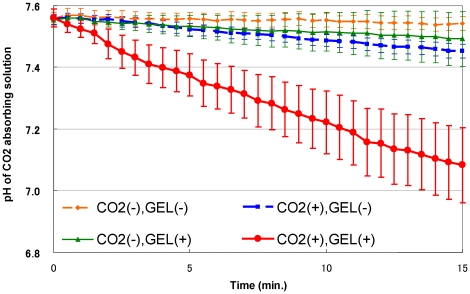
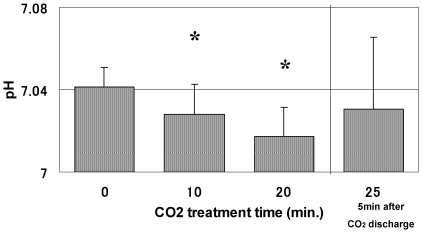
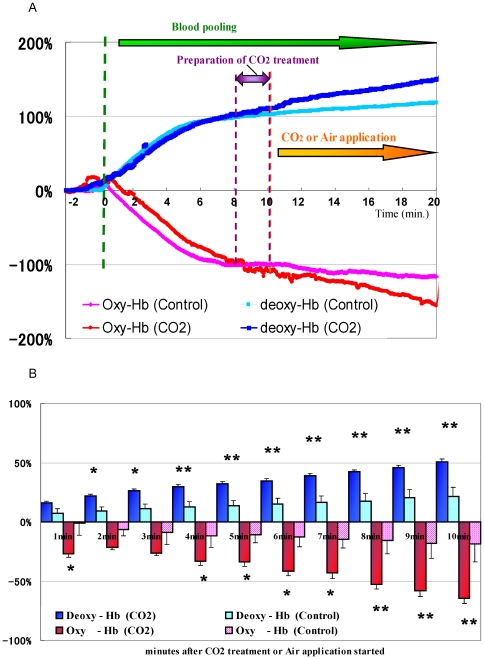
Results: The rat skin experiment showed that CO(2) hydrogel enhanced CO(2) gas permeation through the rat skin. The intracellular pH of the triceps surae muscle decreased significantly 10 min. after transcutaneous application of CO(2). The NIRS data show the oxy-Hb concentration decreased significantly 4 min. after CO(2) application, and deoxy-Hb concentration increased significantly 2 min. after CO(2) application in the CO(2)-applied group compared to the control group. Oxy-Hb concentration significantly decreased while deoxy-Hb concentration significantly increased after transcutaneous CO(2) application.
Conclusions: Our novel transcutaneous CO(2) application facilitated an O(2) dissociation from Hb in the human body, thus providing evidence of the Bohr effect in vivo.
Conflict of interest statement
Figures
References
-
- Blair DA, Glover WE, McArrdle L. The mechanism of the peripheral vasodilation following carbon dioxide inhalation in man. Clin Sci. 1960;19:407–423.
-
- Matz H, Orion E, Wolf R. Balneotherapy in dermatology. Dermatol Ther. 2003;16:132–140. - PubMed
-
- Hartmann BR, Bassenge E, Pittler M. Effect of carbon dioxide-enriched water and fresh water on the cutaneous microcirculation and oxygen tension in the skin of the foot. Angiology. 1997;48:337–343. - PubMed
-
- Hartmann BR, Bassenge E, Hartmann M. Effects of serial percutaneous application of carbon dioxide in intermittent claudication: results of a controlled trial. Angiology. 1997;48:957–963. - PubMed
-
- Toriyama T, Kumada Y, Matsubara T, Murata A, Ogino A, et al. Effect of artificial carbon dioxide foot bathing on critical limb ischemia (Fontaine IV) in peripheral arterial disease patients. Int Angiol. 2002;21:367–73. - PubMed
Publication types
MeSH terms
Substances
LinkOut - more resources
Full Text Sources
Other Literature Sources
Medical
