


Familial adenomatous polyposis-associated desmoids display significantly more genetic changes than sporadic desmoids
- PMID: 21931686
- PMCID: PMC3170296
- DOI: 10.1371/journal.pone.0024354
Familial adenomatous polyposis-associated desmoids display significantly more genetic changes than sporadic desmoids
Abstract
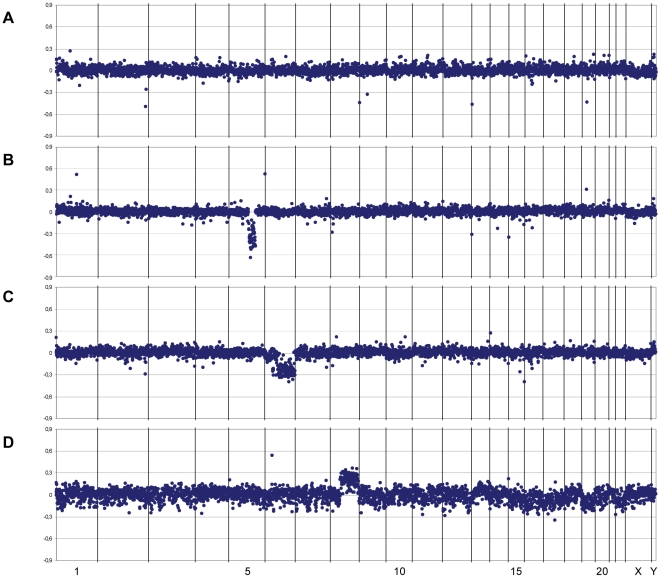
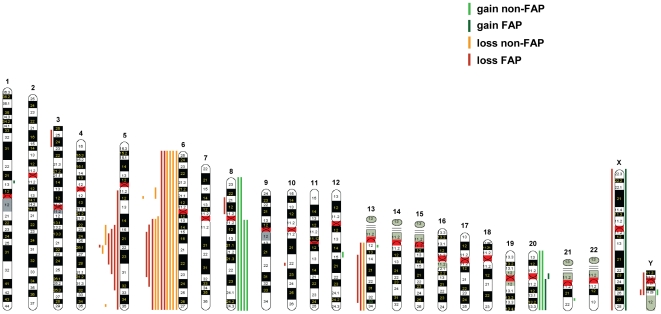
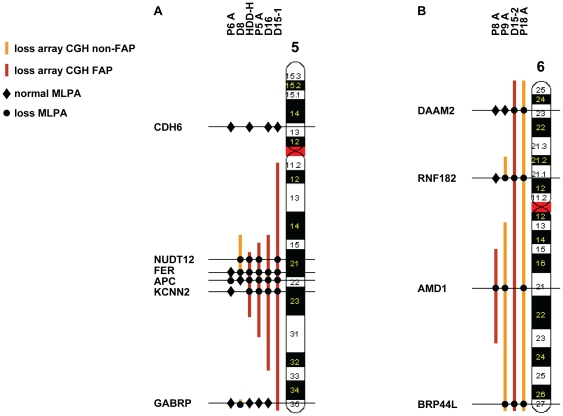
Desmoid tumours (also called deep or aggressive fibromatoses) are potentially life-threatening fibromatous lesions. Hereditary desmoid tumours arise in individuals affected by either familial adenomatous polyposis (FAP) or hereditary desmoid disease (HDD) carrying germline mutations in APC. Most sporadic desmoids carry somatic mutations in CTNNB1. Previous studies identified losses on 5q and 6q, and gains on 8q and 20q as recurrent genetic changes in desmoids. However, virtually all genetic changes were derived from sporadic tumours. To investigate the somatic alterations in FAP-associated desmoids and to compare them with changes occurring in sporadic tumours, we analysed 17 FAP-associated and 38 sporadic desmoids by array comparative genomic hybridisation and multiple ligation-dependent probe amplification. Overall, the desmoids displayed only a limited number of genetic changes, occurring in 44% of cases. Recurrent gains at 8q (7%) and 20q (5%) were almost exclusively found in sporadic tumours. Recurrent losses were observed for a 700 kb region at 5q22.2, comprising the APC gene (11%), a 2 Mb region at 6p21.2-p21.1 (15%), and a relatively large region at 6q15-q23.3 (20%). The FAP-associated desmoids displayed a significantly higher frequency of copy number abnormalities (59%) than the sporadic tumours (37%). As predicted by the APC germline mutations among these patients, a high percentage (29%) of FAP-associated desmoids showed loss of the APC region at 5q22.2, which was infrequently (3%) seen among sporadic tumours. Our data suggest that loss of region 6q15-q16.2 is an important event in FAP-associated as well as sporadic desmoids, most likely of relevance for desmoid tumour progression.
Conflict of interest statement
Figures
References
-
- Clark SK, Phillips RK. Desmoids in familial adenomatous polyposis. Br J Surg. 1996;83:1494–1504. - PubMed
-
- Wu C, Nik-Amini S, Nadesan P, Stanford WL, Alman BA. Aggressive fibromatosis (desmoid tumor) is derived from mesenchymal progenitor cells. Cancer Res. 2010;70:7690–7698. - PubMed
-
- Fallen T, Wilson M, Morlan B, Lindor NM. Desmoid tumors – a characterization of patients seen at Mayo Clinic 1976–1999. Fam Cancer. 2006;5:191–194. - PubMed
-
- Lips DJ, Barker N, Clevers H, Hennipman A. The role of APC and beta-catenin in the etiology of aggressive fibromatosis (desmoid tumors). Eur J Surg Oncol. 2009;35:3–10. - PubMed
-
- Fodde R, Khan PM. Genotype-phenotype correlations at the adenomatous polyposis coli (APC) gene. Crit Rev Oncog. 1995;6:291–303. - PubMed
Publication types
MeSH terms
Supplementary concepts
LinkOut - more resources
Full Text Sources
Research Materials
Miscellaneous
