


Ralstonia syzygii, the Blood Disease Bacterium and some Asian R. solanacearum strains form a single genomic species despite divergent lifestyles
- PMID: 21931687
- PMCID: PMC3169583
- DOI: 10.1371/journal.pone.0024356
Ralstonia syzygii, the Blood Disease Bacterium and some Asian R. solanacearum strains form a single genomic species despite divergent lifestyles
Abstract
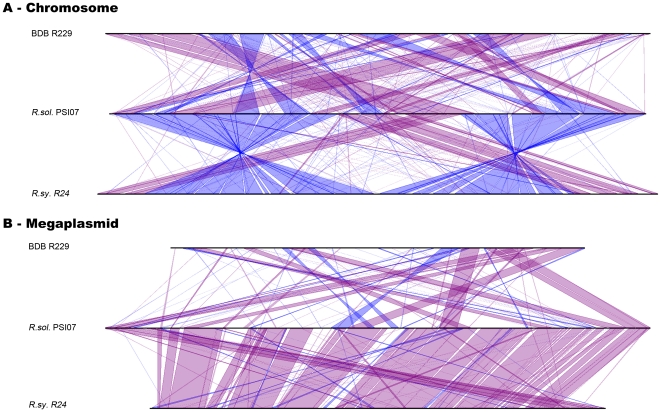
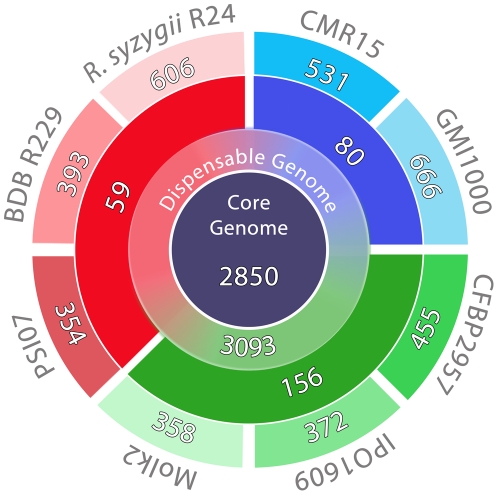
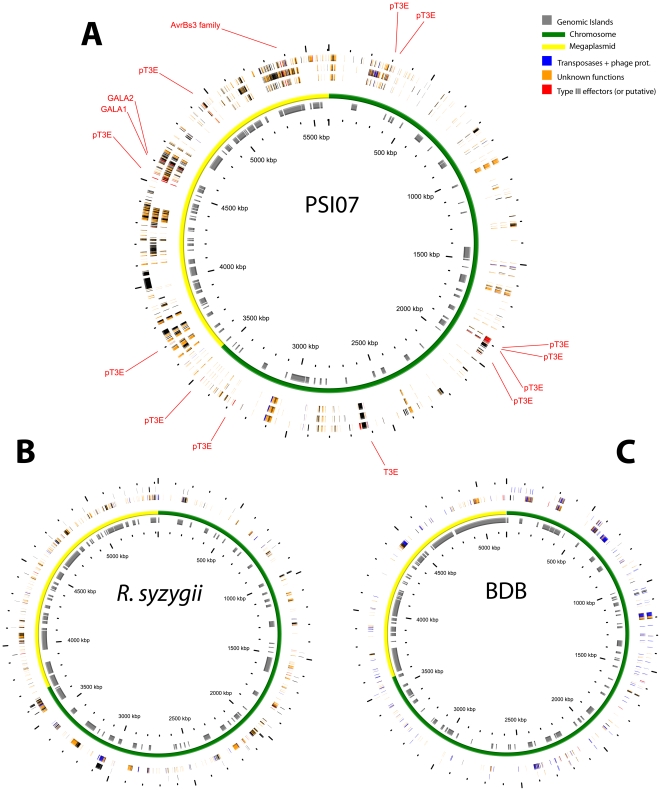
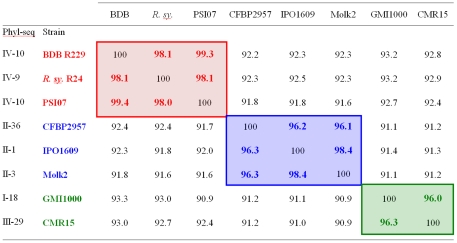
The Ralstonia solanacearum species complex includes R. solanacearum, R. syzygii, and the Blood Disease Bacterium (BDB). All colonize plant xylem vessels and cause wilt diseases, but with significant biological differences. R. solanacearum is a soilborne bacterium that infects the roots of a broad range of plants. R. syzygii causes Sumatra disease of clove trees and is actively transmitted by cercopoid insects. BDB is also pathogenic to a single host, banana, and is transmitted by pollinating insects. Sequencing and DNA-DNA hybridization studies indicated that despite their phenotypic differences, these three plant pathogens are actually very closely related, falling into the Phylotype IV subgroup of the R. solanacearum species complex. To better understand the relationships among these bacteria, we sequenced and annotated the genomes of R. syzygii strain R24 and BDB strain R229. These genomes were compared to strain PSI07, a closely related Phylotype IV tomato isolate of R. solanacearum, and to five additional R. solanacearum genomes. Whole-genome comparisons confirmed previous phylogenetic results: the three phylotype IV strains share more and larger syntenic regions with each other than with other R. solanacearum strains. Furthermore, the genetic distances between strains, assessed by an in-silico equivalent of DNA-DNA hybridization, unambiguously showed that phylotype IV strains of BDB, R. syzygii and R. solanacearum form one genomic species. Based on these comprehensive data we propose a revision of the taxonomy of the R. solanacearum species complex. The BDB and R. syzygii genomes encoded no obvious unique metabolic capacities and contained no evidence of horizontal gene transfer from bacteria occupying similar niches. Genes specific to R. syzygii and BDB were almost all of unknown function or extrachromosomal origin. Thus, the pathogenic life-styles of these organisms are more probably due to ecological adaptation and genomic convergence during vertical evolution than to the acquisition of DNA by horizontal transfer.
Conflict of interest statement
Figures
References
-
- Prior P, Fegan M. Recent development in the phylogeny and classification of Ralstonia solanacearum. Acta Hort. 2005;695:127–136.
-
- Hayward AC. Biology and epidemiology of bacterial wilt caused by Pseudomonas solanacearum. Annual Review of Phytopathology. 1991;29:67–87. - PubMed
-
- Taghavi M, Hayward C, Sly LI, Fegan M. Analysis of the phylogenetic relationships of strains of Burkholderia solanacearum, Pseudomonas syzygii, and the blood disease bacterium of banana based on 16S rRNA gene sequences. Int J Syst Bacteriol. 1996;46:10–15. - PubMed
Publication types
MeSH terms
Associated data
- Actions
- Actions
- Actions
- Actions
- Actions
- Actions
- Actions
- Actions
- Actions
- Actions
- Actions
- Actions
- Actions
- Actions
- Actions
- Actions
- Actions
- Actions
- Actions
- Actions
- Actions
- Actions
- Actions
- Actions
- Actions
- Actions
- Actions
- Actions
- Actions
- Actions
- Actions
- Actions
- Actions
- Actions
LinkOut - more resources
Full Text Sources
Molecular Biology Databases
