. 2011;6(9):e24788.
doi: 10.1371/journal.pone.0024788. Epub 2011 Sep 9.

Biogenic hierarchical TiO₂/SiO₂ derived from rice husk and enhanced photocatalytic properties for dye degradation

Affiliations

Biogenic hierarchical TiO₂/SiO₂ derived from rice husk and enhanced photocatalytic properties for dye degradation

Dalong Yang et al. PLoS One. 2011.

Abstract

Background: Rice husk, an agricultural bioresource, is utilized as a non-metallic bio-precursor to synthesize biogenic hierarchical TiO₂/SiO₂ (BH-TiO₂/SiO₂) and the products are applied to dye degradation.

Methodology/principal findings: The as-prepared BH-TiO₂/SiO₂ samples are characterized by X-ray diffraction(XRD), X-ray photoelectron spectroscopy(XPS), nitrogen-adsorption measurement, UV-vis spectroscopy and electronic paramagnetic resonance (EPR). The results show that BH-TiO₂/SiO₂ possesses both anatase and rutile phases with amorphous SiO₂ as background, which contains mesopore structure, and nitrogen derived from original rice husk is self-doped into the lattice. Besides, the light-harvesting within the visible-light range of BH-TiO₂/SiO₂ has been enhanced. Moreover, the catalytic activity of BH-TiO₂/SiO₂ has been proven by EPR, and both the photocatalytic activity and stability of BH-TiO₂/SiO₂ are improved as well, which has been illustrated by cycled degradation of methylene blue dye under irradiation.

Conclusions/significance: This work provides a good way to combine natural hierarchical porous structure with synthetic material chemistry based on available biomass in the vast natural environment for the sustainable development of human society, and extends potentials of biomass in applications such as photocatalysts, sunlight splitting water and so forth.


Conflict of interest statement

Competing Interests: The authors have declared that no competing interests exist.

Figures

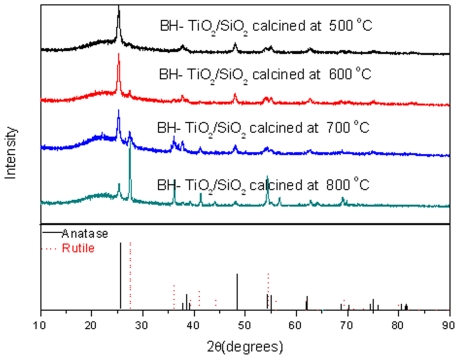
Figure 1
Figure 1. XRD patterns of BH-TiO2/SiO2.
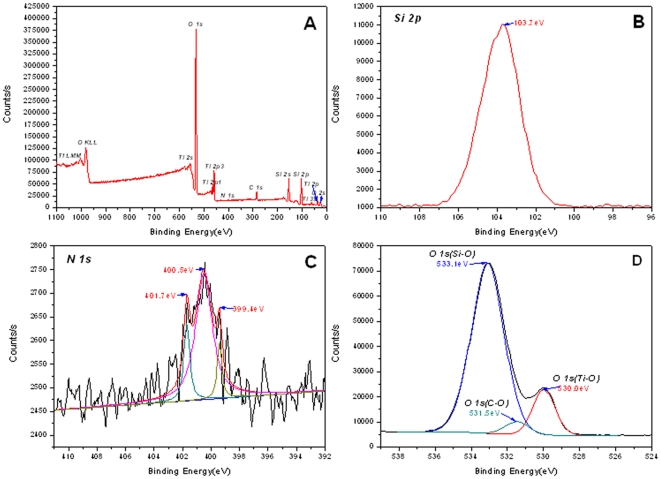
Figure 2
Figure 2. XPS patterns of BH-TiO2/SiO2 calcined at 500°C.
(A) the whole survey; (B) high-resolution spectra of Si2P; (C) high-resolution spectra of N1S; (D) high-resolution spectra of O1S.
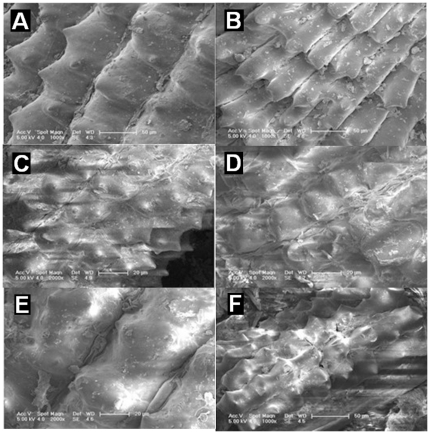
Figure 3
Figure 3. FE-SEM images of the surface structure.
(A) original rice husk; (B) rice husk calcined at 500°C; (C) BH-TiO2/SiO2 calcined at 500°C; (D) BH-TiO2/SiO2 calcined at 600°C; (E) BH-TiO2/SiO2 calcined at 700°C; (F) BH-TiO2/SiO2 calcined at 800°C.
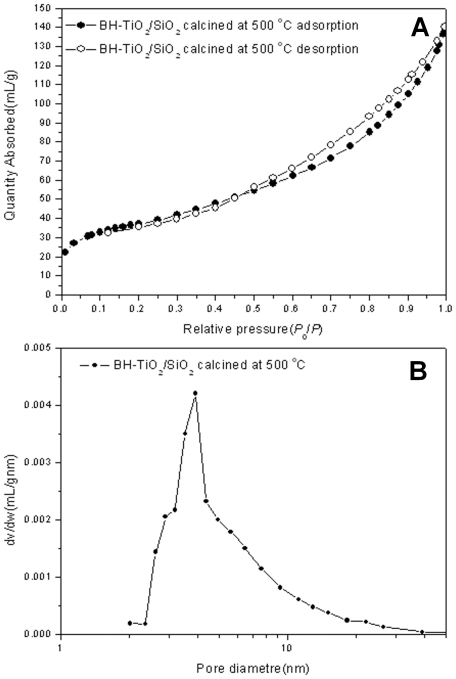
Figure 4
Figure 4. Nitrogen adsorption results of BH-TiO2/SiO2 calcined at 500°C.
(A) adsorption-desorption isotherms; (B) pore-size distribution curves.
Figure 5
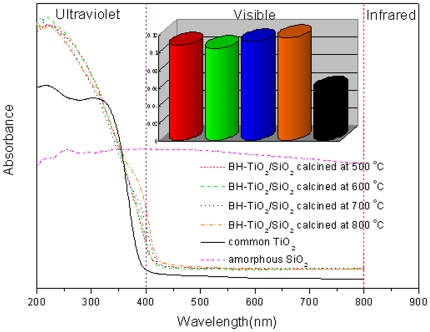
Figure 5. UV-vis absorption spectra of BH-TiO2/SiO2, common TiO2 and amorphous SiO2.
(with a bar graph of the average absorbance intensities within the visible range for BH-TiO2/SiO2 and common TiO2).
Figure 6
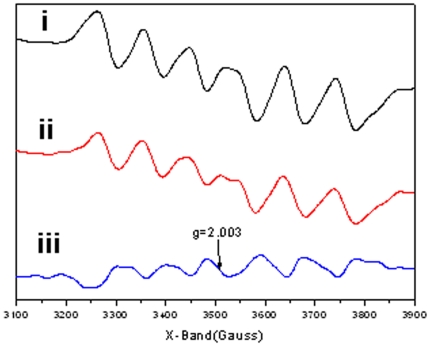
Figure 6. EPR spectra of BH-TiO2/SiO2 calcined at 500°C under 300K.
i) before irradiation; ii) after irradiation for 30 mins; iii) result of subtraction of (i) from (ii).(All data of EPR spectra has been smoothed.)
Figure 7
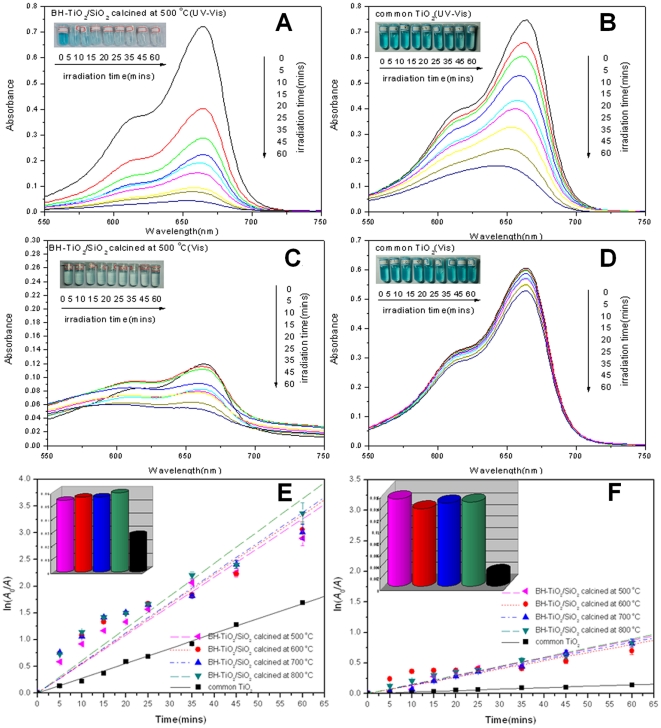
Figure 7. Photocatalytic degradation studies of BH-TiO2/SiO2 and common TiO2 under UV and visible light.
(A) Changes in the UV-vis absorption spectra of methylene blue as a function of irradiation time in the presence of BH-TiO2/SiO2 calcined at 500°C under UV and visible light. (B) Changes in the UV-vis absorption spectra of methylene blue as a function of irradiation time in the presence of common TiO2 under UV and visible light. (C) Changes in the UV-vis absorption spectra of methylene blue as a function of irradiation time in the presence of BH-TiO2/SiO2 calcined at 500°C under visible light. (D) Changes in the UV-vis absorption spectra of methylene blue as a function of irradiation time in the presence of common TiO2 under visible light. (Insets in a, b, c and d are corresponding color variations over irradiation time.) (E) Kinetic study of degradation of methylene blue solution in the presence of BH-TiO2/SiO2 and common TiO2 under Xe lamp irradiation, with a bar graph of the degradation rates in the UV and visible range. (F) Kinetic study of degradation of methylene blue solution in the presence of BH-TiO2/SiO2 and common TiO2 under Xe lamp irradiation, with a bar graph of the degradation rates in the visible range. (Cut-off filters at 400 nm are employed to remove wave lengths shorter than 400 nm to get the desired visible light).
Figure 8
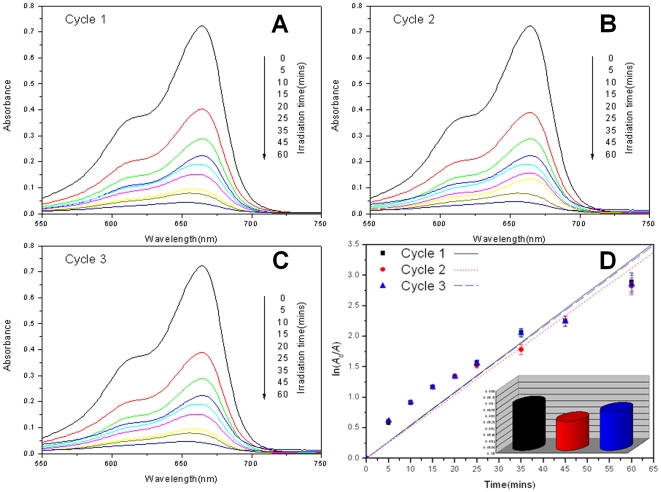
Figure 8. Cycled photocatalytic degradation studies of BH-TiO2/SiO2 calcined at 500°C under Xe lamp.
(A) Cycle 1; (B) Cycle 2; (C) Cycle 3; (D) Kinetic study of cycled degradation.(with a bar graph of the degradation rates for each cycle).

References

    1. Mosier N, Wyman C, Dale B, Elander R, Lee YY, et al. Features of promising technologies for pretreatment of lignocellulosic biomass. Biores Technol. 2005;96:673–686. - PubMed
    1. Weil JR, Dien B, Bothast R, Hendrickson R, Mosier NS, et al. Removal of fermentation inhibitors formed during pretreatment of biomass by polymeric adsorbents. Ind Eng Chem Res. 2002;41:6132–6138.
    1. Kim Y, Hendrickson R, Mosier N, Ladisch MR. Plug-Flow Reactor for Continuous Hydrolysis of Glucans and Xylans from Pretreated Corn Fiber. Energy Fuels. 2005;19:2189–2200.
    1. Fan TX, Chow SK, Zhang D. Biomorphic mineralization: from biology to materials. Prog Mater Sci. 2009;54:542–659.
    1. Hashimoto K, Irie H, Fujishima A. TiO2 Photocatalysis: A Historical Overview and Future Prospects. Jpn J Appl Phys. 2005;44:8269–8285.

Publication types