. 2011 Sep 20;3(1):32.
doi: 10.1186/1758-2946-3-32.

PubChem3D: a new resource for scientists

Affiliations

PubChem3D: a new resource for scientists

Evan E Bolton et al. J Cheminform. .

Abstract

Background: PubChem is an open repository for small molecules and their experimental biological activity. PubChem integrates and provides search, retrieval, visualization, analysis, and programmatic access tools in an effort to maximize the utility of contributed information. There are many diverse chemical structures with similar biological efficacies against targets available in PubChem that are difficult to interrelate using traditional 2-D similarity methods. A new layer called PubChem3D is added to PubChem to assist in this analysis.

Description: PubChem generates a 3-D conformer model description for 92.3% of all records in the PubChem Compound database (when considering the parent compound of salts). Each of these conformer models is sampled to remove redundancy, guaranteeing a minimum (non-hydrogen atom pair-wise) RMSD between conformers. A diverse conformer ordering gives a maximal description of the conformational diversity of a molecule when only a subset of available conformers is used. A pre-computed search per compound record gives immediate access to a set of 3-D similar compounds (called "Similar Conformers") in PubChem and their respective superpositions. Systematic augmentation of PubChem resources to include a 3-D layer provides users with new capabilities to search, subset, visualize, analyze, and download data.A series of retrospective studies help to demonstrate important connections between chemical structures and their biological function that are not obvious using 2-D similarity but are readily apparent by 3-D similarity.

Conclusions: The addition of PubChem3D to the existing contents of PubChem is a considerable achievement, given the scope, scale, and the fact that the resource is publicly accessible and free. With the ability to uncover latent structure-activity relationships of chemical structures, while complementing 2-D similarity analysis approaches, PubChem3D represents a new resource for scientists to exploit when exploring the biological annotations in PubChem.


Figures
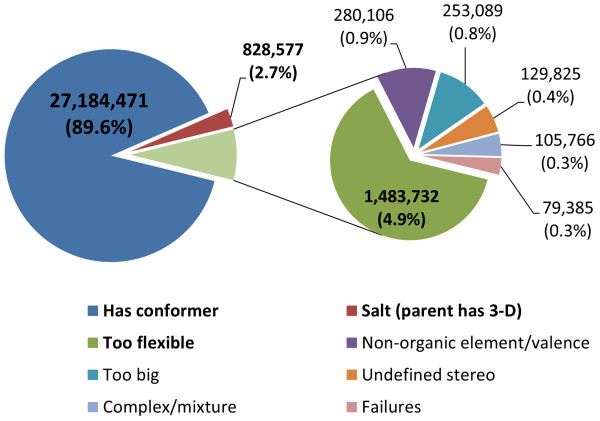
Figure 1
Figure 1
PubChem Compound database 3-D coverage. As one can see, 89.6% of all records have a 3-D conformer model. If one includes the parent compound of salts, this coverage can be considered to be 92.3%. Of the cases not having a 3-D conformer model, the majority are due to the flexibility of the chemical structure being too great to be suitable for conformer generation.
Figure 2
Figure 2
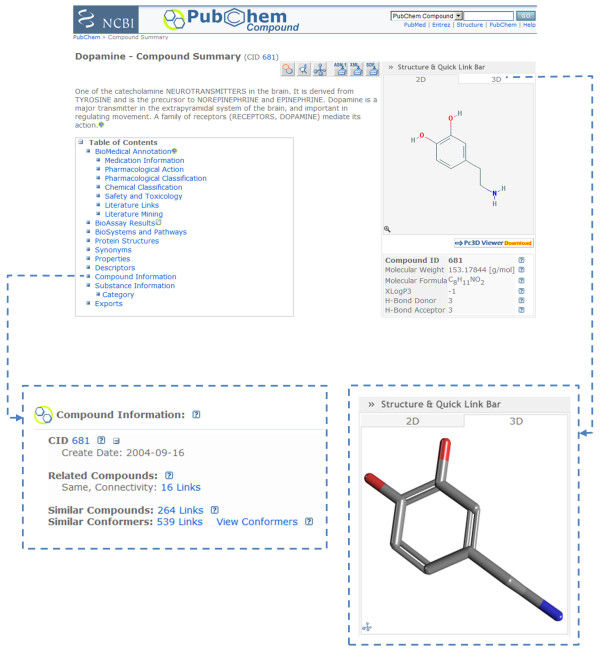
Summary page enhancements. A snapshot of the PubChem Compound summary page of dopamine (CID 681). Clicking on the "3D" tab on the right side of the page shows the 3-D structure of the molecule. Clicking the "Compound information" in the "Table of Contents" box directs users to 2-D neighbors ("Similar Compounds") and 3-D neighbors ("Similar Conformers").
Figure 3
Figure 3
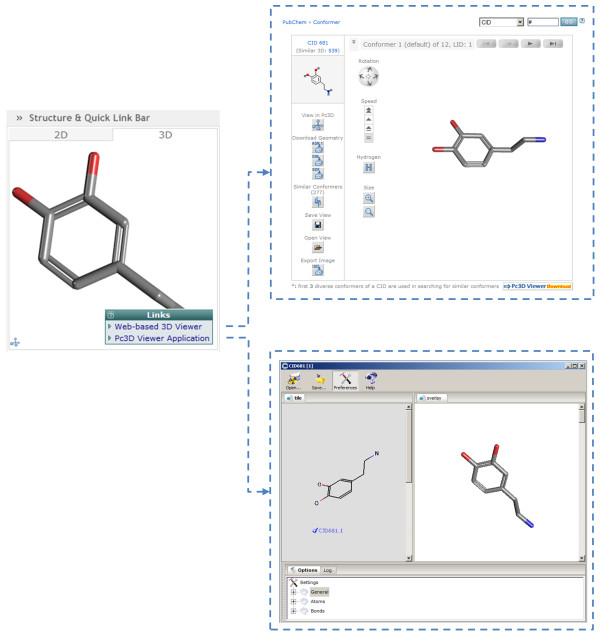
Visualization of a 3-D structure conformer. Clicking on the 3-D image on the PubChem Compound summary page (left) shows links to the web-based 3-D viewer (top right) and the Pc3D desktop helper application (bottom right).
Figure 4
Figure 4
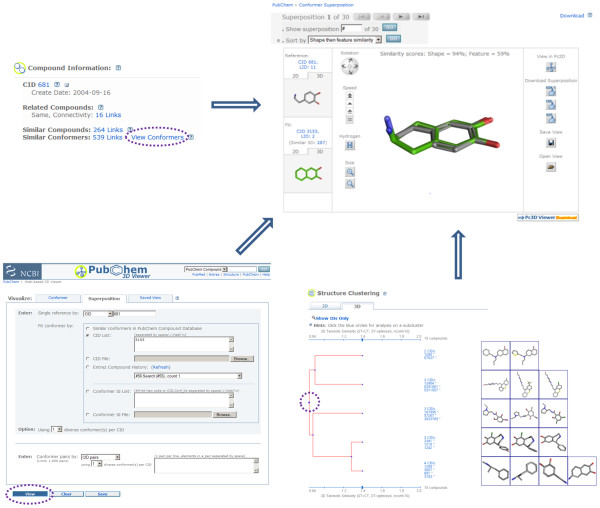
Visualization of 3-D structure conformer superpositions. Superpositions between compound conformers are accessible from various PubChem3D-aware applications. The PubChem Compound summary page (top left) allows the "Similar Conformers" neighboring relationship to be visualized. The PubChem3D web-based viewer (bottom left) allows arbitrary superpositions to be generated. The PubChem Structure Clustering tool (bottom right) enables all pair-wise superpositions to be examined.
Figure 5
Figure 5
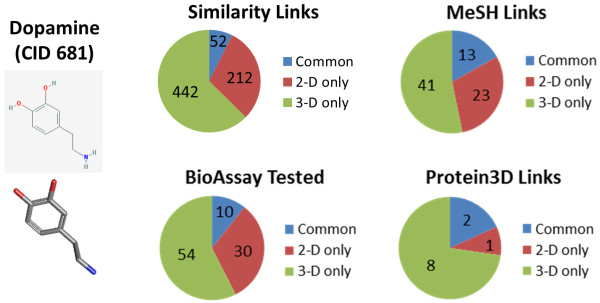
3-D similarity relationship finds additional biological annotation. Comparison of the 2-D "Similar Compound" and 3-D "Similar Conformer" neighboring relationships using dopamine to demonstrate how both neighboring relationship complement each other when locating related chemical structures with unique biological annotation.
Figure 6
Figure 6
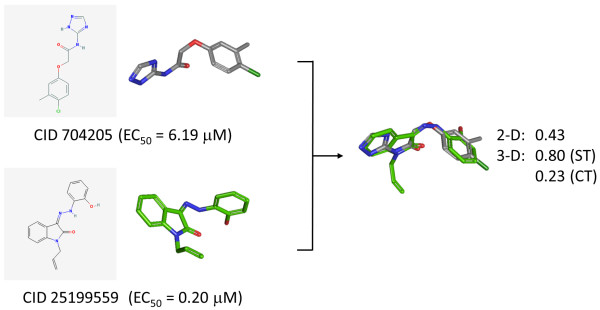
Relating biologically active compounds by means of PubChem3D. Chemical probes ML088 (CID 704205) and ML087 (CID 25199559) from PubChem BioAssay 1548 against tissue non-specific alkaline phosphatase (TNAP, GI:116734717) are not similar by 2-D similarity but are by 3-D similarity.
Figure 7
Figure 7
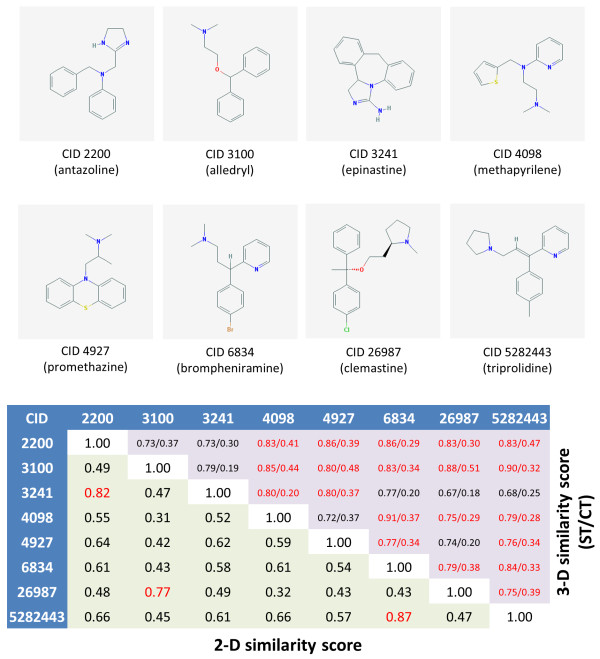
Similarity score matrix for selected histamine H1 receptor antagonist anti-inflammatory drugs. The lower triangle of the score matrix corresponds to the 2-D similarity computed using the PubChem fingerprint. The upper triangle corresponds to the 3-D similarity ST/CT scores. The matrix elements in red text indicate a 2-D similarity ≥ 0.75 or 3-D similarity with ST ≥ 0.74 and ComboT ≥ 1.0. The first ten diverse conformers per molecule were superimposed using shape-based optimization and the single conformer-pair per compound-pair with the largest ComboT retained.
Figure 8
Figure 8
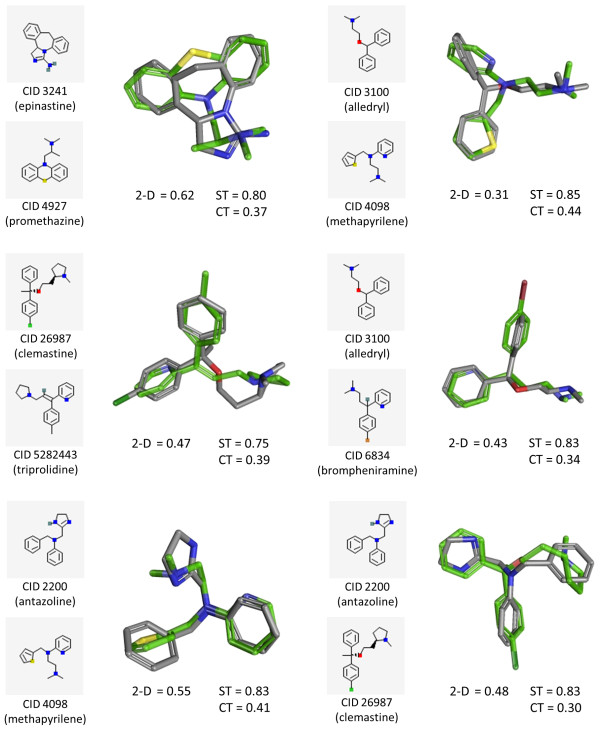
3-D superposition of selected histamine H1 receptor antagonist anti-inflammatory drugs. Although there is little 2-D similarity, using the PubChem fingerprint, substantial 3-D similarity is found between various structurally diverse anti-inflammatory drugs.

References

    1. Bolton EE, Wang Y, Thiessen PA, Bryant SH. In: Annual Reports in Computational Chemistry. Ralph AW, David CS, editor. Vol. 4. Elsevier; 2008. PubChem: integrated platform of small molecules and biological activities; pp. 217–241.
    1. Wang YL, Xiao JW, Suzek TO, Zhang J, Wang JY, Bryant SH. PubChem: a public information system for analyzing bioactivities of small molecules. Nucleic Acids Res. 2009;37:W623–W633. doi: 10.1093/nar/gkp456. - DOI - PMC - PubMed
    1. Wang YL, Bolton E, Dracheva S, Karapetyan K, Shoemaker BA, Suzek TO, Wang JY, Xiao JW, Zhang J, Bryant SH. An overview of the PubChem BioAssay resource. Nucleic Acids Res. 2010;38:D255–D266. doi: 10.1093/nar/gkp965. - DOI - PMC - PubMed
    1. Sayers EW, Barrett T, Benson DA, Bolton E, Bryant SH, Canese K, Chetvernin V, Church DM, DiCuccio M, Federhen S. et al. Database resources of the National Center for Biotechnology Information. Nucleic Acids Res. 2011;39:D38–D51. doi: 10.1093/nar/gkq1172. - DOI - PMC - PubMed
    1. PubChem3D Thematic Series. http://www.jcheminf.com/series/pubchem3d

LinkOut - more resources