


mRNA expression profiles of primary high-grade central osteosarcoma are preserved in cell lines and xenografts
- PMID: 21933437
- PMCID: PMC3193807
- DOI: 10.1186/1755-8794-4-66
mRNA expression profiles of primary high-grade central osteosarcoma are preserved in cell lines and xenografts
Abstract
Background: Conventional high-grade osteosarcoma is a primary malignant bone tumor, which is most prevalent in adolescence. Survival rates of osteosarcoma patients have not improved significantly in the last 25 years. Aiming to increase this survival rate, a variety of model systems are used to study osteosarcomagenesis and to test new therapeutic agents. Such model systems are typically generated from an osteosarcoma primary tumor, but undergo many changes due to culturing or interactions with a different host species, which may result in differences in gene expression between primary tumor cells, and tumor cells from the model system. We aimed to investigate whether gene expression profiles of osteosarcoma cell lines and xenografts are still comparable to those of the primary tumor.
Methods: We performed genome-wide mRNA expression profiling on osteosarcoma biopsies (n = 76), cell lines (n = 13), and xenografts (n = 18). Osteosarcoma can be subdivided into several histological subtypes, of which osteoblastic, chondroblastic, and fibroblastic osteosarcoma are the most frequent ones. Using nearest shrunken centroids classification, we generated an expression signature that can predict the histological subtype of osteosarcoma biopsies.
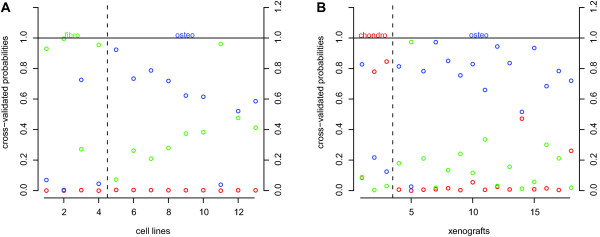
Results: The expression signature, which consisted of 24 probes encoding for 22 genes, predicted the histological subtype of osteosarcoma biopsies with a misclassification error of 15%. Histological subtypes of the two osteosarcoma model systems, i.e. osteosarcoma cell lines and xenografts, were predicted with similar misclassification error rates (15% and 11%, respectively).
Conclusions: Based on the preservation of mRNA expression profiles that are characteristic for the histological subtype we propose that these model systems are representative for the primary tumor from which they are derived.
Figures


References
-
- Cleton-Jansen AM, Buerger H, Hogendoom PCW. Central high-grade osteosarcoma of bone: Diagnostic and genetic considerations. Current Diagnostic Pathology. 2005;11:390–399. doi: 10.1016/j.cdip.2005.08.005. - DOI
-
- Raymond AK, Ayala AG, Knuutila S. In: World Health Classification of Tumours. Pathology and Genetics of Tumours of Soft Tissue and Bone. Fletcher CDM, Unni KK, Mertens F, editor. Lyon: IARC Press; 2002. Conventional osteosarcoma; pp. 264–270.
-
- Buddingh EP, Anninga JK, Versteegh MI, Taminiau AH, Egeler RM, van Rijswijk CS, Hogendoorn PCW, Lankester AC, Gelderblom H. Prognostic factors in pulmonary metastasized high-grade osteosarcoma. Pediatr Blood Cancer. 2010;54:216–221. - PubMed
-
- Lewis IJ, Nooij MA, Whelan J, Sydes MR, Grimer R, Hogendoorn PCW, Memon MA, Weeden S, Uscinska BM, van Glabbeke M, Kirkpatrick A, Hauben EI, Craft AW, Taminiau AHM. Improvement in histologic response but not survival in osteosarcoma patients treated with intensified chemotherapy: A randomized phase III trial of the European Osteosarcoma Intergroup. J Natl Cancer Inst. 2007;99:112–128. doi: 10.1093/jnci/djk015. - DOI - PubMed
Publication types
MeSH terms
Substances
LinkOut - more resources
Full Text Sources
Other Literature Sources
Medical
Molecular Biology Databases
