Review
. 2011 Dec;162(1-2):110-25.
doi: 10.1016/j.virusres.2011.09.004. Epub 2011 Sep 14.

Rhabdovirus accessory genes

Affiliations
Review

Rhabdovirus accessory genes

Peter J Walker et al. Virus Res. 2011 Dec.

Abstract

The Rhabdoviridae is one of the most ecologically diverse families of RNA viruses with members infecting a wide range of organisms including placental mammals, marsupials, birds, reptiles, fish, insects and plants. The availability of complete nucleotide sequences for an increasing number of rhabdoviruses has revealed that their ecological diversity is reflected in the diversity and complexity of their genomes. The five canonical rhabdovirus structural protein genes (N, P, M, G and L) that are shared by all rhabdoviruses are overprinted, overlapped and interspersed with a multitude of novel and diverse accessory genes. Although not essential for replication in cell culture, several of these genes have been shown to have roles associated with pathogenesis and apoptosis in animals, and cell-to-cell movement in plants. Others appear to be secreted or have the characteristics of membrane-anchored glycoproteins or viroporins. However, most encode proteins of unknown function that are unrelated to any other known proteins. Understanding the roles of these accessory genes and the strategies by which rhabdoviruses use them to engage, divert and re-direct cellular processes will not only present opportunities to develop new anti-viral therapies but may also reveal aspects of cellar function that have broader significance in biology, agriculture and medicine.


Figures

Fig. 1
Fig. 1
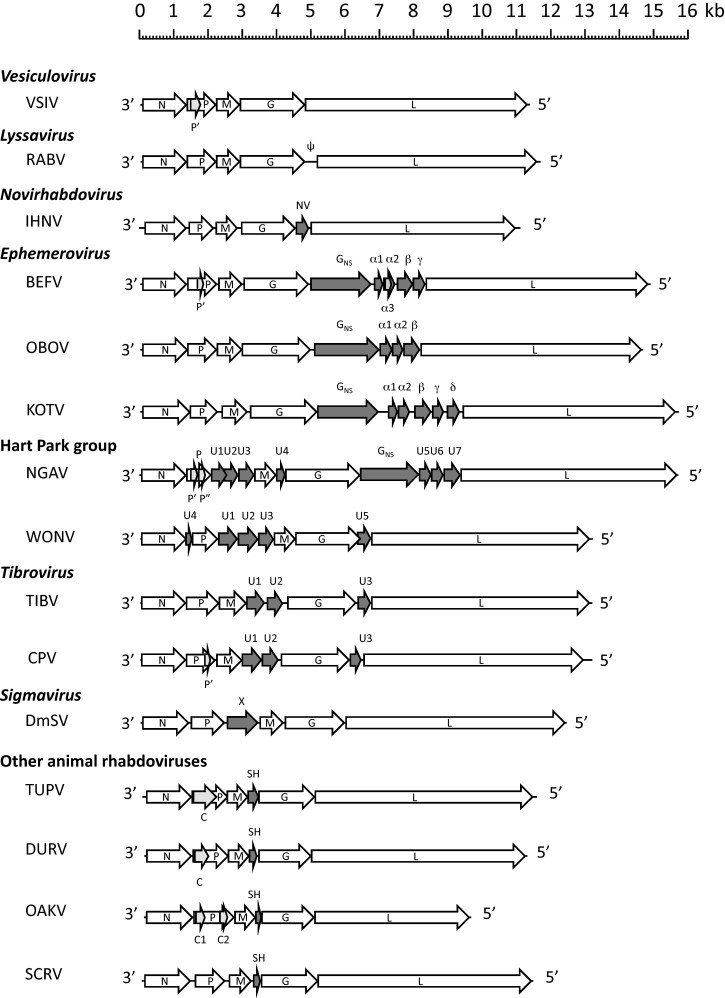
Genome organisation of animal rhabdoviruses (including sigma virus of Drosophila). The positions of ORFs are indicated and those encoding accessory proteins are shaded. Abbreviations of virus names are as listed in Table 1.
Fig. 2
Fig. 2
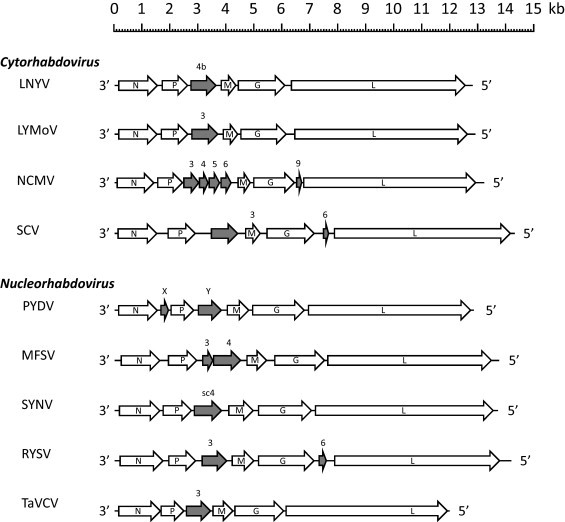
Genome organisation of plant-adapted rhabdoviruses. The positions of ORFs are indicated and those encoding accessory proteins are shaded. Abbreviations of virus names are as listed in Table 1.
Fig. 3
Fig. 3
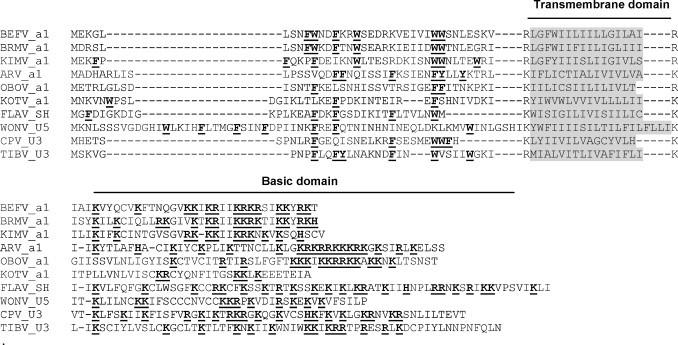
An alignment of the sequences of viroporin-like proteins encoded in the genomes of 10 animal rhabdoviruses. The alignment has been structured to emphasise the predicted N-terminal domains, transmembrane domains (shaded), and highly basic C-terminal domains. Aromatic residues in the N-terminal domain basic amino acids in the C-terminal domain are in bold and underlined. Abbreviations of virus names are as listed in Table 1.
Fig. 4
Fig. 4
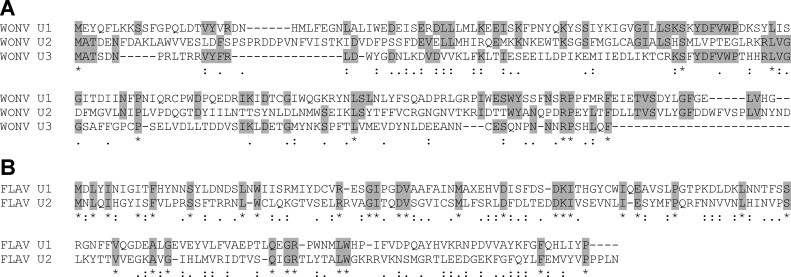
Clustal X alignments of (A) Wongabel virus (WONV) U1, U2 and U3 proteins and (B) Flanders virus (FLAV) U1 and U2 proteins. A single termination codon interrupting the published sequence of the FLAV U1 protein has been removed to infer the complete amino acid sequence. The FLAV U2 protein is also referred to as the 19K protein. Aligned amino acids are shaded. Fully conserved (*), strongly conserved (:) and weakly conserved (.) amino acids have been assigned by the software.
Fig. 5
Fig. 5
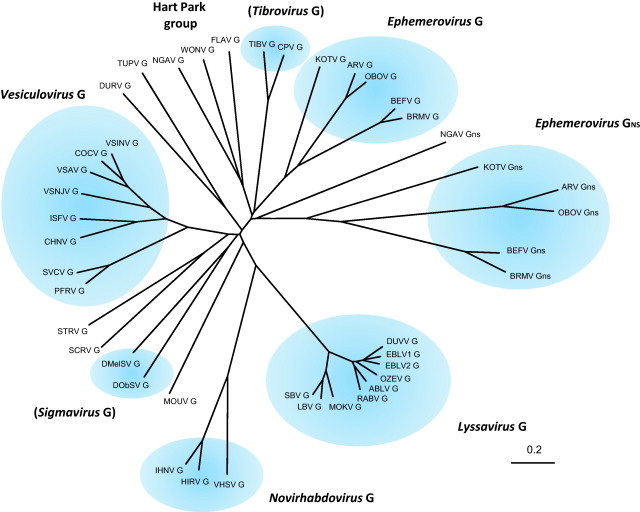
A minimum evolution phylogenetic tree constructed from a Clustal X multiple sequence alignment of animal rhabdovirus G protein and GNS protein sequences. The tree was constructed using the MEGA program. Viruses assigned to established genera and proposed genera are shaded. Abbreviations of virus names are as listed in Table 1.
Fig. 6
Fig. 6
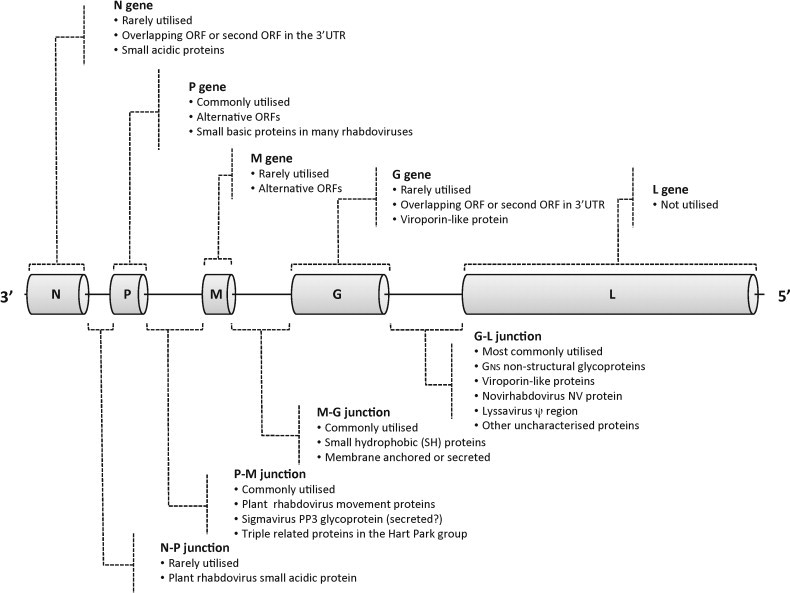
Schematic diagram illustrating the use by rhabdoviruses of the five common structural protein genes (N, P, M, G and L) and the intergenic regions as sites for insertion of ORFs encoding putative accessory proteins genes. The genes are defined as transcriptional units bounded by TI and TTP sequences.

References

    1. Ahne W., Bjorklund H.V., Essbauer S., Fijan N., Kurath G., Winton J.R. Spring viremia of carp (SVC) Diseases of Aquatic Organisms. 2002;52:261–272. - PubMed
    1. Albertini A., Schoehn G., Weissenhorn W., Ruigrok R. Structural aspects of rabies virus replication. Cellular and Molecular Life Sciences. 2008;65:282–294. - PMC - PubMed
    1. Allison A.B., Palacios G., Travassos da Rosa A., Popov V.L., Lu L., Xiao S.Y., DeToy K., Briese T., Lipkin W.I., Keel M.K., Stallknecht D.E., Bishop G.R., Tesh R.B. Characterization of Durham virus, a novel rhabdovirus that encodes both a C and SH protein. Virus Research. 2011;155:112–122. - PMC - PubMed
    1. Alonso M., Kim C.H., Johnson M.C., Pressley M., Leong J.-A. The NV gene of snakehead rhabdovirus (SHRV) is not required for pathogenesis, and a heterologous glycoprotein can be incorporated into the SHRV envelope. Journal of Virology. 2004;78:5875–5882. - PMC - PubMed
    1. Ammayappan A., Kurath G., Thompson T., Vakharia V. A reverse genetics system for the Great Lakes strain of viral hemorrhagic septicemia virus: the NV gene is required for pathogenicity. Marine Biotechnology. 2010 - PubMed

MeSH terms

LinkOut - more resources