High levels of CD34+CD38low/-CD123+ blasts are predictive of an adverse outcome in acute myeloid leukemia: a Groupe Ouest-Est des Leucemies Aigues et Maladies du Sang (GOELAMS) study
- PMID: 21933861
- PMCID: PMC3232261
- DOI: 10.3324/haematol.2011.047894
High levels of CD34+CD38low/-CD123+ blasts are predictive of an adverse outcome in acute myeloid leukemia: a Groupe Ouest-Est des Leucemies Aigues et Maladies du Sang (GOELAMS) study
Abstract
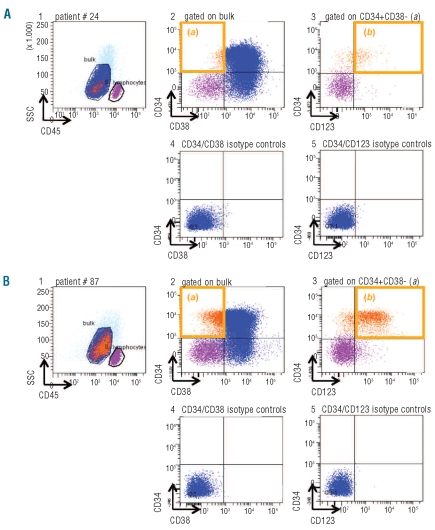
Background: Acute myeloid leukemias arise from a rare population of leukemic cells, known as leukemic stem cells, which initiate the disease and contribute to frequent relapses. Although the phenotype of these cells remains unclear in most patients, these cells are enriched within the CD34(+)CD38(low/-) compartment expressing the interleukin-3 alpha chain receptor, CD123. The aim of this study was to determine the prognostic value of the percentage of blasts with the CD34(+)CD38(low/-)CD123(+) phenotype.
Design and methods: The percentage of CD34(+)CD38(low/-)CD123(+) cells in the blast population was determined at diagnosis using flow cytometry. One hundred and eleven patients under 65 years of age with de novo acute myeloid leukemia and treated with intensive chemotherapy were retrospectively included in the study. Correlations with complete response, disease-free survival and overall survival were evaluated with univariate and multivariate analyses.
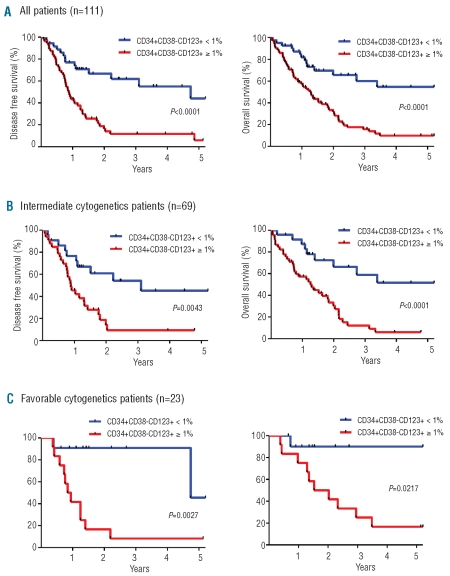
Results: A proportion of CD34(+)CD38(low/-)CD123(+) cells greater than 15% at diagnosis and an unfavorable karyotype were significantly correlated with a lack of complete response. By logistic regression analysis, a percentage of CD34(+)CD38(low/-)CD123(+) higher than 15% retained significance with an odds ratio of 0.33 (0.1-0.97; P=0.044). A greater than 1% population of CD34(+)CD38(low/-)CD123(+) cells negatively affected disease-free survival (0.9 versus 4.7 years; P<0.0001) and overall survival (1.25 years versus median not reached; P<0.0001). A greater than 1% population of CD34(+)CD38(low/-)CD123(+) cells retained prognostic significance for both parameters after multivariate analysis.
Conclusions: The percentage of CD34(+)CD38(low/-)CD123(+) leukemic cells at diagnosis was significantly correlated with response to treatment and survival. This prognostic marker might be easily adopted in clinical practice to rapidly identify patients at risk of treatment failure.
Figures
References
-
- Steffen B, Muller-Tidow C, Schwable J, Berdel WE, Serve H. The molecular pathogenesis of acute myeloid leukemia. Crit Rev Oncol Hematol. 2005;56(2):195–221. - PubMed
-
- Dick JE. Acute myeloid leukemia stem cells. Ann NY Acad Sci. 2005;1044:1–5. - PubMed
-
- Deschler B, Lubbert M. Acute myeloid leukemia: epidemiology and etiology. Cancer. 2006;107(9):2099–107. - PubMed
-
- Schlenk RF, Dohner K, Krauter J, Frohling S, Corbacioglu A, Bullinger L, et al. Mutations and treatment outcome in cytogenetically normal acute myeloid leukemia. N Engl J Med. 2008;358(18):1909–18. - PubMed
Publication types
MeSH terms
Substances
LinkOut - more resources
Full Text Sources
Other Literature Sources
Medical
Research Materials