


FoxO feedback control of basal IRS-2 expression in pancreatic β-cells is distinct from that in hepatocytes
- PMID: 21933986
- PMCID: PMC3198101
- DOI: 10.2337/db11-0340
FoxO feedback control of basal IRS-2 expression in pancreatic β-cells is distinct from that in hepatocytes
Abstract
Objective: Appropriate regulation of insulin receptor substrate 2 (IRS-2) expression in pancreatic β-cells is essential to adequately compensate for insulin resistance. In liver, basal IRS-2 expression is controlled via a temporal negative feedback of sterol regulatory element-binding protein 1 (SREBP-1) to antagonize transcription factors forkhead box class O (FoxO)1/FoxO3a at an insulin response element (IRE) on the IRS-2 promoter. The purpose of the study was to examine if a similar mechanism controlled IRS-2 expression in β-cells.
Research design and methods: IRS-2 mRNA and protein expression, as well as IRS-2 gene promoter activity, were examined in isolated rat islets. Specific transcription factor association with the IRE on the IRS-2 promoter was examined by chromatin immunoprecipitation (ChIP) assay, and their nuclear translocation was examined by immunofluorescence. A direct in vivo effect of insulin on control of IRS-2 expression in liver and pancreatic islets was also investigated.
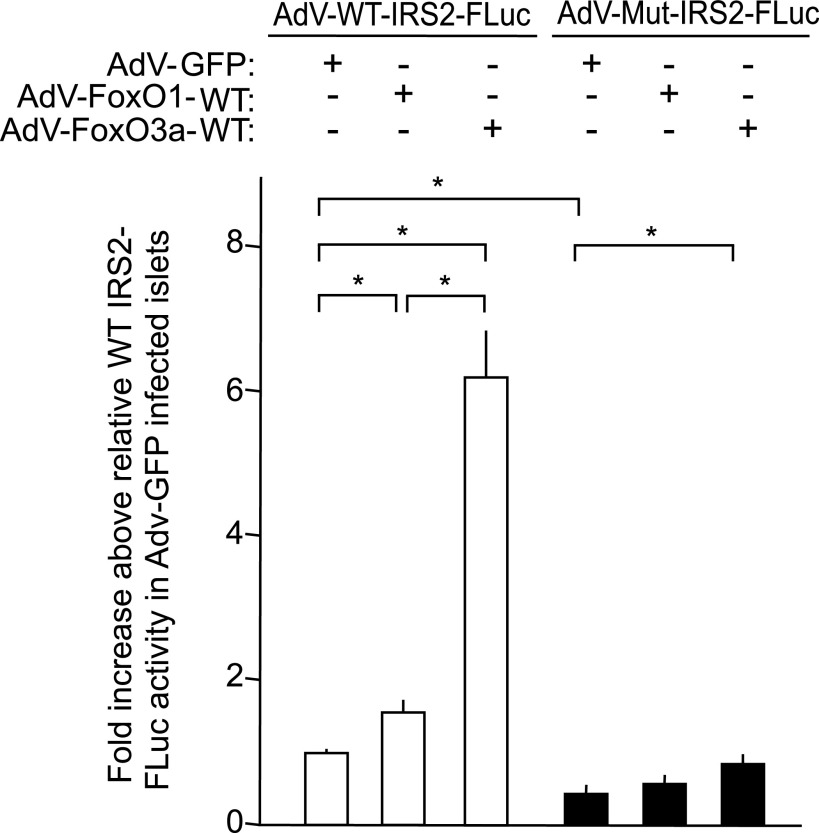
Results: In IRS-2 promoter-reporter assays conducted in isolated islets, removal of the IRE decreased basal IRS-2 promoter activity in β-cells up to 80%. Activation of IRS signaling in isolated rat islets by insulin/IGF-I (used as an experimental in vitro tool) or downstream constitutive activation of protein kinase B (PKB) significantly decreased IRS-2 expression. In contrast, inhibition of phosphatidylinositol 3-kinase (PI3K) or PKB significantly increased IRS-2 levels in β-cells. ChIP assays indicated that transcription factors FoxO1 and FoxO3a associated with the IRE on the IRS-2 promoter in β-cells in a PI3K/PKB-dependent manner, whereas others, such as SREBP-1, the transcription factor binding to immunoglobulin heavy chain enhancer 3', and the aryl hydrocarbon receptor nuclear translocator (ARNT), did not. However, only FoxO3a, not FoxO1, was capable of driving IRS-2 promoter activity via the IRE in β-cells. In vivo studies showed insulin was able to suppress IRS-2 expression via activation of SREBP-1 in the liver, but this mechanism was not apparent in pancreatic islets from the same animal.
Conclusions: The molecular mechanism for feedback control of IRS signaling to decrease IRS-2 expression in liver and β-cells is quite distinct, with a predominant role played by FoxO3a in β-cells.
Figures



References
-
- Rhodes CJ. Type 2 diabetes-a matter of β-cell life and death? Science 2005;307:380–384 - PubMed
-
- Withers DJ, Gutierrez JS, Towery H, et al. Disruption of IRS-2 causes type 2 diabetes in mice. Nature 1998;391:900–904 - PubMed
-
- Withers DJ, Burks DJ, Towery HH, Altamuro SL, Flint CL, White MF. Irs-2 coordinates Igf-1 receptor-mediated beta-cell development and peripheral insulin signalling. Nat Genet 1999;23:32–40 - PubMed
-
- Kubota N, Tobe K, Terauchi Y, et al. Disruption of insulin receptor substrate 2 causes type 2 diabetes because of liver insulin resistance and lack of compensatory beta-cell hyperplasia. Diabetes 2000;49:1880–1889 - PubMed
-
- Lingohr MK, Dickson LM, Wrede CE, et al. Decreasing IRS-2 expression in pancreatic beta-cells (INS-1) promotes apoptosis, which can be compensated for by introduction of IRS-4 expression. Mol Cell Endocrinol 2003;209:17–31 - PubMed
Publication types
MeSH terms
Substances
Grants and funding
LinkOut - more resources
Full Text Sources
Molecular Biology Databases
Research Materials
Miscellaneous
