. 2011;6(9):e24263.
doi: 10.1371/journal.pone.0024263. Epub 2011 Sep 15.

Hippocampal neurogenesis and dendritic plasticity support running-improved spatial learning and depression-like behaviour in stressed rats

Affiliations

Hippocampal neurogenesis and dendritic plasticity support running-improved spatial learning and depression-like behaviour in stressed rats

Suk-Yu Yau et al. PLoS One. 2011.

Abstract

Exercise promotes hippocampal neurogenesis and dendritic plasticity while stress shows the opposite effects, suggesting a possible mechanism for exercise to counteract stress. Changes in hippocampal neurogenesis and dendritic modification occur simultaneously in rats with stress or exercise; however, it is unclear whether neurogenesis or dendritic remodeling has a greater impact on mediating the effect of exercise on stress since they have been separately examined. Here we examined hippocampal cell proliferation in runners treated with different doses (low: 30 mg/kg; moderate: 40 mg/kg; high: 50 mg/kg) of corticosterone (CORT) for 14 days. Water maze task and forced swim tests were applied to assess hippocampal-dependent learning and depression-like behaviour respectively the day after the treatment. Repeated CORT treatment resulted in a graded increase in depression-like behaviour and impaired spatial learning that is associated with decreased hippocampal cell proliferation and BDNF levels. Running reversed these effects in rats treated with low or moderate, but not high doses of CORT. Using 40 mg/kg CORT-treated rats, we further studied the role of neurogenesis and dendritic remodeling in mediating the effects of exercise on stress. Co-labelling with BrdU (thymidine analog) /doublecortin (immature neuronal marker) showed that running increased neuronal differentiation in vehicle- and CORT-treated rats. Running also increased dendritic length and spine density in CA3 pyramidal neurons in 40 mg/kg CORT-treated rats. Ablation of neurogenesis with Ara-c infusion diminished the effect of running on restoring spatial learning and decreasing depression-like behaviour in 40 mg/kg CORT-treated animals in spite of dendritic and spine enhancement. but not normal runners with enhanced dendritic length. The results indicate that both restored hippocampal neurogenesis and dendritic remodelling within the hippocampus are essential for running to counteract stress.


Conflict of interest statement

Competing Interests: The authors have declared that no competing interests exist.

Figures

Figure 1
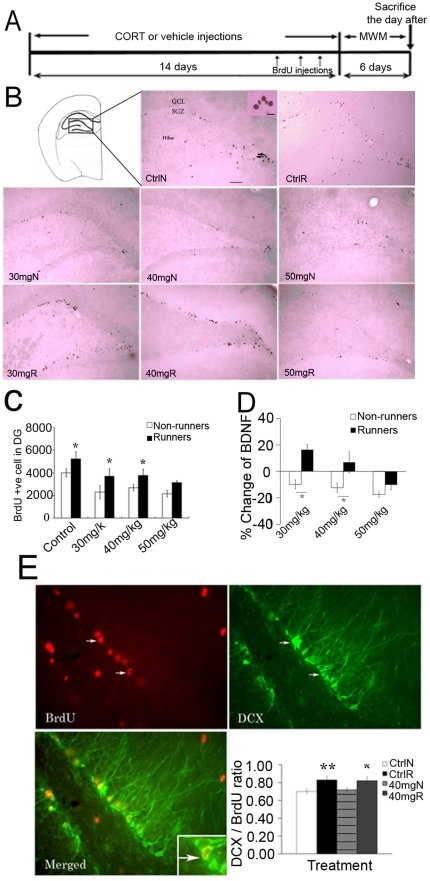
Figure 1. Hippocampal cell proliferation and neurogenesis in the dentate gyus.
(A) A schematic diagram depicting experimental procedures for the treatment. MWM: Morris water maze (B) Representative images of BrdU-labelled cells. (C) CORT significantly suppressed hippocampal cell proliferation, whereas running reversed the decrease in vehicle-, 30 mg/kg and 40 mg/kg CORT-treated rats. *P<0.05 compared to non-runner counterparts. (D) There was no difference in hippocampal BDNF level between vehicle-treated runners and non-runners. However, BDNF level was decreased by CORT in a dose-dependent manner. Running up-regulated BDNF level in 30 mg/kg and 40 mg/kg CORT-treated rats, but not in 50 mg/kg CORT-treated rats. Data are expressed as percentage change±S.E.M. *P<0.005 compared to non-runner counterparts. (E) Running increased neuronal differentiation of newborn cells while CORT treatment showed no effect. *P<0.05, **P<0.005 compared to control non-runners. Values are respresented as mean±S.E.M. Ctrl: control; 30–50 mg: dosages of CORT treatment; N: non-runner; R:runner. Scale bar = 50 µm. N = 6–8/group.
Figure 2
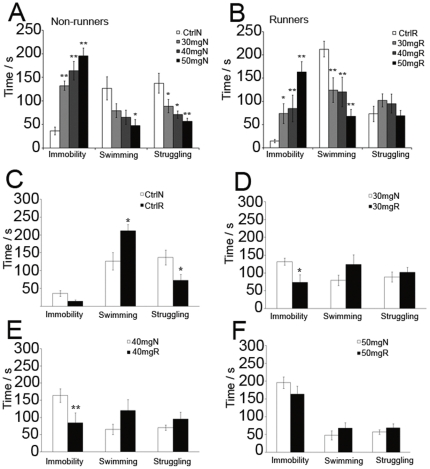
Figure 2. Effect of CORT injections on depression-like behavior.
(A and B) Treatment with CORT increased immobility time in a dose-dependent manner while running decreased immobility time. * P<0.05; ** P<0.005 compared to control. (C) Running did not decrease immobility time but increased swimming time and decreased struggling time of vehicle-treated rats. (D and E) Post hoc analysis revealed that running significantly decreased immobility time in 30 mg/kg and 40 mg/kg CORT-treated rats when compared to non-runner counterparts. (F) Running showed no effect on immobility time in 50 mg/kg CORT-treated rats. *P<0.05, **P<0.005 compared to non-runner counterparts. N = 8–10/group for forced-swim test. Ctrl: control; 30–50 mg: dosages of CORT treatment; N: non-runners; R:runners.
Figure 3
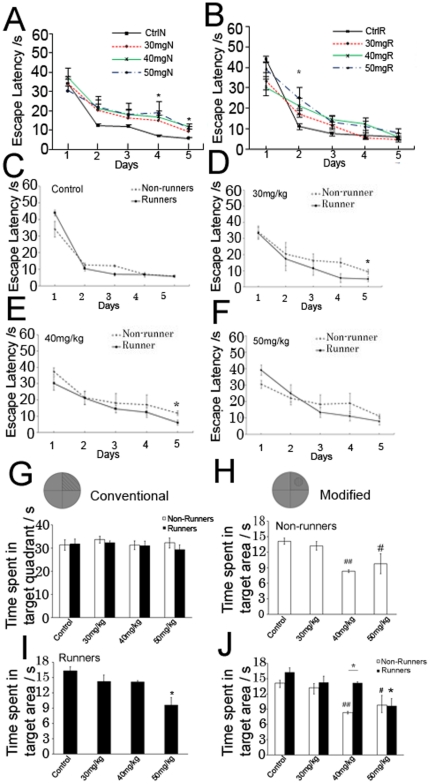
Figure 3. Performance in water maze task of CORT-treated non-runners and runners.
(A) Non-runners treated with 30 mg/kg, 40 mg/kg and 50 mg/kg CORT showed impairment in spatial learning. (B) Runners with 50 mg/kg CORT treatment showed impairment in spatial learning compared to vehicle-treated runners. *P<0.05 compared to control. (CE) Runners treated with 30 mg/kg and 40 mg/kg CORT showed significantly shorter escape latency compared to non-runner counterparts indicating improved spatial learning. (F) Running did not improve spatial learning in 50 mg/kg CORT-treated rats. *P<0.05 compared to non-runner conterparts. Data were analysed using conventional method in (G) and modified scoring method in (H–J). (G) There was no significant difference among groups using conventional method. (H) In the modified method, 40 mg/kg and 50 mg/kg CORT-treated non-runners showed a shorter time spent in target area compared with control non-runners. (I) Runners treated with 50 mg/kg CORT showed impairment in spatial learning compared to control runners. (J) This graph was a combination of (H) and (I) for representing the comparison between non-runners and runners. Running increased time spent in the target area in 40 mg/kg CORT-treated runners, but not in 50 mg/kg CORT-treated runners compared with non-runner counterparts. #P<0.05, ##P<0.005 compared to vehicle-treated non-runners. * P<0.05 compared to vehicle-treated runners. N = 8-10/group.
Figure 4
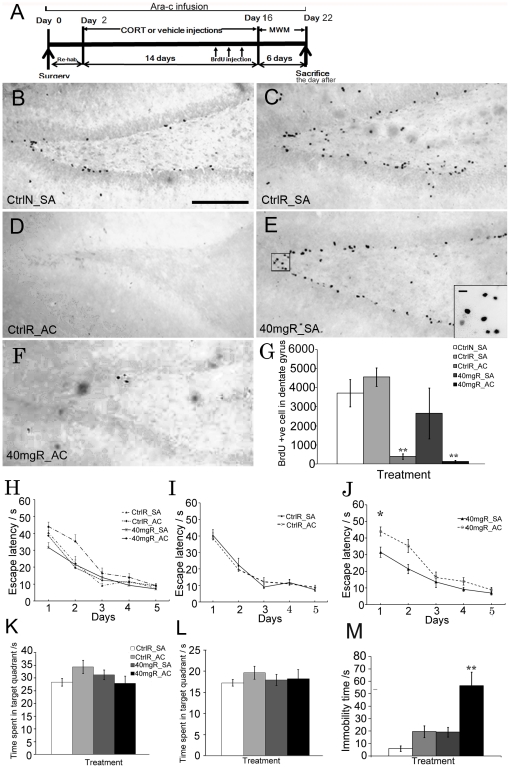
Figure 4. Effect of neurogenesis ablation on spatial memory and depression-like behavior.
(A) A schematic diagram of intraventrucular infusion and treatment procedure; CORT treatment was started after two days of recovery from the surgical procedure. The behavioral test was then performed 24 hr after the treatment. MWM: Morris water maze (BF) Representative images of BrdU staining. (G) Ara-c infusion significantly blocked hippocampal cell proliferation. (H) Spatial learning for different treatment groups. (I) Ara-c infusion did not affect spatial learning in vehicle-treated runners. (J) Blocking hippocampal neurogenesis in 40 mg/kg CORT-treated runners significantly impaired spatial learning compared to saline infused counterparts. Main effect of Ara-c infusion, * P<0.05 (K and L) Data were analyzed with the modified method. Memory consolidation was not altered by Ara-c infusion in either vehicle- or 40 mg/kg CORT-treated runners as indicated by analysis of conventional and modified method respectively in probe trial test. (M) Ara-c infusion significantly increased immobility time in 40 mg/kg CORT-treated runners indicating increased depression-like behavior. Main effect of Ara-c: **P<0.005. SA: Saline infusion; AC: Ara-c infusion. Scale bar  = 100 µm. N = 8–10/group.
Figure 5
Figure 5. Dendritic remodeling of hippocampal CA3 pyramidal neurons.
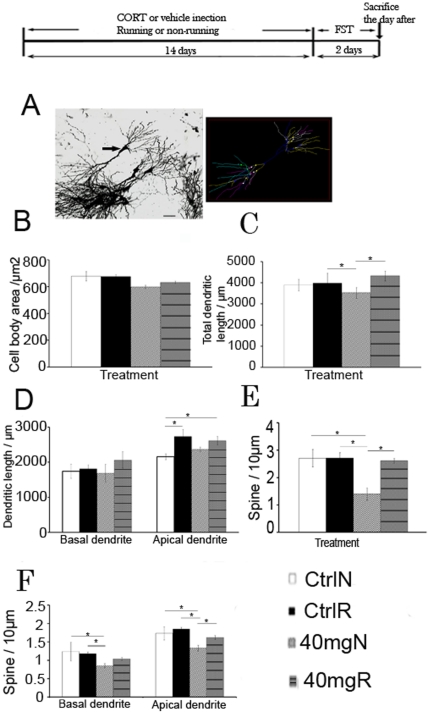
(A) Left: A representative image of a selected neuron for analysis; Right: A neuronal morphology by using Neurolucida software (B) The soma size was not affacted by running and CORT treatment. (C) CORT treatment significantly decreased total dendritic length while running reversed the decrease. (D) The basal dendritic length was not affected by running and CORT treatmnet. The apical dendritic length was significantly increased by running in vehicle or CORT treated rats. (E) Running did not increase spine density in vehicle-treated rats, but restored the decrease in 40 mg/kg CORT-treated rats. (F) Treatment with 40 mg/kg CORT significantly decreased spine density in basal dendrites and apical dendrites. Running restored the decrease in spine density in 40 mg/kg CORT-treated rats. *P<0.05; **P<0.005. N = 3 for control non-runnes, N = 5-8 for the rest groups. Ctrl: control; 40 mg: 40 mg/kg CORT; N: non-runner; R:runner. Scale bar = 100 µm. FST: forced swim test.
Figure 6
Figure 6. Structural remodeling of CA3 pyramidal neurons in Ara-c-infused runners and non-runners.
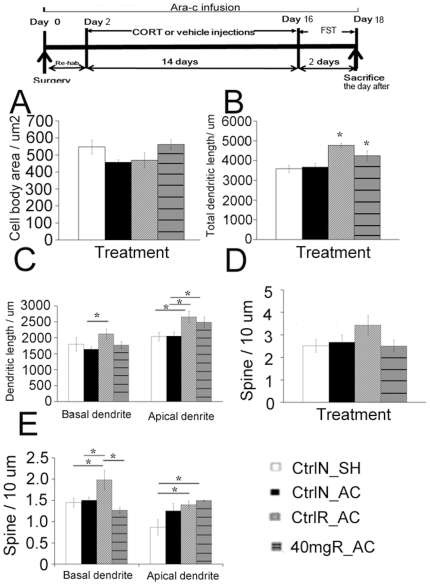
(A) There was no significant difference in the soma size among groups. (B) The total dendrite length was not affected by Ara-c infusion in vehicle-treated non-runners. A significant increase in dendritic length was observed in both vehicle-treated runners with Ara-c infusion and 40 mg/kg CORT-treated runners with Ara-c infusion when compared with vehicle-treated non-runners with sham-operation or vehicle-treated non-runners with Ara-c infusion. (C) Dendritic length of basal and apical dendrite was increased in vehicle-treated runners with Ara-c infusion when compared to non-runners. (D) There was no change in spine density in Ara-c infused non-runners with vehicle treatment. Running increased spine density in vehicle-treated and 40 mg/kg CORT-treated rats. (E) Vehicle-treated runners with Ara-c infusion showed a significant increase in spine density in basal dendrite when compared with other groups respectively. Ara-c infused runners treated with either vehicle or 40 mg/kg CORT showed a significant increase in spine density in apical dendrite when compared with vehicle-treated non-runners with sham operation. Values are represented as mean±S.E.M. *P<0.05. N = 5-6/group for CtrlN_SH, CtrlN_AC and CtrlR_AC group. N = 3/group for 40 mgR_AC group. CtrlN_SH: Vehicle-treated non-runners with sham-operation. CtrlN_AC: Vehicle-treated non-runners with Ara-c infusion; CtrlR_AC: Vehicle-treated runners with Ara-c infusion: 40 mgR_AC: 40 mg/kg CORT-treated runners with Ara-c infusion. FST: forced swim test.
Figure 7
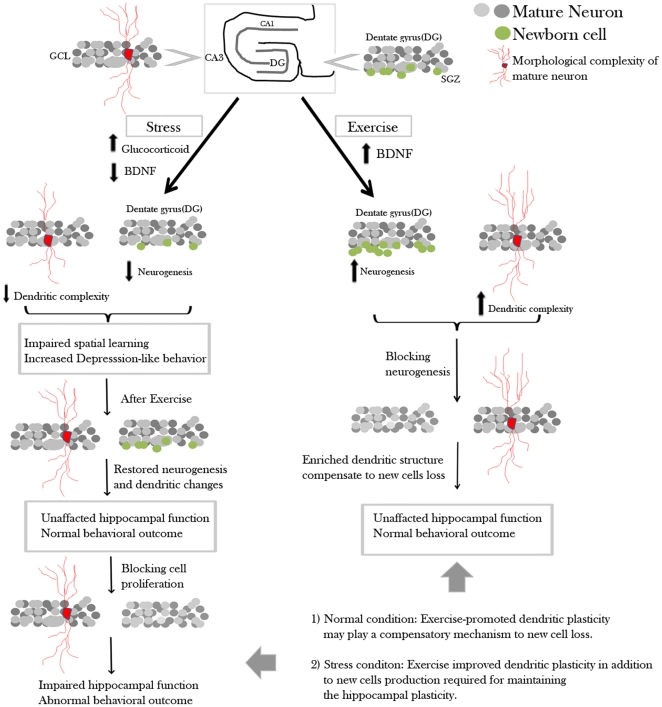
Figure 7. Schematic diagram showing the hypothesis of the counteracting mechanism of running on stress.
Exposure to stress increases glucocorticoid level and decreases BDNF, which results in decreased hippocampal neurogenesis and dendritic retraction. In normal rats, existing neurons may be able to maintain hippocampal plasticity. In stressed rats, intact hippocampal plasticity, which maintained by continuous production of new neurons and dendritic remodeling, may mediate the beneficial effects of running on stress.

References

    1. van Praag H, Christie BR, Sejnowski TJ, Gage FH. Running enhances neurogenesis, learning, and long-term potentiation in mice. Proc Natl Acad Sci U S A. 1999;96:13427–13431. - PMC - PubMed
    1. Redila VA, Christie BR. Exercise-induced changes in dendritic structure and complexity in the adult hippocampal dentate gyrus. Neuroscience. 2006;137:1299–1307. - PubMed
    1. Neeper SA, Gomez-Pinilla F, Choi J, Cotman CW. Physical activity increases mRNA for brain-derived neurotrophic factor and nerve growth factor in rat brain. Brain Res. 1996;726:49–56. - PubMed
    1. McEwen BS, Cameron H, Chao HM, Gould E, Magarinos AM, et al. Adrenal steroids and plasticity of hippocampal neurons: toward an understanding of underlying cellular and molecular mechanisms. Cell Mol Neurobiol. 1993;13:457–482. - PMC - PubMed
    1. Watanabe Y, Gould E, McEwen BS. Stress induces atrophy of apical dendrites of hippocampal CA3 pyramidal neurons. Brain Res. 1992;588:341–345. - PubMed

Publication types

Substances