


Changes in the genetic structure of Aedes aegypti (Diptera: Culicidae) populations in Queensland, Australia, across two seasons: implications for potential mosquito releases
- PMID: 21936318
- PMCID: PMC3290397
- DOI: 10.1603/me10264
Changes in the genetic structure of Aedes aegypti (Diptera: Culicidae) populations in Queensland, Australia, across two seasons: implications for potential mosquito releases
Abstract
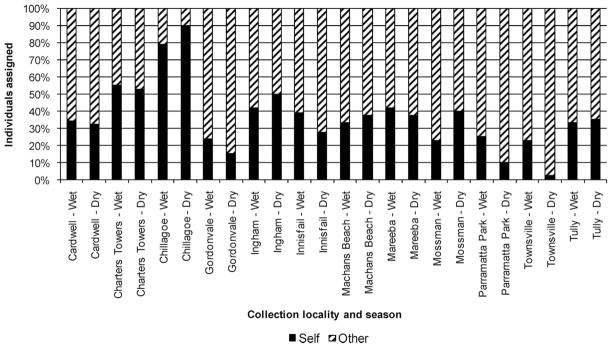
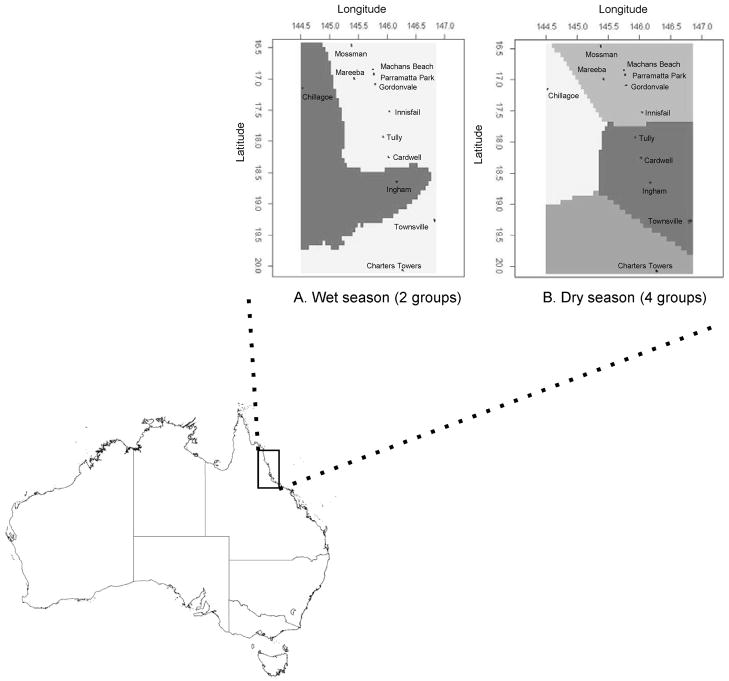
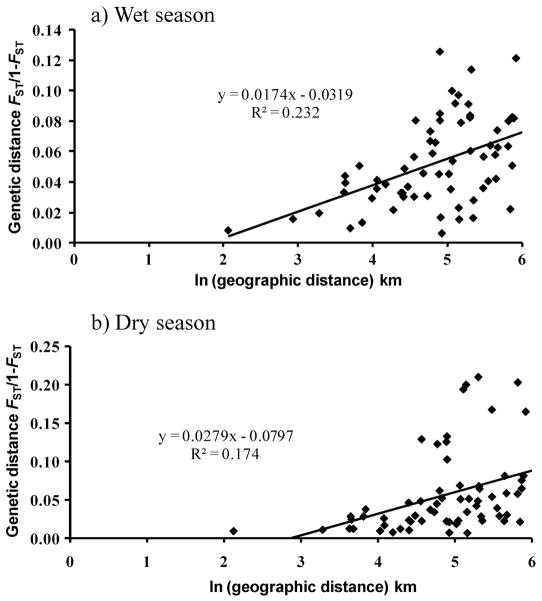
Diseases transmitted by mosquitoes could be controlled if vector populations were replaced with strains that have reduced vector competency. Such a strategy is being developed for control of dengue virus which is transmitted by Aedes aegypti (L.) (Diptera: Culicidae). Mosquitoes artificially infected with the bacterium, Wolbachia pipientis Hertig, are being assessed as candidates for release at the adult stage with the aim of replacement of the wild population. Wolbachia can reduce the capacity of Ae. aegypti to transmit dengue virus and has potential to be driven through the natural population via a system of cytoplasmic incompatibility. Deployment of benign mosquito strains will be influenced by population size and structure of wild-type Ae. aegypti in proposed release areas, as well as rates of gene flow among populations in the wet and dry tropical seasons. Mosquitoes from northern Queensland were screened with genetic markers to find an optimal locality for release of a benign strain of Ae. aegypti. The inland towns of Chillagoe and Charters Towers and the coastal town of Ingham had mosquito populations that were partly genetically isolated from mosquitoes in other areas across both seasons. These locations may be suitable release sites if it is important for the released strain to be restricted during initial phases of implementation. Smaller genetic differences were also evident among other regions and were consistent over two seasons (wet and dry).
Figures
References
-
- [ABS] Australian Bureau of Statistics. Australian Bureau of Statistics: Canberra. Australian Capital Territory; Australia: 2002. Year book Australia 2002, no. 84, ABS catalog no. 1301.0.
-
- Belkhir K, Borsa P, Chikhi L, Raufaste N, Bonhomme F. Laboratoire Génome et Populations. Université de Montpellier II; Montpellier, France: 2004. GENETIX 4.03, Logiciel Sous Windows™ pour la génétique des populations.
-
- Canyon D. A review of the dengue mosquito, Aedes aegypti (Diptera: Culicidae), in Australia. In: Canyon DV, Speare RS, editors. Rural and remote environmental health I. The Australasian College of Tropical Medicine; Townsville, Queensland, Australia: 2001. pp. 27–36.
-
- Chambers EW, Meece JK, McGowan JA, Lovin DD, Hemme RR, Chadee DD, McAbee K, Brown SE, Knudson DL, Severson DW. Microsatellite isolation and linkage group identification in the yellow fever mosquito Aedes aegypti. J Hered. 2007;98:202–210. - PubMed
-
- Endersby NM, Hoffmann AA, White VL, Lowenstein S, Ritchie S, Johnson PH, Rapley LP, Ryan PA, Nam VS, Yen NT, et al. Genetic structure of Aedes aegypti in Australia and Vietnam revealed by microsatellite and exon primed intron crossing markers suggests feasibility of local control options. J Med Entomol. 2009;46:1074–1083. - PMC - PubMed
Publication types
MeSH terms
Grants and funding
LinkOut - more resources
Full Text Sources
Medical
