Oral immunotherapy for the treatment of peanut allergy: systematic review of six case series studies
- PMID: 21938350
- PMCID: PMC6548306
- DOI: 10.4104/pcrj.2011.00071
Oral immunotherapy for the treatment of peanut allergy: systematic review of six case series studies
Abstract
Background: Allergy to peanuts is associated with considerable morbidity and, in a minority of cases, mortality. Natural resolution to peanut allergy occurs in only a few cases, hence the need to find effective interventions. Peanut oral immunotherapy (OIT) is a potentially important new therapeutic development.
Aims: To assess the benefits and harms of OIT for peanut allergy.
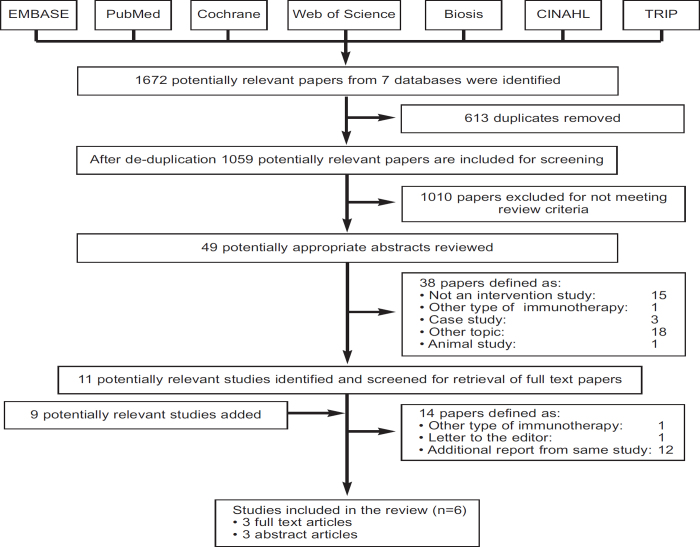
Methods: Fourteen databases were searched for published reports and unpublished/in-progress studies. We included studies employing randomised controlled trial (RCT), quasi-RCT, controlled clinical trial, controlled before-and-after, interrupted time series, and case series designs.
Results: Six studies enrolling a total of 85 participants satisfied our inclusion criteria. All studies employed a case series design and were thus judged to be at high risk of bias. Overall, this body of evidence provided suggestive evidence that it is possible for many participants to increase their threshold dose for peanut exposure whilst receiving treatment. Adverse reactions were common and, whilst most of these were relatively minor, some were potentially life-threatening.
Conclusions: OIT appears to be a potentially promising new therapy for the short- to medium-term management of carefully selected and monitored patients with peanut allergy. The effectiveness and cost-effectiveness of OIT - particularly over the longer term - need to be clearly established using more robust designs before its clinical use can be contemplated. Given the risk of triggering serious adverse reactions, OIT should not be administered outside clinical trial settings.
Conflict of interest statement
AS is a consultant to ALK and Phadia. He has advised the Scottish Government and House of Lords Allergy Inquiry. He is the Royal College of General Practitioners Clinical Champion in Allergy. AS is the Joint Editor-in-Chief of the
Comment in
-
Oral immunotherapy for peanut allergy: an evidence-based medicine assessment.Prim Care Respir J. 2012 Mar;21(1):7-8. doi: 10.4104/pcrj.2012.00019. Prim Care Respir J. 2012. PMID: 22362311 Free PMC article. No abstract available.
References
-
- Kotz D, Simpson CR, Sheikh A. Incidence, prevalence, and trends of general practitioner-recorded diagnosis of peanut allergy in England, 2001 to 2005. J Allergy Clin Immunol 2011. Jan 12 [Epub ahead of print]. - PubMed
-
- Worth A, Soar J, Sheikh A. Management of anaphylaxis in the emergency setting. Expert Rev Clin Immunol 2010;6:89–100. http://dx.doi.org/10.1586/eci.09.73 - PubMed
-
- Sicherer SH. Clinical update on peanut allergy. Ann Allergy Asthma Immunol 2002;88:350–61. http://dx.doi.org/10.1016/S1081-1206(10)62363-0 - PubMed
-
- Frank L, Marian A, Visser M, Weinberg E, Potter PC. Exposure to peanuts in utero and in infancy and the development of sensitization to peanut allergens in young children. Pediatr Allergy Immunol 1999;10:27–32. http://dx.doi.org/10.1034/j.1399-3038.1999.101010.x - PubMed
Publication types
MeSH terms
Grants and funding
LinkOut - more resources
Full Text Sources
Other Literature Sources