Review
. 2011 Dec;27(12):516-25.
doi: 10.1016/j.tig.2011.08.002. Epub 2011 Sep 21.

Epigenetic factors influencing resistance to nuclear reprogramming

Affiliations
Review

Epigenetic factors influencing resistance to nuclear reprogramming

Vincent Pasque et al. Trends Genet. 2011 Dec.

Abstract

Patient-specific somatic cell reprogramming is likely to have a large impact on medicine by providing a source of cells for disease modelling and regenerative medicine. Several strategies can be used to reprogram cells, yet they are generally characterised by a low reprogramming efficiency, reflecting the remarkable stability of the differentiated state. Transcription factors, chromatin modifications, and noncoding RNAs can increase the efficiency of reprogramming. However, the success of nuclear reprogramming is limited by epigenetic mechanisms that stabilise the state of gene expression in somatic cells and thereby resist efficient reprogramming. We review here the factors that influence reprogramming efficiency, especially those that restrict the natural reprogramming mechanisms of eggs and oocytes. We see this as a step towards understanding the mechanisms by which nuclear reprogramming takes place.


Figures

Figure 1
Figure 1
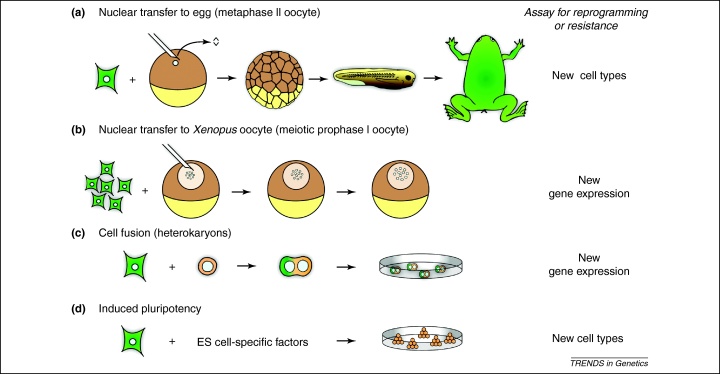
Different strategies induce nuclear reprogramming towards pluripotency. (a) During reprogramming by nuclear transfer to eggs, the nucleus of a cell is transplanted into an unfertilised egg whose own nucleus has been removed . The resulting embryos, larvae and adults have the same genetic constitution as the donor nucleus. The animal and vegetal poles of the egg are shown in brown and yellow, respectively. (b) For nuclear reprogramming by nuclear transfer to Xenopus oocytes, multiple mammalian nuclei are transplanted into the nucleus (germinal vesicle) of a meiotic prophase I oocyte . Transcriptional reactivation of previously silenced genes is induced without cell division or DNA synthesis, and no new cell types are formed. The animal and vegetal poles of the oocyte are shown in brown and yellow, respectively. (c) The nuclei of distinct cell types can be induced to reside within a common cytoplasm . The fused cells form heterokaryons, in which the nuclei remain as separate entities, and these can be maintained by inhibiting cell division. (d) Pluripotency can be induced in cultured somatic cells by overexpression of embryonic stem (ES) cell-specific transcription factors or by overexpression of small noncoding RNAs together with histone deacetylases inhibitors . The cells obtained are very similar to ES cells. Adapted, with permission, from .
Figure 2
Figure 2
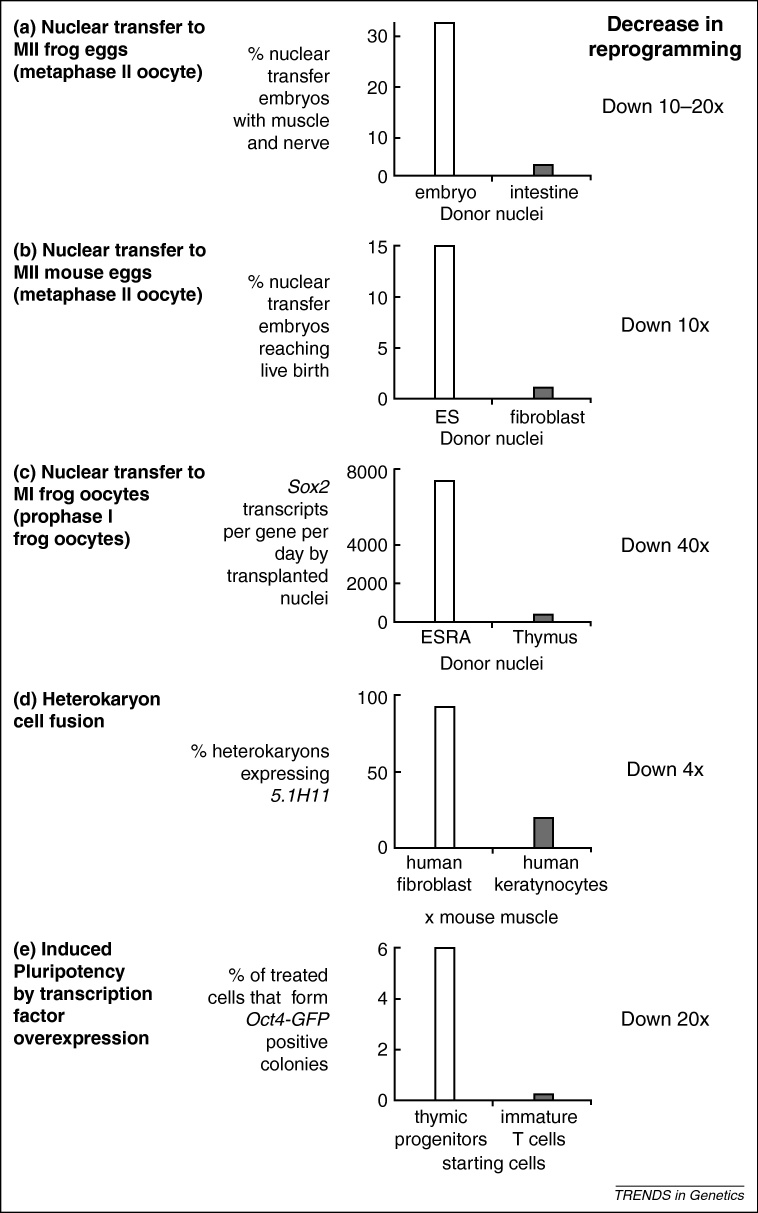
Resistance to reprogramming increases as cells differentiate. The extent of resistance to reprogramming (equivalent to a decrease in reprogramming efficiency) as cells differentiate, when tested by nuclear transfer (a–c), cell fusion (heterokaryon) (d) and induced pluripotency (e). Reproduced, with permission, from (a), (b), (c), (d) (but also see [100,101]) and (e). Abbreviations: ES, embryonic stem; ESRA, retinoic-acid differentiated embryonic stem cells.
Figure 3
Figure 3
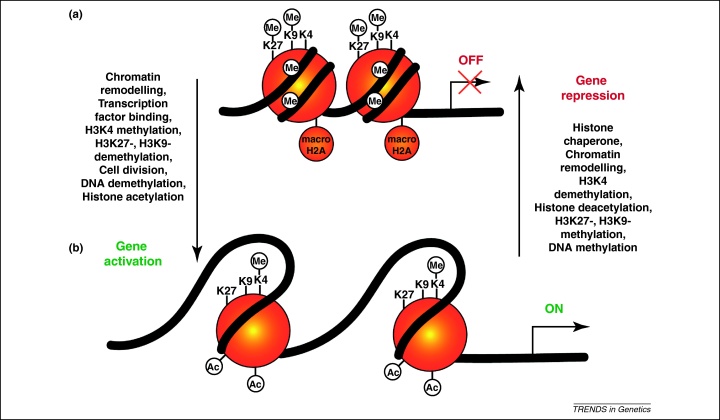
Hypothetical model of chromatin state changes at gene regulatory regions during reprogramming and differentiation. Epigenetic reprogramming of chromatin states requires several events, some of which are summarised here. A fully repressed gene (a) must be remodelled to evict repressive nucleosomes, which may contain histone variants such as macroH2A and multiple repressive histone modifications. Once accessible, regulatory regions may be bound by transcriptional regulators with the ability to recruit activities, such as H3K4 methyltransferases. Loss of repressive histone modifications, such as H3K9me2/3, H3K27me2/3 and DNA methylation and demethylation may occur actively or passively through cell divisions. Histone acetylation also strongly increases transcriptional activity (b). The opposite route may lead to transcriptional silencing of differentiation genes during reprogramming towards pluripotency, or silencing of pluripotency genes during cell differentiation. The steps represented may occur simultaneously and/or in a different order according to the gene and system considered. The order of the epigenetic events that occur during nuclear reprogramming may not be in the exact reverse order of the events that occur during cell differentiation.

References

    1. Gurdon J.B. Sexually mature individuals of Xenopus laevis from the transplantation of single somatic nuclei. Nature. 1958;182:64–65. - PubMed
    1. Wilmut I. Viable offspring derived from fetal and adult mammalian cells. Nature. 1997;385:810–813. - PubMed
    1. Byrne J.A. Producing primate embryonic stem cells by somatic cell nuclear transfer. Nature. 2007;450:497–502. - PubMed
    1. Harland R.M., Grainger R.M. Genetic and genomic metamorphosis of Xenopus. Trends Genet. 2011;27:D-11-00110. doi:10.1016/j.tig.2011.08.003. - PMC - PubMed
    1. Halley-Stott R.P. Mammalian nuclear transplantation to germinal vesicle stage Xenopus oocytes – a method for quantitative transcriptional reprogramming. Methods. 2010;51:56–65. - PMC - PubMed

Publication types