


Mesenteric fat as a source of C reactive protein and as a target for bacterial translocation in Crohn's disease
- PMID: 21940721
- PMCID: PMC3230831
- DOI: 10.1136/gutjnl-2011-300370
Mesenteric fat as a source of C reactive protein and as a target for bacterial translocation in Crohn's disease
Abstract
Objective: Mesenteric fat hyperplasia is a hallmark of Crohn's disease (CD), and C reactive protein (CRP) is correlated with disease activity. The authors investigated whether mesenteric adipocytes may be a source of CRP in CD and whether inflammatory and bacterial triggers may stimulate its production by adipocytes.
Design: CRP expression in the mesenteric and subcutaneous fats of patients with CD and the correlation between CRP plasma concentrations and mesenteric messenger RNA (mRNA) levels were assessed. The impact of inflammatory and bacterial challenges on CRP synthesis was tested using an adipocyte cell line. Bacterial translocation to mesenteric fat was studied in experimental models of colitis and ileitis and in patients with CD.
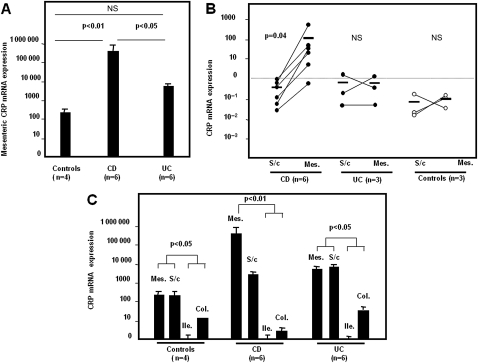
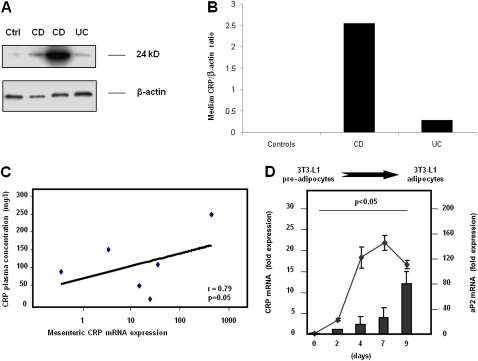
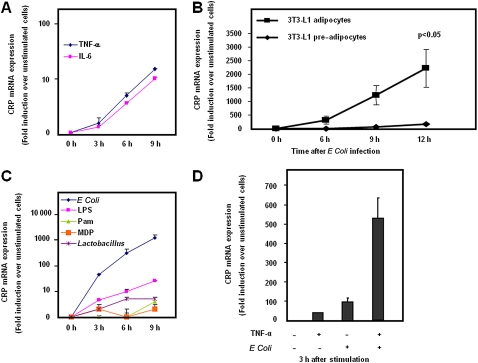
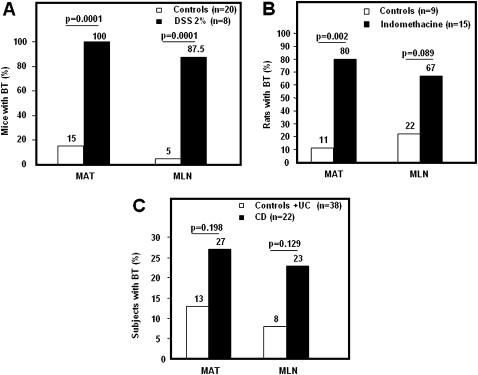
Results: CRP expression was increased in the mesenteric fat of patients with CD, with mRNA levels being 80 ± 40 (p<0.05) and 140 ± 65 (p=0.04) times higher than in the mesenteric fat of patients with ulcerative colitis and in the subcutaneous fat of the same CD subjects, respectively, and correlated with plasma levels. Escherichia coli (1230 ± 175-fold, p<0.01), lipopolysaccharide (26 ± 0.5-fold, p<0.01), tumour necrosis factor α (15 ± 0.3-fold, p<0.01) and interleukin-6 (10 ± 0.7-fold, p<0.05) increased CRP mRNA levels in adipocyte 3T3-L1 cells. Bacterial translocation to mesenteric fat occurred in 13% and 27% of healthy and CD subjects, respectively, and was increased in experimental colitis and ileitis. Human mesenteric adipocytes constitutively expressed mRNA for TLR2, TLR4, NOD1 and NOD2.
Conclusion: Mesenteric fat is an important source of CRP in CD. CRP production by mesenteric adipocytes may be triggered by local inflammation and bacterial translocation to mesenteric fat, providing a mechanism whereby mesenteric fat hyperplasia may contribute to inflammatory response in CD.
Conflict of interest statement
Figures
Comment in
-
Mesenteric fat in Crohn's disease: the hot spot of inflammation?Gut. 2012 Jan;61(1):3-5. doi: 10.1136/gutjnl-2011-301354. Epub 2011 Nov 7. Gut. 2012. PMID: 22068165 No abstract available.
-
Visceral adipose tissue in Crohn's disease: Satan or Samaritan?Inflamm Bowel Dis. 2012 Sep;18(9):1795-6. doi: 10.1002/ibd.22869. Epub 2012 Jan 24. Inflamm Bowel Dis. 2012. PMID: 22275295 No abstract available.
-
Mesenteric fat as a source of CRP and target for bacterial translocation in Crohn's disease.Gastroenterology. 2012 Aug;143(2):496-8. doi: 10.1053/j.gastro.2012.06.018. Epub 2012 Jun 20. Gastroenterology. 2012. PMID: 22727663 No abstract available.
References
-
- Black S, Kushner I, Samols D. C-reactive protein. J Biol Chem 2004;279:48487–90 - PubMed
-
- Bottazzi B, Doni A, Garlanda C, et al. An integrated view of humoral innate immunity: pentraxins as a paradigm. Annu Rev Immunol 2010;28:157–83 - PubMed
-
- Henriksen M, Jahnsen J, Lygren I, et al. C-reactive protein: a predictive factor and marker of inflammation in inflammatory bowel disease. Results from a prospective population-based study. Gut 2008;57:1518–23 - PubMed
-
- Colombel JF, Sandborn WJ, Reinisch W, et al. Infliximab, azathioprine, or combination therapy for Crohn's disease. N Engl J Med 2010;362:1383–95 - PubMed
-
- Treton X, Bouhnik Y, Mary JY, et al. Azathioprine withdrawal in patients with Crohn's disease maintained on prolonged remission: a high risk of relapse. Clin Gastroenterol Hepatol 2009;7:80–5 - PubMed
Publication types
MeSH terms
Substances
LinkOut - more resources
Full Text Sources
Medical
Research Materials
Miscellaneous
