National trends in mental health disability, 1997-2009
- PMID: 21940913
- PMCID: PMC3222386
- DOI: 10.2105/AJPH.2011.300258
National trends in mental health disability, 1997-2009
Abstract
Objectives: I assessed recent trends in mental health disability in the US nonelderly adult population in the context of trends in physical disabilities and psychological distress.
Methods: Using data for 312 364 adults aged 18 to 64 years from the US National Health Interview Survey, 1997 to 2009, I examined time trends in self-reported disability attributed to mental health conditions, disability attributed to other chronic problems, and significant psychological distress (measured by using the K6 instrument).
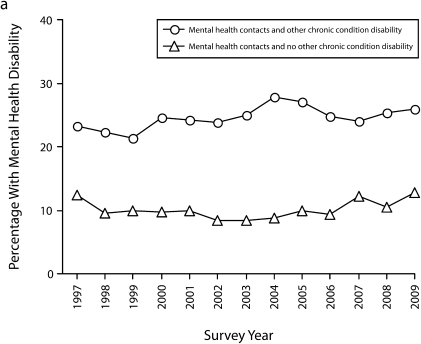
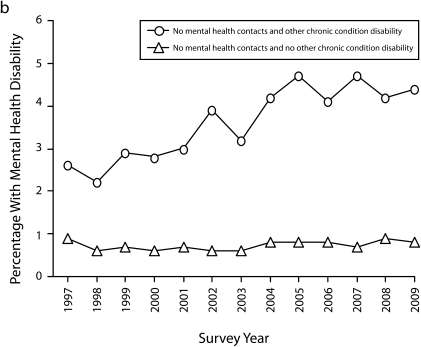
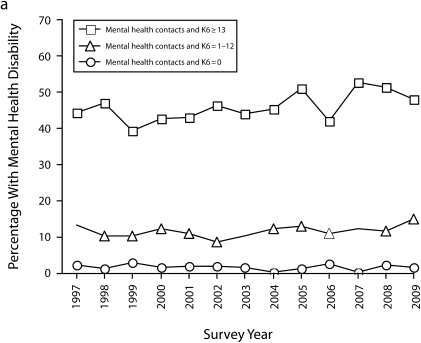
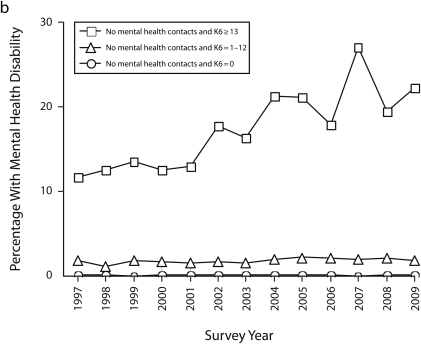
Results: The prevalence of self-reported mental health disability increased from 2.0% of the nonelderly adult population in the first 3 years (1997 to 1999) to 2.7% in the last 3 years (2007 to 2009), corresponding to an increase of almost 2 million disabled adults. Disability attributed to other chronic conditions decreased and significant psychological distress did not change appreciably. Change in self-reported mental health disability was more pronounced in adults who also reported disability attributed to other chronic conditions or significant psychological distress but who had no mental health contacts in the past year.
Conclusions: These findings highlight the need for improved access to mental health services in the community and for better integration of these services with primary care.
Figures
Similar articles
-
Assessing the association between mental health and disability indicators among adults living in the United States.Disabil Health J. 2019 Jan;12(1):98-105. doi: 10.1016/j.dhjo.2018.08.006. Epub 2018 Aug 9. Disabil Health J. 2019. PMID: 30122448
-
Moderate to severe psychological distress, disability, and non-receipt of past year visits to a mental health professional.Disabil Health J. 2016 Oct;9(4):735-40. doi: 10.1016/j.dhjo.2016.06.002. Epub 2016 Jun 21. Disabil Health J. 2016. PMID: 27425651
-
A triple play: psychological distress, physical comorbidities, and access and use of health services among U.S. adults with disabilities.J Health Care Poor Underserved. 2014 May;25(2):814-36. doi: 10.1353/hpu.2014.0103. J Health Care Poor Underserved. 2014. PMID: 24858888 Free PMC article.
-
Psychological distress and mental health diagnoses in adults by disability and functional difficulty status: Findings from the 2021 national health interview survey.Disabil Health J. 2024 Oct;17(4):101641. doi: 10.1016/j.dhjo.2024.101641. Epub 2024 May 15. Disabil Health J. 2024. PMID: 38816306
-
Determinants of self rated health for Canadians with chronic disease and disability.J Epidemiol Community Health. 1999 Nov;53(11):731-6. doi: 10.1136/jech.53.11.731. J Epidemiol Community Health. 1999. PMID: 10656104 Free PMC article. Review.
Cited by
-
Development of a Questionnaire to Assess Nursing Competencies for the Care of People with Psychiatric Disabilities in a Hospital Environment.Psychiatr Q. 2018 Sep;89(3):699-706. doi: 10.1007/s11126-018-9567-6. Psychiatr Q. 2018. PMID: 29457189
-
Associations between dietary intake of B-vitamins and psychological disorders among Iranian women: a cross-sectional study.Public Health Nutr. 2021 May;24(7):1787-1797. doi: 10.1017/S1368980020002943. Epub 2020 Sep 16. Public Health Nutr. 2021. PMID: 32933593 Free PMC article.
-
Drinking plain water is associated with decreased risk of depression and anxiety in adults: Results from a large cross-sectional study.World J Psychiatry. 2018 Sep 20;8(3):88-96. doi: 10.5498/wjp.v8.i3.88. eCollection 2018 Sep 20. World J Psychiatry. 2018. PMID: 30254979 Free PMC article.
-
Trends in Outpatient Treatment for Depression in Survivors of Stroke in the United States, 2004-2017.Neurology. 2022 May 31;98(22):e2258-e2267. doi: 10.1212/WNL.0000000000200286. Epub 2022 Apr 4. Neurology. 2022. PMID: 35379756 Free PMC article.
-
The association of whole and refined grains consumption with psychological disorders among Iranian adults.Eur J Nutr. 2019 Feb;58(1):211-225. doi: 10.1007/s00394-017-1585-x. Epub 2017 Nov 30. Eur J Nutr. 2019. PMID: 29189904
References
-
- Mojtabai R. Residual symptoms and impairment in major depression in the community. Am J Psychiatry. 2001;158(10):1645–1651 - PubMed
-
- Kessler RC, Walters EE, Forthofer MS. The social consequences of psychiatric disorders, III: probability of marital stability. Am J Psychiatry. 1998;155(8):1092–1096 - PubMed
-
- Kessler RC, Foster CL, Saunders WB, Stang PE. Social consequences of psychiatric disorders, I: educational attainment. Am J Psychiatry. 1995;152(7):1026–1032 - PubMed
-
- Alonso J, Angermeyer MC, Bernert S, et al. Disability and quality of life impact of mental disorders in Europe: results from the European Study of the Epidemiology of Mental Disorders (ESEMeD) project. Acta Psychiatr Scand Suppl. 2004;(420):38–46 - PubMed
Publication types
MeSH terms
LinkOut - more resources
Full Text Sources
Medical
Miscellaneous