


Comparison of Gene Expression in Human Embryonic Stem Cells, hESC-Derived Mesenchymal Stem Cells and Human Mesenchymal Stem Cells
- PMID: 21941565
- PMCID: PMC3166576
- DOI: 10.4061/2011/368192
Comparison of Gene Expression in Human Embryonic Stem Cells, hESC-Derived Mesenchymal Stem Cells and Human Mesenchymal Stem Cells
Abstract
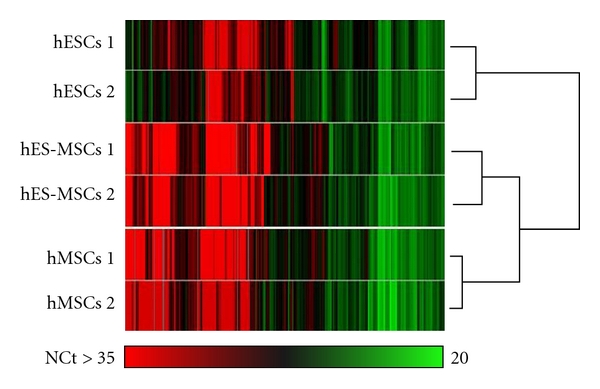
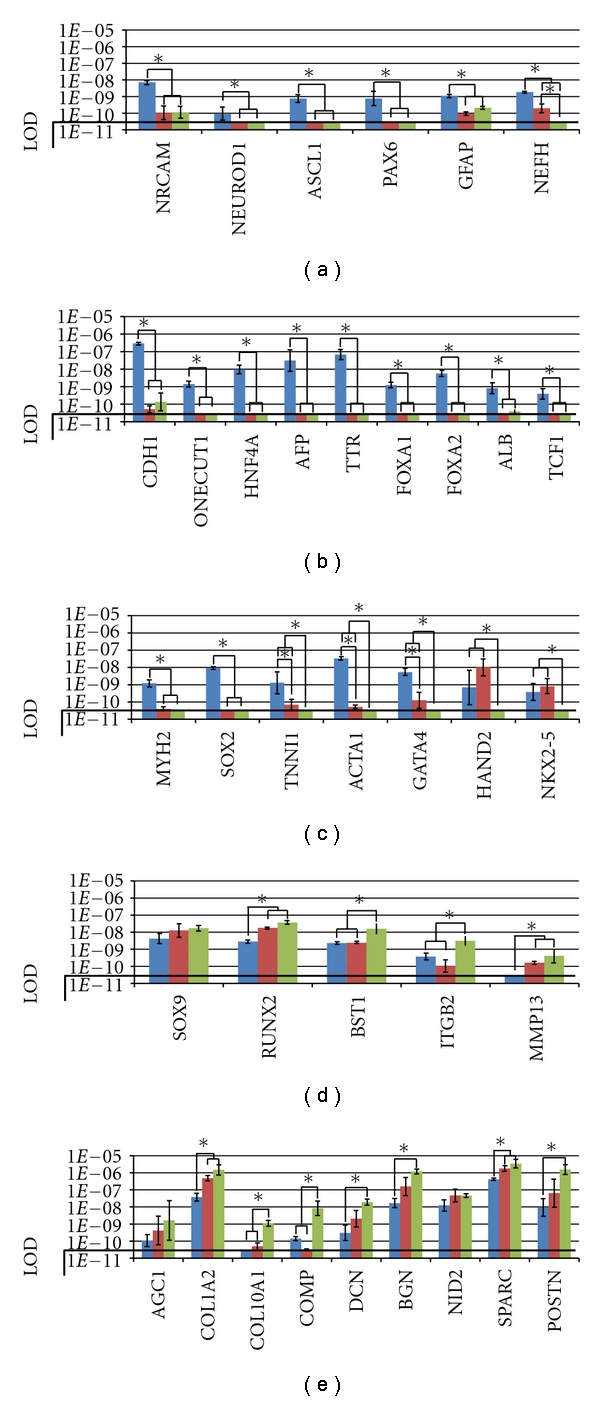
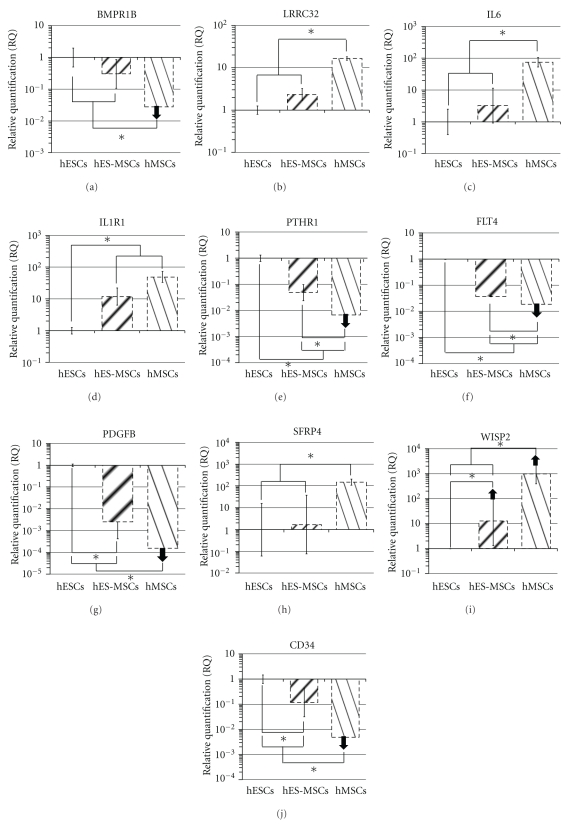
We present a strategy to identify developmental/differentiation and plasma membrane marker genes of the most primitive human Mesenchymal Stem Cells (hMSCs). Using sensitive and quantitative TaqMan Low Density Arrays (TLDA) methodology, we compared the expression of 381 genes in human Embryonic Stem Cells (hESCs), hESC-derived MSCs (hES-MSCs), and hMSCs. Analysis of differentiation genes indicated that hES-MSCs express the sarcomeric muscle lineage in addition to the classical mesenchymal lineages, suggesting they are more primitive than hMSCs. Transcript analysis of membrane antigens suggests that IL1R1(low), BMPR1B(low), FLT4(low), LRRC32(low), and CD34 may be good candidates for the detection and isolation of the most primitive hMSCs. The expression in hMSCs of cytokine genes, such as IL6, IL8, or FLT3LG, without expression of the corresponding receptor, suggests a role for these cytokines in the paracrine control of stem cell niches. Our database may be shared with other laboratories in order to explore the considerable clinical potential of hES-MSCs, which appear to represent an intermediate developmental stage between hESCs and hMSCs.
Figures
References
-
- Short B, Brouard N, Occhiodoro-Scott T, Ramakrishnan A, Simmons PJ. Mesenchymal stem cells. Archives of Medical Research. 2003;34(6):565–571. - PubMed
-
- Pittenger MF, Mackay AM, Beck SC, et al. Multilineage potential of adult human mesenchymal stem cells. Science. 1999;284(5411):143–147. - PubMed
-
- Pontikoglou C, Delorme B, Charbord P. Human bone marrow native mesenchymal stem cells. Regenerative Medicine. 2008;3(5):731–741. - PubMed
-
- Deschaseaux F, Gindraux F, Saadi R, Obert L, Chalmers D, Herve P. Direct selection of human bone marrow mesenchymal stem cells using an anti-CD49a antibody reveals their CD45med,low phenotype. British Journal of Haematology. 2003;122(3):506–517. - PubMed
LinkOut - more resources
Full Text Sources
Other Literature Sources
Miscellaneous
