. 2011 Sep 23;8(1):65.
doi: 10.1186/1743-7075-8-65.

The intake of high fat diet with different trans fatty acid levels differentially induces oxidative stress and non alcoholic fatty liver disease (NAFLD) in rats

Affiliations

The intake of high fat diet with different trans fatty acid levels differentially induces oxidative stress and non alcoholic fatty liver disease (NAFLD) in rats

Madiha Dhibi et al. Nutr Metab (Lond). .

Abstract

Background: Trans-fatty acids (TFA) are known as a risk factor for coronary artery diseases, insulin resistance and obesity accompanied by systemic inflammation, the features of metabolic syndrome. Little is known about the effects on the liver induced by lipids and also few studies are focused on the effect of foods rich in TFAs on hepatic functions and oxidative stress. This study investigates whether high-fat diets with different TFA levels induce oxidative stress and liver dysfunction in rats.

Methods: Male Wistar rats were divided randomly into four groups (n = 12/group): C receiving standard-chow; Experimental groups that were fed high-fat diet included 20% fresh soybean oil diet (FSO), 20% oxidized soybean oil diet (OSO) and 20% margarine diet (MG). Each group was kept on the treatment for 4 weeks.

Results: A liver damage was observed in rats fed with high-fat diet via increase of liver lipid peroxidation and decreased hepatic antioxidant enzyme activities (superoxide dismutase, catalase and glutathione peroxidase). The intake of oxidized oil led to higher levels of lipid peroxidation and a lower concentration of plasma antioxidants in comparison to rats fed with FSO. The higher inflammatory response in the liver was induced by MG diet. Liver histopathology from OSO and MG groups showed respectively moderate to severe cytoplasm vacuolation, hypatocyte hypertrophy, hepatocyte ballooning, and necroinflammation.

Conclusion: It seems that a strong relationship exists between the consumption of TFA in the oxidized oils and lipid peroxidation and non alcoholic fatty liver disease (NAFLD). The extent of the peroxidative events in liver was also different depending on the fat source suggesting that feeding margarine with higher TFA levels may represent a direct source of oxidative stress for the organism. The present study provides evidence for a direct effect of TFA on NAFLD.


Figures
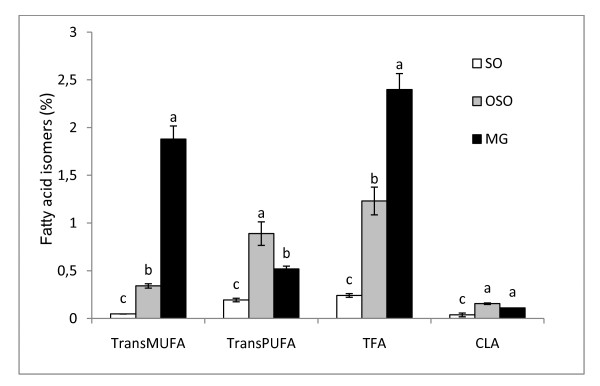
Figure 1
Figure 1
Fatty acid isomers in dietary fat diet. trans MUFA: trans monounsaturated fatty acid, trans PUFA: trans polyunsaturated fatty acid, TFA: total trans fatty acid, CLA: conjugated linoleic acid. Data are expressed as means ± SD (n = 3). Comparison between groups was made using Duncan's test. Values followed by different subscript letters are significantly different. (p < 0.05).
Figure 2
Figure 2
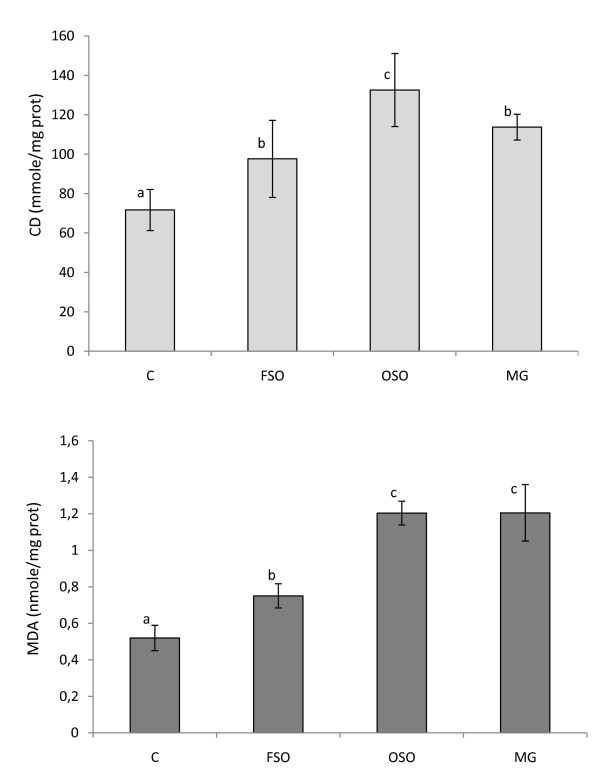
Malondialdehyde (MDA) and conjugated dienes (CD) in the liver of rats fed with high fat diet with different trans fatty acid levels. C: controls group, FSO: Fresh soybean oil fed group, OSO: oxidized soybean oil-fed group, MG: margarine-fed group. Data are expressed as means ± SD (n = 12 rats per group). Comparison between groups was made using Duncan's test. Values followed by different subscript letters are significantly different. (p < 0.05).
Figure 3
Figure 3
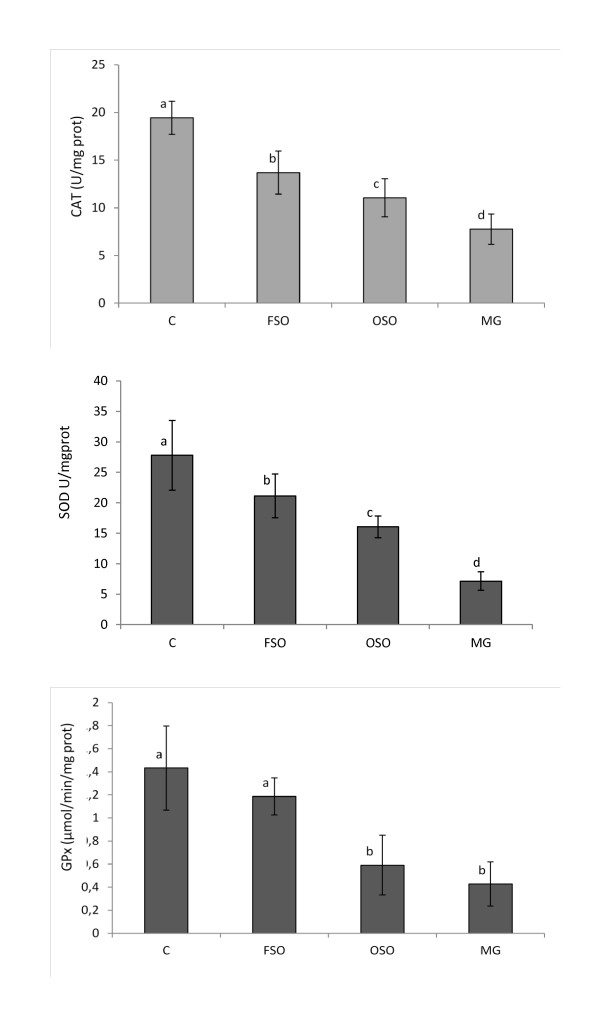
Antioxidant enzyme activities in the liver of rats fed with high fat diet with different trans fatty acid levels. CAT, SOD and GPx of rat's liver exposed to different high-fat diets. C: controls group, FSO: Fresh soybean oil-fed group, OSO: oxidized soybean oil-fed group, MG: margarine-fed group. Data are expressed as means ± SD (n = 12 rats per group). Comparison between groups was made using Duncan's test. Values followed by different subscript letters are significantly different. (p < 0.05).
Figure 4
Figure 4
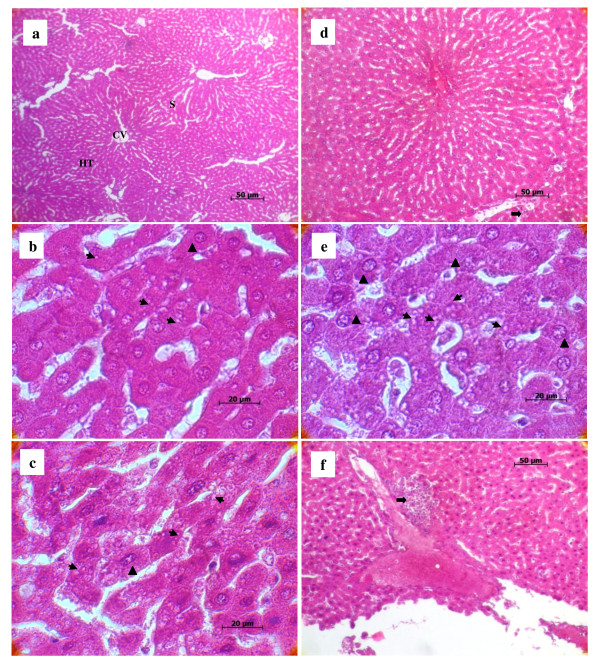
Effect of high fat diet with different trans fatty acid levels on rat's liver histology. Normal liver histological aspect from a control (H&E 32 ×). Panel (a) it is composed of hexagonal or pentagonal lobules with central veins (CV) and peripheral hepatic triads (HT) embedded in connective tissue. Hepatocytes are arranged in trabecules running radiantly from the central vein and are separated by sinusoids (S) containing Kuppfer cells. Liver from experimental groups (H&E 100×): FSO Panel (b): moderate lipid accumulation is seen in many hepatocytes; OSO Panel (b); abundance of cytoplasm vacuolization and ballooned hepatocytes and MG Panel (e); severe lipid accumulation in hepatocytes and high number of ballooned hepatocytes. Cytoplasm vacuolization in parenchymatous cells of the liver (thin arrow), hypertrophied hepatocytes (black triangle). Liver from OSO Panel (d) and MG Panel (f) groups (H&E 32×): photomicrograph of degenerated hepatocytes and necrosis (thick arrow).

References

    1. Gurr AI, James AI. An introduction. 2. England. Wiley Publishers; 1975. Lipid Biochemistry; pp. 50–96.
    1. Kubows S. Routes of formation and toxic consequences of lipid oxidation products in foods. Free Rad Bio Med. 1992;12:63–81. doi: 10.1016/0891-5849(92)90059-P. - DOI - PubMed
    1. Ononogbu CI. Lipids in Human Existence. Nig.: AP Express Publishers; 2002. pp. 105–123.
    1. Jimoh FO, Odutuga AA, Obaleye JA. Changes in Oxidized Groundnut Oil and its Effect on Na+/k+ - Atpase in Rat Tissues. Pakistan J Nut. 2007;6(1):63–67.
    1. Sommerfeld M. Trans unsaturated fatty acids in natural products and processed foods. Prog Lipid Res. 1983;22:221. doi: 10.1016/0163-7827(83)90010-3. - DOI - PubMed

LinkOut - more resources