. 2011 Nov;32(11):811-6.
doi: 10.1016/j.placenta.2011.08.013. Epub 2011 Sep 25.

Global hormone profiling of murine placenta reveals Secretin expression

Affiliations

Global hormone profiling of murine placenta reveals Secretin expression

K Knox et al. Placenta. 2011 Nov.

Abstract

Objective: To elucidate and categorize the murine placental hormones expressed across gestation, including the expression of hormones with previously undescribed roles.

Study design: Expression levels of all genes with known or predicted hormone activity expressed in two separate tissues, the placenta and maternal decidua, were assessed across a timecourse spanning the full lifetime of the placenta. Novel expression patterns were confirmed by in situ hybridization and protein level measurements.

Results: A combination of temporal and spatial information defines five groups that can accurately predict the patterns of uncharacterized hormones. Our analysis identified Secretin, a novel placental hormone that is expressed specifically by the trophoblast at levels many times greater than in any other tissue.

Conclusions: The characteristics of Secretin fit the paradigm of known placental hormones and suggest that it may play an important role during pregnancy.


Figures

Fig. 1
Fig. 1
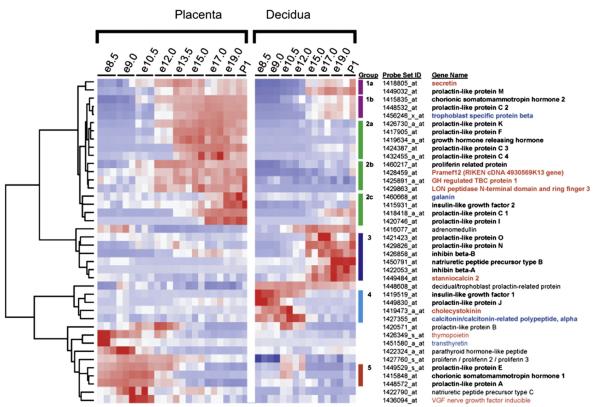
Placental hormone expression clusters. Using a microarray timecourse for placenta and decidua throughout mouse gestation 41 hormones were identified. These placental hormones are clustered according to their expression profiles in the placenta and decidua, with five co-expression groups indicated by colored bars. Novel placental hormones are shown in red, while previously described placental hormones are shown in black (expression verified in mouse placenta) or blue (no described expression pattern in the mouse placenta). Expression values for each gene across all samples were linearly scaled to have a mean of 0 and standard deviation of 1; red indicates expression greater than the mean and blue indicates expression below the mean.
Fig. 2
Fig. 2
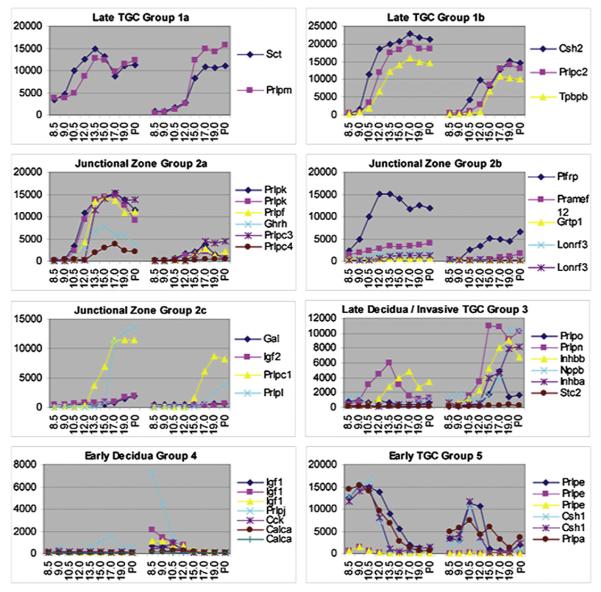
Placental hormone groups. Absolute expression levels across the timecourse were analyzed separately for the fetal placenta (e8.5 – P0, shown on left side of each graph) and maternal decidua (e8.5 – P0, shown on right side of each graph). Spatial expression pattern predictions for each co-expression group are indicated by the group labels: Late TGC Group 1, Junctional Zone Group 2, Late Decidua/Invasive TGC Group 3, Early Decidua Group 4, and Early TGC Group 5. Hormones that appear more than once are represented by multiple probe sets on the microarray.
Fig. 3
Fig. 3
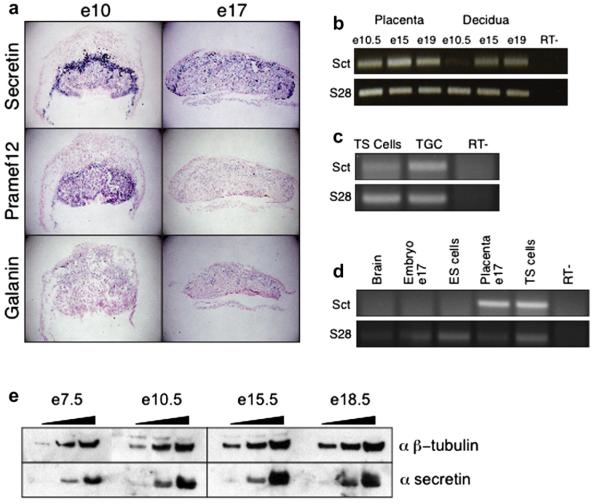
Characterization of Secretin expression in placental tissues. a) In situ hybridization for Secretin, Pramef12, and Galanin was conducted using e10 and e17 placental sections. Secretin is strongly expressed in migratory TGCs and in TGCs and spongtiotrophoblasts within the junctional zone at e10 and e17, with additional lighter staining within the labyrinth layer at e10 and scattered staining in the labyrinth at e17. Pramef12 is expressed in the junctional zone and labyrinth at e10 and in the junctional zone at e17. Galanin is expressed in the junctional zone at e17. b) RT-PCR confirms the Secretin expression profile generated in the array analysis. c) RT-PCR analysis demonstrates that Secretin is preferentially expressed in differentiated trophoblast cells compared to trophoblast stem (TS) cells, in vitro. d) Secretin expression is found at much higher levels in the placenta (e17) and in TS cells than in the developing embryo (e17), adult brain, or embryonic stem cells. e) Western blot analysis confirms that Secretin protein levels mimic the RNA expression levels.

References

    1. Linzer DI, Fisher SJ. The placenta and the prolactin family of hormones: regulation of the physiology of pregnancy. Molecular Endocrinology. 1999;13:837–40. - PubMed
    1. Soares MJ, Muller H, Orwig KE, Peters TJ, Dai G. The uteroplacental prolactin family and pregnancy. Biology of Reproduction. 1998;58:273–84. - PubMed
    1. Wiemers DO, Shao LJ, Ain R, Dai G, Soares MJ. The mouse prolactin gene family locus. Endocrinology. 2003;144:313–25. - PubMed
    1. Knox K, Baker JC. Genomic evolution of the placenta using co-option and duplication and divergence. Genome Research. 2008;18:695–705. - PMC - PubMed
    1. Li C, Wong WH. Model-based analysis of oligonucleotide arrays: expression index computation and outlier detection. Proceedings of the National Academy of Sciences of the United States of America. 2001;98:31–6. - PMC - PubMed

Publication types