


Effects of multiple daily genistein treatments on delayed alternation and a differential reinforcement of low rates of responding task in middle-aged rats
- PMID: 21945133
- PMCID: PMC3267004
- DOI: 10.1016/j.ntt.2011.09.002
Effects of multiple daily genistein treatments on delayed alternation and a differential reinforcement of low rates of responding task in middle-aged rats
Abstract
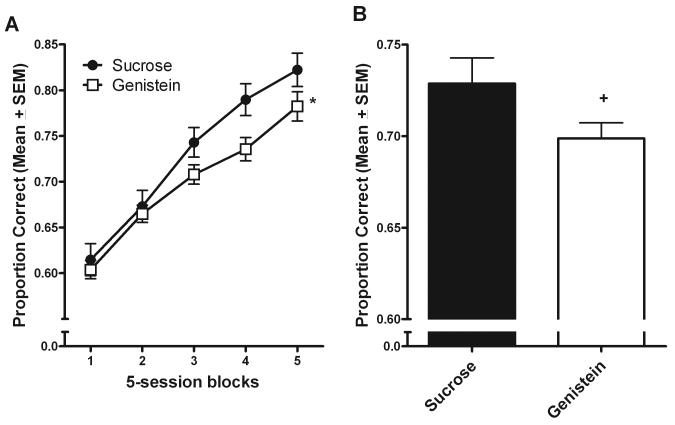
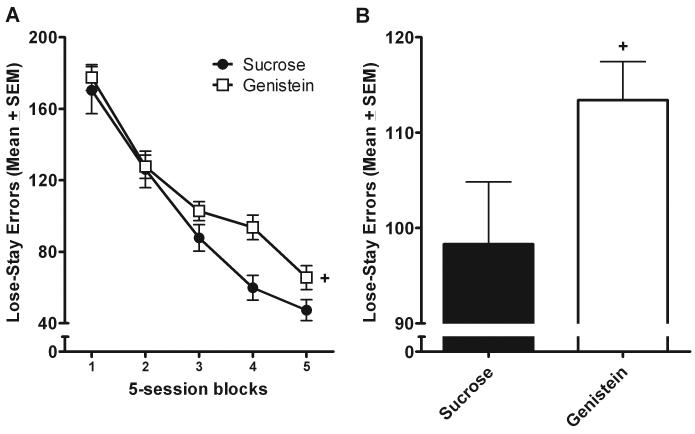
The use of extracts that are highly enriched in phytoestrogens, such as genistein, has become popular to promote various aspects of healthy aging, including maintenance of cognitive function. These compounds are promoted to menopausal women as safe, natural alternatives to traditional estrogen therapies, yet their safety and efficacy are poorly understood. Previous research in our lab found that once daily oral treatment of ovariectomized female Long-Evans (LE) rats with the soy phytoestrogen, genistein resulted in subtle deficits in performance on cognitive tasks assessing working memory and response inhibition/timing ability. The present study further modeled exposure of the menopausal woman to genistein by treating 14-month old ovariectomized female LE rats three times daily at a dose of genistein resulting in serum concentrations similar to those that could be achieved in humans consuming either a commercially available soy isoflavone supplement or a diet high in these phytoestrogens. Genistein (3.4 mg/kg) or sucrose control pellets were orally administered to animals daily, 30 min before behavioral testing, and again both 4 and 8 h after the first treatment. The test battery consisted of a delayed spatial alternation task (DSA) that tested working memory and a differential reinforcement of low rates of responding (DRL) task that tested inhibitory control/timing. Genistein treatment impaired DSA performance relative to sucrose controls. Performance on the DRL task was largely unaffected by genistein treatment. Although the impairment measured on DSA was less pronounced than that we have previously reported following chronic treatment with 17β-estradiol, the pattern of the deficit was very similar to that observed with 17β-estradiol.
Copyright © 2011 Elsevier Inc. All rights reserved.
Figures


References
-
- Aldercreutz H, Fotsis T, Watanabe S, Lampe J, Wahala K, Makela T, Hase T. Determination of lignans and isoflavonoids in plasma by isotope dilution gas chromatography-mass spectrometry. Cancer Detect Prev. 1994;18:259–271. - PubMed
-
- Bitto A, Altavilla D, Bonaiuto A, Polito F, Minutoli L, Di Stefano V, Giuliani D, Guarini S, Arcoraci V, Squadrito F. Effects of aglycone genistein in a rat experimental model of postmenopausal metabolic syndrome. J Endocrinol. 2009;200:367–376. - PubMed
-
- Brown NM, Setchell KD. Animal models impacted by phytoestrogens in commercial chow: implications for pathways influenced by hormones. Lab Invest. 2001;81:735–747. - PubMed
Publication types
MeSH terms
Substances
Grants and funding
LinkOut - more resources
Full Text Sources
Medical
Miscellaneous
