


Blood-brain barrier permeability derangements in posterior circulation ischemic stroke: frequency and relation to hemorrhagic transformation
- PMID: 21945462
- PMCID: PMC3254818
- DOI: 10.1016/j.jns.2011.08.048
Blood-brain barrier permeability derangements in posterior circulation ischemic stroke: frequency and relation to hemorrhagic transformation
Abstract
Background: Early disruption of the blood-brain barrier (BBB) due to severe ischemia can be detected by MRI T2* permeability imaging. In middle cerebral artery (MCA) infarction, pretreatment T2* permeability derangements have been found in 22% of patients and are powerful predictors of hemorrhagic transformation after revascularization therapy. The frequency, clinical correlates, and relation to hemorrhagic transformation of permeability derangements in posterior circulation have not been previously explored, and may differ as ischemia volume and collateral status are different between vertebrobasilar and MCA infarcts.
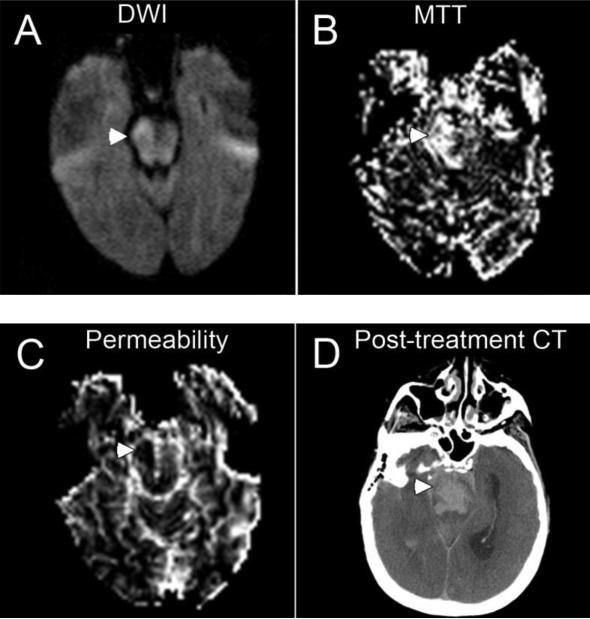
Methods: We analyzed clinical and pretreatment MRI data on consecutive patients undergoing recanalization therapy for acute vertebrobasilar ischemia at a medical center November 2001 through September 2009. Pretreatment MRI permeability images were derived from perfusion source imaging acquisitions. Permeability abnormality was detected as persisting increased signal intensity at later time points in perfusion MRI acquisition, indicating local accumulation of contrast caused by BBB leakage.
Results: Among the 14 patients meeting study entry criteria, mean age was 71.1 years and median pretreatment NIHSS was 20.5. Permeability imaging abnormality was present in 1 of the 14 patients (7%). Among 14 patients, post-treatment parenchymal hematoma occurred in one and more minor degrees of hemorrhagic transformation in four. The one patient with pretreatment permeability abnormality was the patient to develop post-treatment parenchymal hematoma (Fisher's exact test, P=0.07).
Conclusion: Pretreatment permeability abnormality, an indicator of BBB derangements, is an infrequent finding in acute posterior circulation ischemic stroke and may be associated with an increased risk of parenchymal hematoma development undergoing recanalization therapy.
Copyright © 2011 Elsevier B.V. All rights reserved.
Figures
References
-
- Lees KR, Bluhmki E, von Kummer R, Brott TG, Toni D, Grotta JC, Albers GW, Kaste M, Marler JR, Hamilton SA, Tilley BC, Davis SM, Donnan GA, Hacke W. Time to treatment with intravenous alteplase and outcome in stroke: an updated pooled analysis of ECASS, ATLANTIS, NINDS, and EPITHET trials. Lancet. 2010;375:1695–703. - PubMed
-
- The IMS Study Investigators Hemorrhage in the Interventional Management of Stroke study. Stroke. 2006;37:847–51. - PubMed
-
- Kase CS, Furlan AJ, Wechsler LR, Higashida RT, Rowley HA, Hart RG, Molinari GF, Frederick LS, Roberts HC, Gebel JM, Sila CA, Schulz GA, Roberts RS, Gent M. Cerebral hemorrhage after intra-arterial thrombolysis for ischemic stroke: the PROACT II trial. Neurology. 2001;57:1603–10. - PubMed
-
- Kidwell CS, Saver JL, Carneado J, Sayre J, Starkman S, Duckwiler G, Gobin YP, Jahan R, Vespa P, Villablanca JP, Liebeskind DS, Vinuela F. Predictors of hemorrhagic transformation in patients receiving intra-arterial thrombolysis. Stroke. 2002;33:717–24. - PubMed
Publication types
MeSH terms
Grants and funding
LinkOut - more resources
Full Text Sources
Medical
