


A comparison of a postal survey and mixed-mode survey using a questionnaire on patients' experiences with breast care
- PMID: 21946048
- PMCID: PMC3222165
- DOI: 10.2196/jmir.1241
A comparison of a postal survey and mixed-mode survey using a questionnaire on patients' experiences with breast care
Abstract
Background: The Internet is increasingly considered to be an efficient medium for assessing the quality of health care seen from the patients' perspective. Potential benefits of Internet surveys such as time efficiency, reduced effort, and lower costs should be balanced against potential weaknesses such as low response rates and accessibility for only a subset of potential participants. Combining an Internet questionnaire with a traditional paper follow-up questionnaire (mixed-mode survey) can possibly compensate for these weaknesses and provide an alternative to a postal survey.
Objective: To examine whether there are differences between a mixed-mode survey and a postal survey in terms of respondent characteristics, response rate and time, quality of data, costs, and global ratings of health care or health care providers (general practitioner, hospital care in the diagnostic phase, surgeon, nurses, radiotherapy, chemotherapy, and hospital care in general).
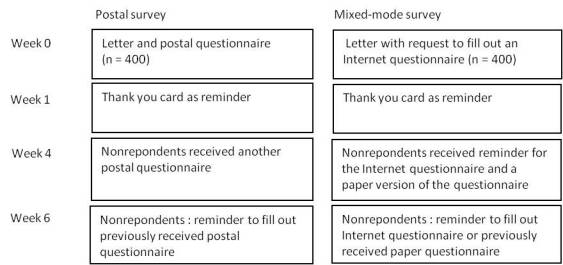
Methods: Differences between the two surveys were examined in a sample of breast care patients using the Consumer Quality Index Breast Care questionnaire. We selected 800 breast care patients from the reimbursement files of Dutch health insurance companies. We asked 400 patients to fill out the questionnaire online followed by a paper reminder (mixed-mode survey) and 400 patients, matched by age and gender, received the questionnaire by mail only (postal survey). Both groups received three reminders.
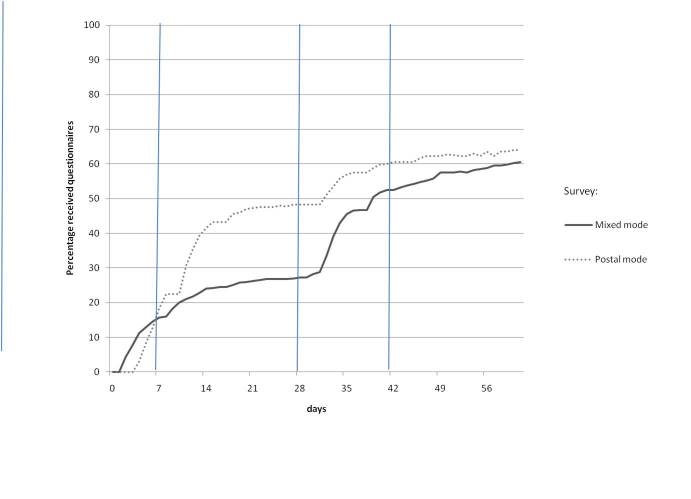
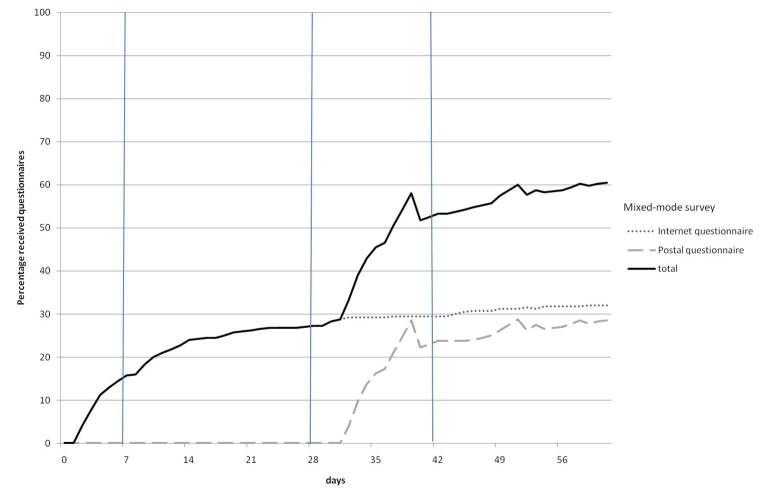
Results: The respondents to the two surveys did not differ in age, gender, level of education, or self-reported physical and psychological health (all Ps > .05). In the postal survey, the questionnaires were returned 20 days earlier than in the mixed-mode survey (median 12 and 32 days, respectively; P < .001), whereas the response rate did not differ significantly (256/400, 64.0% versus 242/400, 60.5%, respectively; P = .30). The costs were lower for the mixed-mode survey (€2 per questionnaire). Moreover, there were fewer missing items (3.4% versus 4.4%, P = .002) and fewer invalid answers (3.2% versus 6.2%, P < .001) in the mixed-mode survey than in the postal survey. The answers of the two respondent groups on the global ratings did not differ. Within the mixed-mode survey, 52.9% (128/242) of the respondents filled out the questionnaire online. Respondents who filled out the questionnaire online were significantly younger (P < .001), were more often highly educated (P = .002), and reported better psychological health (P = .02) than respondents who filled out the paper questionnaire. Respondents to the paper questionnaire rated the nurses significantly more positively than respondents to the online questionnaire (score 9.2 versus 8.4, respectively; χ²₁ = 5.6).
Conclusions: Mixed-mode surveys are an alternative method to postal surveys that yield comparable response rates and groups of respondents, at lower costs. Moreover, quality of health care was not rated differently by respondents to the mixed-mode or postal survey. Researchers should consider using mixed-mode surveys instead of postal surveys, especially when investigating younger or more highly educated populations.
Conflict of interest statement
None declared
Figures
References
-
- Delnoij DM, ten Asbroek G, Arah OA, de Koning JS, Stam P, Poll A, Vriens B, Schmidt P, Klazinga NS. Made in the USA: the import of American Consumer Assessment of Health Plan Surveys (CAHPS) into the Dutch social insurance system. Eur J Public Health. 2006 Dec;16(6):652–9. doi: 10.1093/eurpub/ckl023. http://eurpub.oxfordjournals.org/cgi/pmidlookup?view=long&pmid=16524940ckl023 - DOI - PubMed
-
- Brandt H, Zuidgeest M, Sixma H. Development of CQ-index Care for the Handicapped: measuring the quality of care from a client perspective (in Dutch) Utrecht: NIVEL; 2007. [2010-12-06]. http://www.nivel.nl/pdf/Pilot-ontwikkeling-CQ-index-Gehandicaptenzorg-20....
Publication types
MeSH terms
LinkOut - more resources
Full Text Sources
Medical
