Review
. 2012 May;14(3):212-22.
doi: 10.1016/j.ymben.2011.09.004. Epub 2011 Sep 18.

Applications of genetically-encoded biosensors for the construction and control of biosynthetic pathways

Affiliations
Review

Applications of genetically-encoded biosensors for the construction and control of biosynthetic pathways

Joshua K Michener et al. Metab Eng. 2012 May.

Abstract

Cells are filled with biosensors, molecular systems that measure the state of the cell and respond by regulating host processes. In much the same way that an engineer would monitor a chemical reactor, the cell uses these sensors to monitor changing intracellular environments and produce consistent behavior despite the variable environment. While natural systems derive a clear benefit from pathway regulation, past research efforts in engineering cellular metabolism have focused on introducing new pathways and removing existing pathway regulation. Synthetic biology is a rapidly growing field that focuses on the development of new tools that support the design, construction, and optimization of biological systems. Recent advances have been made in the design of genetically-encoded biosensors and the application of this class of molecular tools for optimizing and regulating heterologous pathways. Biosensors to cellular metabolites can be taken directly from natural systems, engineered from natural sensors, or constructed entirely in vitro. When linked to reporters, such as antibiotic resistance markers, these metabolite sensors can be used to report on pathway productivity, allowing high-throughput screening for pathway optimization. Future directions will focus on the application of biosensors to introduce feedback control into metabolic pathways, providing dynamic control strategies to increase the efficient use of cellular resources and pathway reliability.


Figures

Figure 1
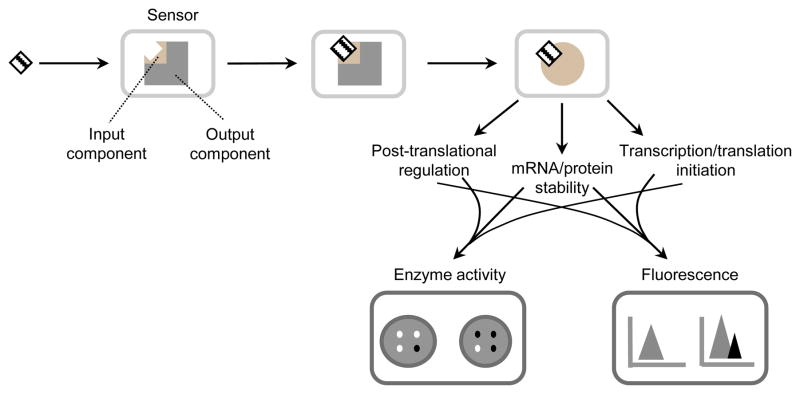
Figure 1. Cellular sensors transmit binding information into differential phenotypes
Cellular sensors are composed of two functional components. The input component detects the small molecule and undergoes a conformational change to modulate the activity of the output component, which in turn mediates regulatory processes through diverse mechanisms. The activity of the output component is translated into measurable genetic outputs, such as fluorescence or enzyme activity.
Figure 2
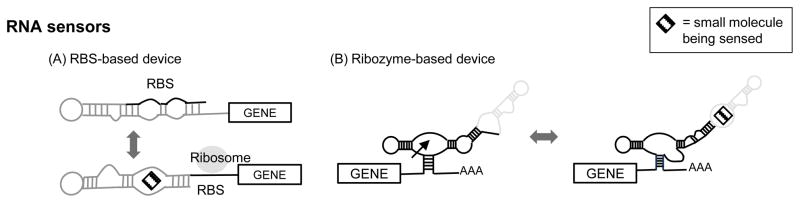
Figure 2. Types of RNA sensors
(A) Example of a RBS-based sensing-regulatory device. An aptamer is linked to a RBS via a linker sequence, which mediates access of the ribosomal subunit to the RBS through a ligand-dependent conformational change (Desai and Gallivan, 2004). (B) Example of a ribozyme-based sensing-regulatory device. An aptamer is modularly linked to a hammerhead ribozyme through a linker sequence capable of strand displacement. The linker allows the device to adopt two functional conformations that are associated with ligand-unbound (ribozyme-active) or ligand-bound (ribozyme-inactive) states (Win and Smolke, 2007).
Figure 3
Figure 3. Types of protein sensors
(A) Allosteric regulation of a transcription factor (TF) is one example of a sensing mechanism based on transcriptional regulation, where the presence of a small molecule is linked to expression of a reporter or enzyme by placing the relevant promoter element upstream of the selected gene. (B) Additional sensing functionality can be encoded in a yeast three-hybrid system, where the small molecule-dependent interaction of the bait and prey proteins reconstitutes a transcriptional activator from a DNA-binding domain (DB) and activation domain (AD). (C) By a similar design, chemical complementation senses the small molecule of interest fused within the ligands of the bait and prey (circle and square) and produces a transcriptional readout. (D) A combined domain sensor is an example of sensing mechanism based on post-translational regulation of protein activity, where the binding of the small molecule to the ligand-binding (LB) input domain causes a conformational change that is reported as a change in enzymatic activity of the output domain. (E) By a distinctly different method of sensing, intein sensors use ligand-dependent intein splicing to link the concentration of a target small molecule to the level of active processed protein. (F Finally, FRET-based sensors report the binding of a small molecule to the ligand-binding domain as a change in the level of fluorescence resonance energy transfer (FRET) between a fluorophore pair such as CFP and YFP.
Figure 4
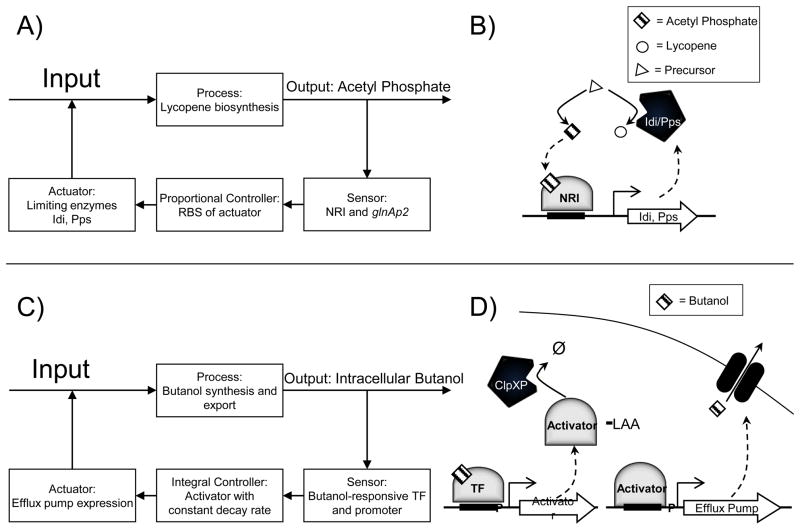
Figure 4. Block diagrams and molecular mechanisms of feedback controller designs
(A) A block diagram for an existing lycopene controller (Farmer and Liao, 2000). The sensor measures the output (acetyl phosphate) and converts it into a modular biological signal (transcription from the glnAp2 promoter). The controller connects that signal to the actuator, expression of the rate limiting pathway enzymes. (B) Molecular implementation of the lycopene controller. The precursor (triangle) is converted into acetyl phosphate by endogenous enzymes. Overproduction of acetyl phosphate leads to expression of Idi and Pps, diverting flux to lycopene. (C) A block diagram of a hypothetical controller combining a biofuels-responsive controller (Dunlop et al., 2010) and an integral controller (Anesiadis et al., 2008). (D) Molecular implementation of the hypothetical biofuels controller. A butanol-responsive transcription factor is used to regulate activator expression. The activator has a degradation tag, leading to constant degradation by ClpXP. The activator also induces expression of the efflux pump, lowering the intracellular butanol concentration.

References

    1. Anesiadis N, et al. Dynamic metabolic engineering for increasing bioprocess productivity. Metab Eng. 2008;10:255–66. - PubMed
    1. Ang J, et al. Considerations for using integral feedback control to construct a perfectly adapting synthetic gene network. J Theor Biol. 2010;266:723–38. - PubMed
    1. Atsumi S, et al. Non-fermentative pathways for synthesis of branched-chain higher alcohols as biofuels. Nature. 2008;451:86–9. - PubMed
    1. Babiskin AH, Smolke CD. A synthetic library of RNA control modules for predictable tuning of gene expression in yeast. Mol Syst Biol. 2011;7:471. - PMC - PubMed
    1. Baker K, et al. Chemical complementation: a reaction-independent genetic assay for enzyme catalysis. Proc Natl Acad Sci U S A. 2002;99:16537–42. - PMC - PubMed

MeSH terms

Substances