. 2011 Dec;55(12):5459-68.
doi: 10.1128/AAC.05178-11. Epub 2011 Sep 26.

Role of Aspergillus lentulus 14-α sterol demethylase (Cyp51A) in azole drug susceptibility

Affiliations

Role of Aspergillus lentulus 14-α sterol demethylase (Cyp51A) in azole drug susceptibility

Emilia Mellado et al. Antimicrob Agents Chemother. 2011 Dec.

Abstract

Recent studies have demonstrated that some morphologically atypical Aspergillus fumigatus strains are different species belonging to the section Fumigati. Aspergillus lentulus, one of these sibling species, is increasingly reported in patients under corticosteroid treatment. MICs of most antifungals in clinical use are elevated against A. lentulus, and it shows primary resistance to azole drugs. Two A. lentulus cytochrome P450 14-α sterol demethylases, encoded by A. lentulus cyp51A (Alcyp51A) and Alcyp51B genes, were identified. Targeted cyp51A gene knockout in A. lentulus showed that the intrinsic azole resistance of this species is cyp51A dependent. The Δcyp51A strain was morphologically indistinguishable from the A. lentulus wild-type strain, retaining the ability to cause pulmonary disease in neutropenic mice. The heterologous expression of A. lentulus cyp51A was performed in an A. fumigatus cyp51A-deficient strain, confirming that Cyp51A is responsible for the differences in A. lentulus-azole drug interaction.


Figures
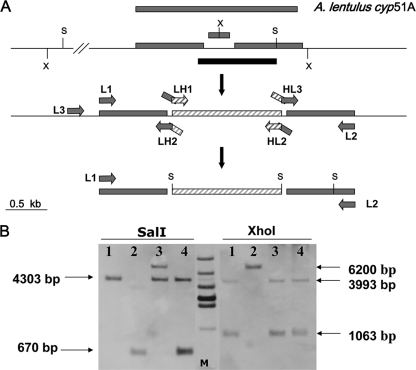
Fig. 1.
Fig. 1.
Construction of the A. lentulus cyp51A-defective mutant strain. (A) Design of the fusion vector for A. lentulus cyp51A gene deletion. The location of restriction sites used for the Southern analysis are indicated before (upper section) and after (lower section) the cyp51A locus. The transformants were selected using the hyg gene (1.4 kb) flanked by SalI (S) restriction sites included in the deletion cassette (striped bars). The excised cyp51A coding fragment and the probe used for hybridization are indicated in gray and black bars, respectively. The location of the primers for fusion vector construction is indicated in the middle section of the diagram. (B) Southern hybridization of genomic DNA of A. lentulus digested with SalI and XhoI (X). Lane 1, wild-type strain; lane 2, A. lentulus cyp51A-deficient T38.18 strain. Lanes 3 and 4 show two ectopic transformants that maintained the wild-type cyp51A copy. Sizes of the expected fragment are indicated in bp on the right side. Lane M, 1-kb molecular size marker.
Fig. 2.
Fig. 2.
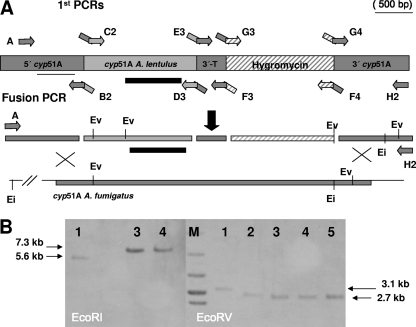
Construction of the A. fumigatus cyp51A-defective mutant strain expressing the A. lentulus cyp51A gene (Alcyp51A). (A) Design of the fusion vector for A. fumigatus cyp51A gene deletion and target integration of the Alcyp51A gene driven by the A. fumigatus cyp51A promoter (5′cyp51A) and terminator (3′ T) and including the hygromycin cassette (hyg) for transformant selection. At least 1 kb of A. fumigatus sequence outside the cyp51A coding region was included on both sides of the fusion construction to facilitate the homologous recombination. The location of restriction sites used for the Southern analysis are indicated before (upper section) and after (lower section) the cyp51A locus. The transformants were selected using the hyg gene (1.4 kb) included in the deletion cassette (striped bars). The location of the primers for fusion vector construction is indicated in this section of the diagram. (B) Southern hybridization of genomic DNA with EcoRV (Ev) and EcoRI (Ei) restriction enzyme digested with A. fumigatus wild type (lanes 1), A. lentulus CM-1290 wild type (lanes 2), and three hygromycin-resistant transformants with the wild-type cyp51A deleted and replaced by A. lentulus cyp51A copy T51.7 (lanes 3), T51.8 (lanes 4), and T51.9 (lane 5). Sizes of the expected fragment are indicated in bp on the right side. Lane M, 1-kb molecular size marker. The A. lentulus cyp51A probe used for hybridization is indicated by a black bar.
Fig. 3.
Fig. 3.
Etest susceptibility testing of itraconazole (ITC), voriconazole (VCZ), fluconazole (FCZ), and posaconazole (POS) for the A. lentulus wild-type strain (CM-1290) and an A. lentulus cyp51A-deficient strain (T38.18).
Fig. 4.
Fig. 4.
Etest susceptibility testing of voriconazole (VCZ) and posaconazole (POS) for the A. lentulus wild-type strain (CM-1290), the A. fumigatus parental strain (akuBKU80), and three mutant strains (T51.7, T51.8, and T51.9).
Fig. 5.
Fig. 5.
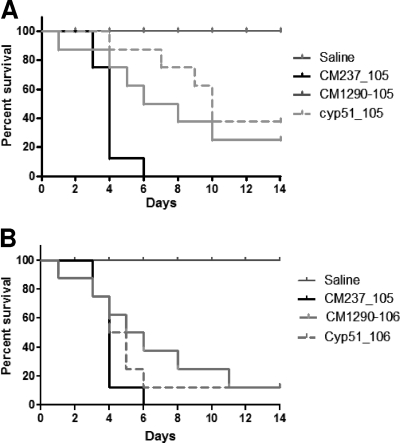
Comparative analysis of parental A. lentulus wild-type and cyp51A-deficient strains in a neutropenic murine model of pulmonary aspergillosis. Survival of CD-1 immunocompromised mice infected with the A. fumigatus wild-type CM-237 strain (105 spores/mice) and the A. lentulus wild-type (CM-1290) and cyp51A-deficient (Cyp51) strains. Two inoculum sizes, 105 (A) and 106 (B) spores/mouse, were used for both A. lentulus strains. A control group with mice immunocompromised and inoculated only with saline also was included. Survival was monitored for a time period of 14 days, and moribund animals were sacrificed.

References

    1. Aberkane A., et al. 2002. Comparative evaluation of two different methods of inoculum preparation for antifungal susceptibility testing of filamentous fungi. J. Antimicrob. Chemother. 50: 719–722 - PubMed
    1. Alcazar-Fuoli L., Cuesta I., Cuenca-Estrella M., Rodriguez-Tudela J. L., Mellado E. 2011. Three dimensional models of 14-α sterol demethylase (Cyp51A) from Aspergillus lentulus and A. fumigatus: An insight into differences in voriconazole interaction. Int. J. Antimicrob. Agents 38: 426–434 - PubMed
    1. Alcazar-Fuoli L., Mellado E., Alastruey-Izquierdo A., Cuenca-Estrella M., Rodriguez-Tudela J. L. 2008. Aspergillus section Fumigati: antifungal susceptibility patterns and sequence-based identification. Antimicrob. Agents Chemother. 52: 1244–1251 - PMC - PubMed
    1. Alhambra A., et al. 2008. Isolation of Aspergillus lentulus in Spain from a critically ill patient with chronic obstructive pulmonary disease. Rev. Iberoam. Micol. 25: 246–249 - PubMed
    1. Balajee S. A., et al. 2005. Mistaken identity: Neosartorya pseudofischeri and its anamorph masquerading as Aspergillus fumigatus. J. Clin. Microbiol. 43: 5996–5999 - PMC - PubMed

Publication types

MeSH terms

LinkOut - more resources